
Over the past few issues, we have continued to discuss different paradigms of enterprise AI deployment: Home Depot embeds AI into key nodes along the customer journey, including knowledge entry points, project decision-making, and service handoff; Chow Tai Fook first strengthens its data and process foundation before pushing AI into employee collaboration, digital customization, and business decision-making. Enterprises that are moving ahead now begin to face a more practical challenge: after AI enters the enterprise, can the organization itself absorb the enablement brought by AI? Here, “absorption” does not refer to whether employees know how to use a specific AI tool, but whether the enterprise can rearrange process responsibilities, role capabilities, training mechanisms, and cross-departmental collaboration around AI. Management research refers to this capability to recognize, assimilate, and apply new knowledge as an organization’s absorptive capacity. This concept itself deserves a separate discussion, which we will leave for a later entry.
The two hiring signals discussed in this issue happen to demonstrate two ways of responding. In May 2026, Unilever released the “Artwork Process - Technology Specialist” role, assigning continuous AI transformation responsibility to the specific business chain of packaging artwork; Marriott International released the “Senior Manager, AI Enablement” role, reorganizing employee training, demand intake, adoption frameworks, and change communication after AI spreads from the central team into various business domains.
From these two roles, we can directly read three core judgments in this article:
- After AI deployment enters deeper waters, role changes become a noteworthy signal for observing enterprise AI maturity. Enterprises are beginning to set up dedicated responsibilities for continuously absorbing AI, and budgets are also showing signs of extending from tool procurement toward process transformation and employee enablement. It should be noted that job postings reflect enterprise intent. There is still a distance between publishing a role, filling the position, and the role truly taking effect——this article reads them as directional signals, rather than as an already established industry trend.
- There are two entry points for organizations to absorb AI: process absorption (allowing AI to steadily enter process nodes and settle into standard operating procedures) and people absorption (allowing AI to enter employee capabilities, organizational communication, and usage boundaries). These two entry points are complementary——if processes are changed but employee capabilities are not updated, or if employees are trained but processes are not reorganized, value will be difficult to release sustainably. The choice of entry point determines sequencing, but it does not mean choosing one over the other.
- First determine whether organizational pressure falls on processes or people, and then decide which capability to strengthen first——this is more important than copying any role title.
After AI Is Embedded into Business, Enterprises First Encounter Two Types of Absorption Needs
Process absorption needs. After AI enters a specific business process, enterprises need to answer: Can AI be steadily embedded into process nodes? Can it operate together with data assets, approval mechanisms, workflow systems, and supplier collaboration? Can it move from proof of concept (PoC) into daily operations? Many enterprises can see localized efficiency gains during the pilot stage, such as faster content generation and faster material review, but if the process itself is not reorganized, these gains will be difficult to settle into long-term mechanisms: one node becomes more efficient, but upstream and downstream responsibilities remain unchanged; one tool goes live, but review standards and human intervention points are not adjusted at the same time.
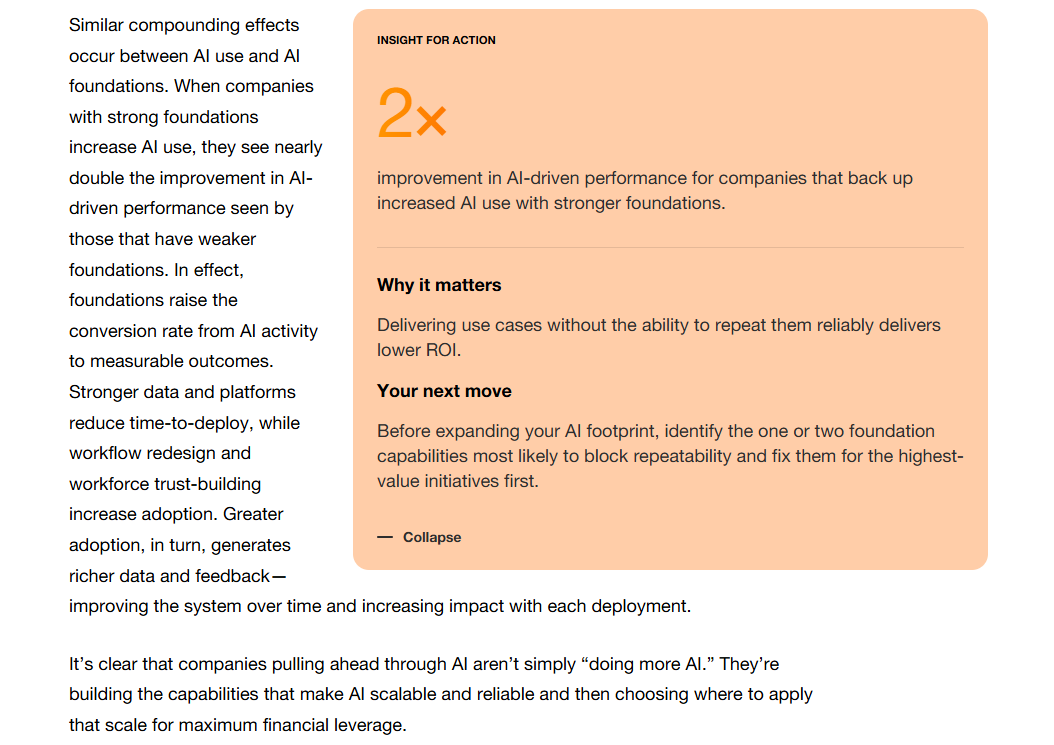
PwC points out in “Want ROI from AI? Go for growth” that enterprises cannot rely only on tool launch if they want to turn AI use into measurable results: strong data and platforms can shorten deployment time, while workflow redesign can increase adoption. According to its survey, companies with stronger digital foundations see AI-driven productivity improvements after increasing AI use that are nearly twice those of companies with weaker foundations.
People absorption needs. After AI spreads from the central team into business departments, enterprises need to answer: Do employees know how to use it, dare to use it, and continue to use it? Do business teams know how to raise clear AI needs? Do managers know how to drive adoption? Can legal, privacy, human resources, and change communication teams jointly define clear boundaries? Tool launch does not mean employee capabilities are updated at the same time, and AI can easily remain the spontaneous trial of a small number of people. Boston Consulting Group (BCG) found in “AI at Work: Momentum Builds, but Gaps Remain” that when employees do not receive suitable AI tools, more than half will look for alternative tools on their own, bringing security risks and fragmented efforts; employees who receive at least five hours of training, in-person coaching, and leadership support are more likely to develop stable use.
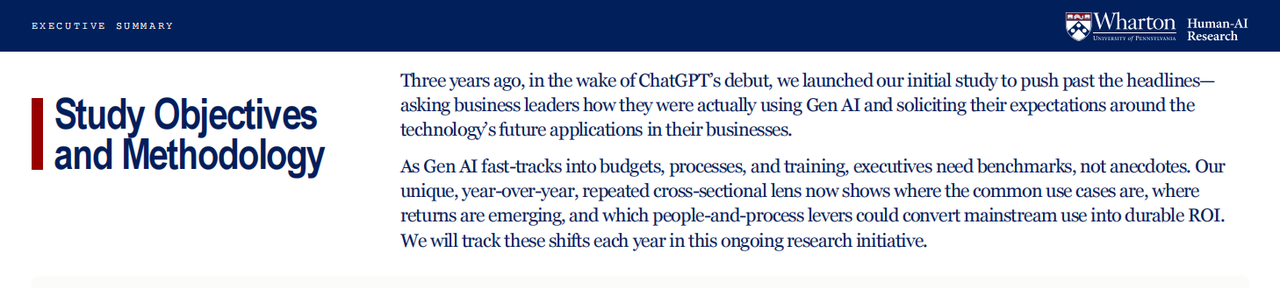
These two types of needs correspond to what the Wharton School of the University of Pennsylvania’s 2025 “AI Adoption Report” calls people-and-process levers: generative AI has rapidly entered enterprise budgets, processes, and training, and the key in the next stage is to use these two types of levers to turn mainstream use into sustained returns. Unilever and Marriott each chose one of these levers as an entry point.
Unilever Places Absorption Responsibility into Processes, While Marriott Places It into People
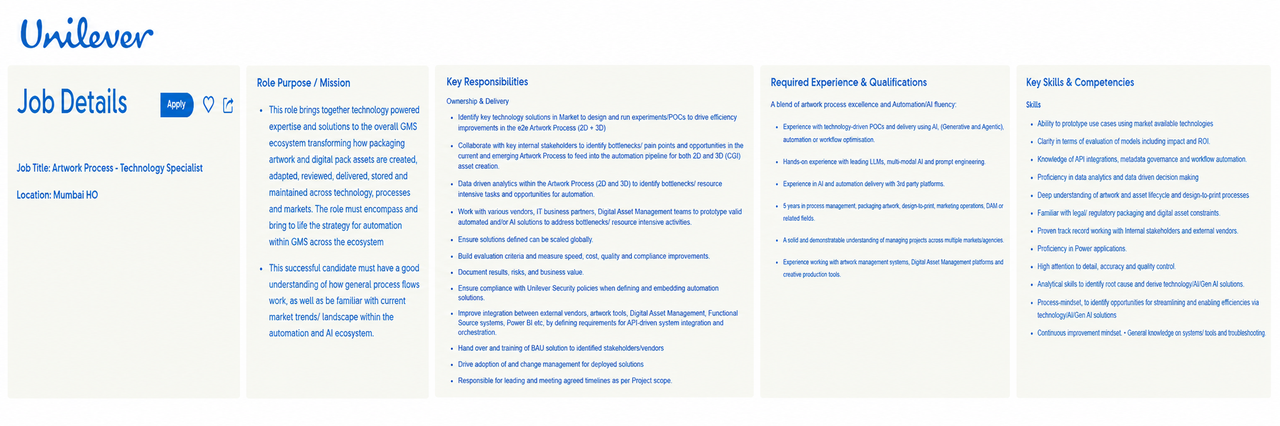
Unilever’s “Artwork Process - Technology Specialist” is embedded in the packaging artwork and digital asset processes of the consumer goods business, covering the continuous chain from artwork generation, design-to-print, and marketing operations to digital asset management. Packaging artwork is a highly complex and high-value operational chain in fast-moving consumer goods companies: it carries multiple requirements at the same time, including brand expression, product information, regional languages, local regulations, printing specifications, and digital reuse; when a product enters different markets or packaging specifications, the artwork needs repeated adaptation, review, modification, and archiving, with long processes, many roles, and high compliance requirements. The value of AI therefore runs through multiple nodes: assisting content adaptation and layout adjustment at the front end, checking consistency and compliance risks during review, driving file circulation and supplier collaboration automation during delivery, and improving tagging, retrieval, and reuse efficiency in asset management. What the role owner needs to do is continuously identify bottlenecks in this process, judge which nodes are suitable for generative AI, agentic AI, and automation, drive proof of concept and delivery, and settle pilot experience into a new standard operating mechanism.
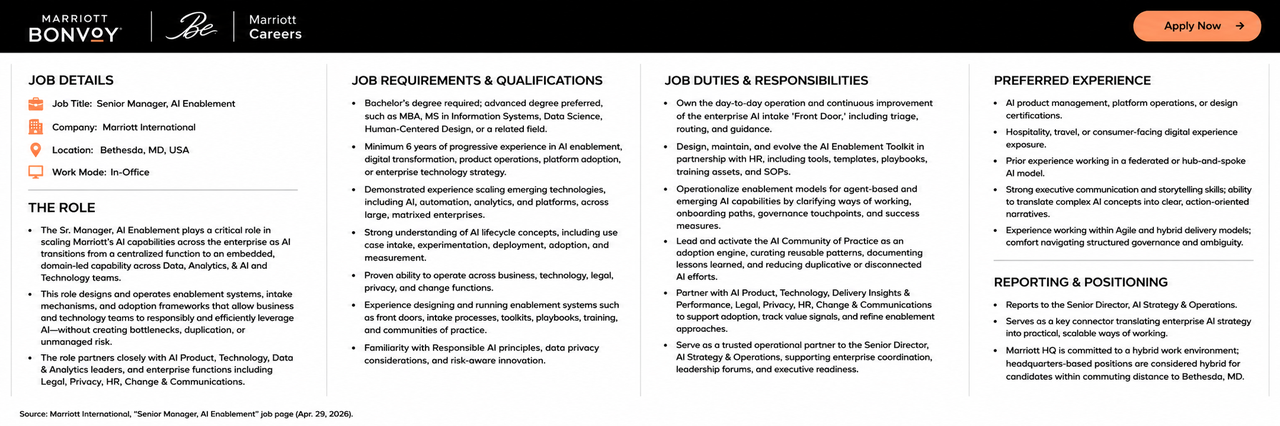
The background for Marriott’s “Senior Manager, AI Enablement” is Marriott’s judgment that its internal AI deployment is shifting from a centralized function to an embedded, domain-led capability: AI is no longer built uniformly by one central team, but will gradually enter the daily work of hotel operations, customer experience, data analytics, and various functional departments. The organizational issues brought by this shift are multi-layered——whether employees have the required skills, whether business teams can raise clear needs, whether managers can drive adoption, and whether legal, privacy, human resources, and change communication teams can jointly build executable boundaries. The core of this role is to design and operate an internal AI enablement mechanism: building AI enablement systems, demand intake mechanisms, and adoption frameworks, and translating abstract AI capabilities into work methods that employees can learn and execute——designing training content for different roles, providing usage guidance for business teams, building adoption promotion methods for managers, and clarifying for employees which scenarios are suitable for AI, which scenarios require human judgment, and which data cannot be casually handed over to AI. It is also worth noting that this role ties governance responsibilities——usage boundaries, compliance collaboration, and decision-right arrangements——together with training and adoption. Where governance sits within the organization is in fact a third observation dimension beyond processes and people. This article first focuses on the first two, leaving the governance dimension for later discussion.
Looking at the two roles together: Unilever places responsibility on process bottlenecks, AI automation experiments, and standardized iteration, turning AI into a reusable process asset; Marriott places responsibility on employee training, demand intake, adoption frameworks, and cross-functional collaboration, turning AI into a sustainable employee capability.
Candidate Profile: Enterprises Are Looking for Composite Talent That Can Translate AI into Processes and Capabilities
Once role responsibilities are defined, the screening logic changes accordingly. What enterprises truly need is not necessarily the person who understands models the most, but the person who can turn AI capabilities into process actions, role capabilities, and organizational mechanisms.
For process absorption roles, Unilever requires candidates to have both artwork process experience (design-to-print, marketing operations, digital asset management) and AI and automation application capabilities (exposure to large language models, multimodal AI, prompt engineering, and third-party AI platform delivery). When other enterprises refer to this type of role, the profile can be summarized into three layers: first, end-to-end process understanding, the ability to see blocking points and responsibility gaps in the process; second, AI embedding and experimental delivery, the ability to translate business pain points into AI use cases, and to work with IT, data, suppliers, or AI consultants to design pilots and push implementation; third, standardization and continuous iteration, the ability to establish evaluation metrics (process cycle time, rework rate, review accuracy, asset reuse rate) and continuously adjust process nodes and human intervention points based on operating results.
For people absorption roles, Marriott requires candidates to design and operate enablement systems, demand intake mechanisms, and adoption frameworks, and to collaborate with legal, privacy, human resources, and change communication teams. The corresponding profile also has three layers: first, training and capability model design, breaking AI usage capabilities into skill modules that different roles can absorb——frontline employees master safe prompting and information verification, business teams master scenario identification and result evaluation, and managers understand how AI affects division of labor and performance; second, adoption promotion and organizational communication, identifying adoption resistance across departments and expanding use through cases, demonstration teams, and management advocacy; third, HR, change management, and compliance collaboration, connecting usage rules, training plans, role capability updates, and change communication.
Industry Attributes Determine the Absorption Entry Point: Process-Intensive Industries Strengthen Processes First, Service-Intensive Industries Strengthen People First
These two entry points do not exclude each other, nor do they have a fixed sequence. It depends on where the enterprise’s core value chain lies, which links AI has already entered, and where the current biggest organizational friction is.
Process-intensive enterprises whose business value is concentrated in production, operations, content assets, and supplier collaboration are more likely to encounter Unilever-style problems first: quality inspection records and process documents in manufacturing companies, product information and e-commerce listing in retail companies, compliance materials and multi-region label review in pharmaceutical and consumer goods companies, and procurement approvals and contract circulation in large enterprises. After AI enters these scenarios, the core problem to solve is who will continuously transform the process.
Service-intensive industries whose value release highly depends on employee judgment, customer interaction, and on-site execution——hotels, airlines, retail stores, healthcare services, financial customer service, and professional services——are more likely to encounter people absorption problems first. From a management perspective, people absorption is essentially an organizational change problem. The judgment made by John P. Kotter in the Harvard Business Review classic article “Leading Change: Why Transformation Efforts Fail” remains applicable here: transformation failures often stem from the lack of a sense of urgency, a guiding coalition, a clear vision, continuous communication, short-term wins, and institutionalization. Whether a new technology can enter an organization depends on whether employees understand why they should use it, how managers drive use, how the organization removes obstacles, and how the new way of working is fixed in place.
Therefore, the way to refer to these two cases is to first ask where one’s own organizational absorption pressure mainly falls: if the pressure falls on process standardization and cross-system collaboration, prioritize strengthening process absorption capabilities; if the pressure falls on employee use and service experience, prioritize strengthening people absorption capabilities. Only after the entry point is clear can role setting have a clear work object.
This judgment also needs a reverse check: sometimes role setting is merely a gesture under peer pressure. In the last round of digital transformation, many companies created Chief Digital Officer roles, and cases where role titles moved ahead while substantive responsibilities lagged were not rare. Therefore, when reading role signals, they should be cross-validated with the enterprise’s existing deployment facts. Unilever’s role is built on the basis that AI has already entered the packaging artwork process, while Marriott’s role corresponds to the reality that AI has already spread to multiple business domains——both are supported by real deployment progress, which is also why this article chooses to analyze them.
Budget Signal: Enterprises Are Beginning to Pay for Sustained Absorption Capabilities After AI Deployment
Behind the role signals in this issue, there is a noteworthy direction of change in enterprise AI budgets: budgets are expanding from model usage, platform procurement, and single-point pilots to the sustained absorption capabilities after AI deployment. The two cases are not enough to represent the entire industry. A more cautious reading is: among enterprises that have moved further ahead in deployment, this budget awareness has already appeared.
The first type is AI process transformation budget. Unilever’s role shows that enterprises are already willing to set up a long-term owner for a specific business process. Such investments usually transform from existing budgets: business department process optimization budgets (efficiency improvement projects such as artwork, product listing, contract review, and compliance materials), automation and process reengineering budgets from operations or digital departments (PoC, node reconstruction, system integration), digital asset management budgets from marketing or content teams (material reuse and version management), and supplier collaboration budgets from procurement or supply chain teams. Enterprises pay for this type of role essentially to pay for shorter process cycles, lower rework rates, higher review efficiency, and reduced compliance risks.
The second type is AI employee capability-building budget. Marriott’s role shows that after AI enters multiple business domains, employee training, adoption promotion, role capability updates, and organizational communication begin to become formal investments. Such investments usually enter from three directions: employee training and learning development budgets from human resources departments (tiered AI courses, role-based learning paths, manager adoption manuals), organizational capability-building budgets from organizational development or change management departments (usage rules, capability model updates, demonstration teams, feedback mechanisms), and business enablement budgets from business departments (helping sales, customer service, operations, and other teams embed AI into daily work). What it purchases is the organizational mechanism that allows employees to continuously absorb AI.
There are precedents for this budget evolution in management history. During the spread of ERP, enterprises commonly created process owner roles; after the rise of e-commerce, a group of e-commerce manager roles also emerged. Economists Erik Brynjolfsson and Lorin Hitt, in their research on information technology productivity (“Beyond Computation: Information Technology, Organizational Transformation and Business Performance,” Journal of Economic Perspectives, 2000), found that the returns on information technology investment depend on complementary investments in process reorganization and employee skills, and these organizational investments often take several years before they are reflected in performance. Using this as a reference, AI role building should likewise be planned as a multi-year investment, rather than as a project expected to show results within the same year.
For most enterprises still in the exploration stage, similar budgets may first appear in the form of consulting projects, process diagnostics, training system design, or AI application roadmaps. No matter which stage an enterprise is in, it needs to pay for the sustained absorption capabilities after AI deployment.
The Premise for Roles to Take Effect: Complete Deployment Judgment First, Then Talk About Role Handoff
These roles do not take effect simply because they are established. They have one premise: the enterprise already roughly knows which processes are suitable for AI intervention, which employee groups most need enablement, which data and system conditions are already in place, and which business indicators can verify results. Unilever can set up a process role because the packaging artwork process is already clear enough; Marriott can set up an enablement role because AI has already spread to multiple business domains. But for many small and medium-sized enterprises, the problem is stuck further upstream: process mapping and the data foundation have not yet been completed, technical teams are lacking the conditions to judge models, data interfaces, and system integration, or the enterprise has already purchased AI tools but finds it difficult to judge which processes the tools should be embedded into, how to design a PoC, and how to measure input and output.
This is precisely the value of AI consulting and implementation design capabilities. For enterprises that have not completed the first round of deployment judgment, we usually help complete four things first:
- Map, judge, and integrate workflows. Return to real business processes, map departmental collaboration, system boundaries, data foundations, and key pain points, and judge which workflows have the conditions for AI intervention and which links need to first strengthen processes or data foundations.
- Select priority pilot scenarios. After workflow mapping, combine the enterprise’s nature, departmental needs, and digital foundation to identify scenarios with higher value, lower resistance, and more easily verifiable results.
- Design a small-scope implementation path. Around the priority scenario, clarify the required data, system interfaces, process nodes, and personnel coordination, first run a verifiable PoC or small-scope demo, and then iterate quickly.
- Clarify subsequent role handoff responsibilities. After small-scope validation, judge which responsibilities need to be carried by the enterprise internally over the long term——process transformation, AI output evaluation, or employee training and adoption promotion——so that role setting has a clear work object.
Another real constraint is the short-term shortage of composite talent. The candidate profiles of both Unilever and Marriott are highly composite, and the market finds it difficult to recruit large numbers of matching candidates all at once. A more realistic path is to view these roles as the direction of internal personnel AI transformation: identify potential candidates from existing process managers, digital project managers, training leads, and HR business partners, and gradually develop them through AI project practice——on the process side, learning use case identification, PoC design, and effect evaluation; on the people side, learning adoption mechanisms, capability models, and change communication. While enterprises carry out AI technology transformation, they also need to carry out human resources transformation at the same time: AI changes not only process efficiency, but also role capability structures, training systems, recruitment standards, and promotion paths. Future enterprise competitiveness will increasingly come from the sustained coordination among AI deployment paths, role capability updates, and talent development mechanisms.
Further Reading
- The public research and cases cited or referenced in this article are listed below for further reading (publication years and links are subject to official sources):
- Wharton School, University of Pennsylvania, “AI Adoption Report,” 2025.
- PwC, “Want ROI from AI? Go for growth.”
- Boston Consulting Group (BCG), “AI at Work: Momentum Builds, but Gaps Remain.”
- John P. Kotter, “Leading Change: Why Transformation Efforts Fail,” Harvard Business Review.
- Erik Brynjolfsson and Lorin M. Hitt, “Beyond Computation: Information Technology, Organizational Transformation and Business Performance,” Journal of Economic Perspectives, 2000.
- Wesley M. Cohen and Daniel A. Levinthal, “Absorptive Capacity: A New Perspective on Learning and Innovation,” Administrative Science Quarterly, 1990.
- Unilever: “Artwork Process - Technology Specialist” job posting.
- Marriott International: “Senior Manager, AI Enablement” job posting.
Feel free to send us a private message or leave a comment to tell us which enterprise AI practice topics you are curious about! You are also welcome to leave a message on NextAIPraxis.com or contact us at [email protected] with real problems your enterprise is trying to solve. We will contact you within 2 working days and invite you to join our practice-sharing community.
Cite as · Enterprise AI Deployment Signals · 16 June 2026