
Over the past several months, Alibaba Cloud’s CIO team held a series of in-depth conversations on AI deployment with executives from more than 40 companies across ten major industries. The participating companies had already pursued digital employees, enterprise knowledge bases, agents, AI development tools, and other practices to varying degrees. Yet when the conversation returned to “What exactly is the enterprise using AI to do?” and “Why have these projects been so slow to produce stable value?”, some seemingly basic questions still made executives pause and reconsider their projects’ objectives, paths, and expected outcomes.
InfoQ, a technology publication for technology executives and software developers, later distilled these discussions into “Ten Questions for CIOs” in “Alibaba Cloud’s CIO Spent Months Talking with 40 Enterprises—and Unearthed Rarely Disclosed Truths About AI Deployment.” These conversations deserve our attention because their context more closely resembles that of the companies served by NextAI+ Praxis. The sources used in previous issues of the Enterprise AI Deployment Signals Weekly have mostly been public cases from overseas companies, reports from international consulting and research institutions, and practices jointly disclosed by global AI vendors and their customers. They have gradually helped us understand use-case selection, pilot validation, production admission, job redesign, and organizational learning, but they cannot fully show the first problems Chinese executives encounter within their own technology ecosystems, digital foundations, and organizational environments.
The conversations between Alibaba Cloud’s CIO and more than 40 Chinese enterprises add this missing perspective. Although the companies span different industries and have different data foundations, system histories, and organizational conditions, they repeatedly returned to a similar concern: When AI moves from a demonstrable technical capability into the real work of an enterprise, what exactly must the enterprise rearrange?
The ten questions distilled by Alibaba Cloud’s CIO team follow AI progressively deeper into real work. The first three return to the project starting point: what tasks a digital employee actually takes on, whether the enterprise’s existing foundations can support it, and which businesses are suited to large models. The middle three move into knowledge and engineering conditions: why enterprise knowledge bases fail, how knowledge engineering should proceed, and who defines the quality of an agent’s output. The final four move into organization and value: how digital employees should be managed, how employees should adapt to job changes, how IT and the business should redivide authority and responsibility, and how R&D efficiency should be measured.
As we read these ten questions, we found clear parallels with the themes that the NextAI+ Praxis Enterprise AI Deployment Signals Weekly has continued to study. Real tasks, digital foundations, enterprise context, evaluation and acceptance, job redesign, collaboration between IT and the business, and workflow value have all appeared in different cases and reports. Most of the answers we formed in the past came from overseas practice. This time, we can use the questions raised by Chinese executives to re-examine which judgments still hold, which need to be understood anew in light of Chinese enterprises’ actual conditions, and which areas still warrant further exploration.
Whether an AI project can enter the business first depends on whether the enterprise has defined the work clearly
The first three questions raised by Alibaba Cloud’s CIO concern work definition, digital foundations, and the division of labor among technologies. An enterprise must first define a digital employee as a work unit with clear responsibilities and measurable results; then examine whether its existing data, knowledge, systems, and processes can support it; and finally determine which steps in the work should be handled by a large model, traditional tools, or people.
A digital employee must first become a work unit with clear responsibilities and measurable results
Digital humans have become one of the most closely watched concepts in AI projects. The Business Research Company, a UK market research firm, projects in its Digital Human Global Market Report that the global digital human market will grow from $47.72 billion in 2025 to $66.98 billion in 2026. The report, however, uses “digital human” broadly to include virtual avatars, virtual assistants, virtual characters, and other forms. The figures indicate market enthusiasm, but they also show that the term “digital human” is carrying an expanding range of product and application definitions.
Within enterprise applications of digital humans, the “digital employee” is a more specific form. InfoQ records Alibaba Cloud’s CIO distinguishing digital employees from “add-on AI”: translation, content generation, and other add-on AI capabilities help employees with parts of a job, while the employee still initiates and completes the overall work; a digital employee must take over a piece of actual business work previously performed by a person, with inputs, outputs, completion quality, and processing efficiency that the enterprise can observe. Alibaba Cloud’s CIO’s first question therefore asks the enterprise to clarify: Is what it calls a “digital employee” merely an AI capability that assists employees, or has it become a work unit that can assume a defined business responsibility, deliver results, and undergo continuous evaluation?
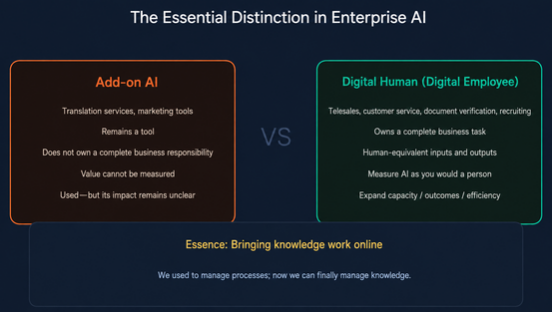
Such a work unit need not independently own an end-to-end process, but it must have clear work boundaries. The enterprise should be able to state which business it serves, where it receives information, what result it must deliver, who reviews it, and under what circumstances it must hand the task back to an employee. Only when these elements can be independently described and continuously measured does a digital employee truly become a management object that the enterprise can configure, supervise, and improve.
Once a digital employee begins to perform real work, the enterprise must also manage the knowledge on which that work depends. In legal, sales, human resources, design, and similar functions, traditional systems can record who owns a task and how far it has progressed, while the crucial methods of judgment and practical experience often remain in employees’ heads. Enterprises need to organize the reusable parts of that experience into knowledge content, business rules, and SOPs that digital employees can invoke while executing tasks; human corrections and exception handling that occur in operation can then flow back into the same knowledge system.
A technology-company CEO in the conversation therefore observed: “We used to manage processes; now we can finally manage knowledge.” In the past, enterprises primarily used systems to manage process nodes, owners, and operating status. As digital employees begin to draw on knowledge to complete tasks, enterprises must continuously know what content they rely on, whether that content remains valid, and how new business experience enters the next round of execution. Knowledge that once moved only through individual experience can thus gradually become an operating asset that the enterprise can preserve, invoke, and update.
Alibaba Cloud’s CIO’s first question ultimately requires the enterprise to define the digital employee and its capability boundaries. A digital employee must correspond to a piece of real business work that can be independently described and measured, and the enterprise must be able to state what responsibility it assumes, what result it delivers, and how it is supervised. The third question will address which businesses a digital employee should enter and which steps should be performed by a large model.
The deeper AI enters the enterprise, the harder its existing digital gaps are to conceal
The second question traces the issue further back: many of the problems a CIO faces after AI enters the enterprise have existed for years. Alibaba Cloud’s CIO likens AI to a mirror: it can rapidly invoke and process information, but it also exposes accumulated problems in data, systems, and processes.
ChatBI, mentioned in the interview, is a typical example. Here, ChatBI can be understood as an application that lets employees query enterprise operating data in natural language and receive analytical results. Employees can ask directly about sales, inventory, or other operating indicators, and the model can produce answers quickly. Yet if different departments use different definitions for the same metric and the underlying data lacks a unified definition, AI’s answers may still conflict. On the surface, this looks like a question of whether the model’s answer is accurate; traced to its source, however, the enterprise must first unify the business definition and confirm where the data comes from and who maintains it.
This also reflects the current state of progress at some Chinese enterprises. AI has begun to enter knowledge processing and business decision-making, while process digitization, system connectivity, and data governance remain incomplete. Informatization, digitization, and intelligent transformation are therefore unfolding at the same time. In this overlapping state, the performance of an AI project is directly affected by the digital foundations already in place. The second question ultimately asks the enterprise to determine whether a deviation in results arises from model capability or from gaps in data, systems, and processes that have not yet been filled. Only by identifying the source of the problem can the enterprise decide what to do next.
Before assigning a digital employee to a business, determine whether the task and the technology fit
After defining the digital employee and checking the conditions that support it, the third question turns to selecting specific tasks. Large models can generate text, understand materials, and answer complex questions. As their capabilities expand, enterprises may easily equate “able to produce a result” with “worth deploying.” Yet the fact that a task can be demonstrated by a model establishes only preliminary technical possibility; accuracy, stability, cost, and auditability will still determine whether it can become business work that a digital employee performs continuously.
In the interview, InfoQ cites data from PwC’s 29th Global CEO Survey: 56% of surveyed CEOs said their companies had yet to obtain revenue growth or cost reductions from AI investment. The figure cannot by itself explain why returns have not appeared, but it reminds management that the breadth of a large model’s capabilities does not automatically become business value. Enterprises still need to determine whether a business should introduce a digital employee and then break down how its different tasks match different technologies.
A manufacturing executive who joined the conversation observed that in structured scenarios, “large models cannot outperform traditional methods.” Structured scenarios are tasks with relatively clear inputs, computational rules, output formats, and decision criteria, such as inventory calculation, production scheduling, and transaction reconciliation. These tasks depend on deterministic rules and precise calculation; SQL queries, rules engines, optimization algorithms, and traditional business systems can generally provide more stable and repeatable results.
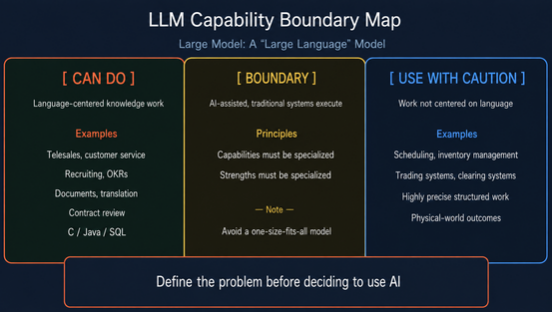
Tasks such as contract review, knowledge Q&A, and customer-intent recognition must process large volumes of unstructured material and form results from language and context; large models can contribute more readily in these steps. Even when a digital employee enters a structured process, a large model can handle natural-language interaction, document understanding, result explanation, and exception information, while precise calculation and rule execution remain with existing systems. Steps involving significant responsibility, exceptional judgment, or irreversible consequences should continue to require employee confirmation or approval.
The third question therefore requires an enterprise to decompose a business into distinct tasks, assess each task’s requirements for language understanding, contextual judgment, precise calculation, stability, and human accountability, and then decide which piece of work a digital employee should take on and what the large model, traditional systems, and employees should each do. The result should be a “task decomposition and technology allocation map.” The first question defines the work boundaries a digital employee should have; the third determines where such a work unit should be used and how it should complete its tasks.
Previous issues have already turned the first three questions into an executable deployment path
Looking back at previous issues, our first concern was also whether AI could be given a clear business responsibility. Issue 1, “Enterprise AI’s Real Inflection Point: Once Standardized Processes Enter Production, Governance and Collaboration Become the New Constraints,” observed that standardized operating processes with strong constraints, auditability, and clear metrics are more likely to enter production first. Issue 12, “From a 300-Person Trial to 98% Team Adoption: Morgan Stanley’s Five Steps for Moving AI into Production,” developed this judgment into a “use-case card”: at project launch, the enterprise should identify the target users and business owner, knowledge and data boundaries, expected deliverables, human review responsibility, and preliminary value metrics. Together, these elements help turn a digital employee from a broad product label into a work unit with clear responsibilities that can be supervised and evaluated.
Once the work is clear, the next question is naturally whether the enterprise’s existing foundations can support it. Issue 5, “An AI Deployment Path Built Around Completing the Digital Foundation: Chow Tai Fook’s Transformation of Traditional Jewelry Retail,” divides this foundation into a data-management foundation and a process-operations foundation. The former unifies business definitions, critical data, and access boundaries; the latter brings business actions into systems and leaves traceable results. The foundation can also be built out progressively around a use case. An enterprise first identifies the data, knowledge, system interfaces, and process nodes on which the current task depends, prioritizes the conditions that directly affect validation, and continues improving them as the scope of use expands. In this way, data definitions, system connections, and process-rule problems exposed by AI can be located and addressed separately.
As the foundations take shape, the enterprise must also determine how to allocate tasks within a business. Issue 1 presented one division-of-labor approach through a hybrid architecture: assign steps with higher reasoning demands to more capable models, steps requiring greater speed and more deterministic rules to smaller models, and use a unified orchestration mechanism to maintain task state. Issue 12 further warned that a smooth demo proves only that the core workflow can be shown; technical feasibility, fit with the real environment, and admission to production still require evidence accumulated through a proof of concept, a limited pilot, and pre-launch acceptance. An enterprise can therefore decompose the task first, assign the large model, traditional systems, and employees to the steps best suited to each, and test that division of labor through accuracy, stability, cost, and failure cases.
Together, the first three questions form a decision path before an AI project enters the business: define the digital employee as a work unit, identify the data, knowledge, systems, and process conditions that support it, and then allocate the specific tasks among large models, traditional tools, and employees. Only then can the enterprise know what it is actually preparing to build, what is missing from its current foundation, and what the next round of validation needs to test.
Enterprise knowledge can truly support AI work only when it enters a specific task and undergoes business evaluation
The first three questions help an enterprise determine what a digital employee is, whether its existing foundations can support it, and how tasks should be allocated. When the digital employee actually begins work, the enterprise must also provide product information, business rules, operating experience, and standards of judgment. Alibaba Cloud’s CIO’s fourth through sixth questions therefore ask: What knowledge does a digital employee need, how can that knowledge remain reliable, and how does the enterprise determine whether the final result is acceptable?
An enterprise knowledge base must be reorganized around real business work to avoid “building a tower on shifting sand”
InfoQ recounts how the credit-card center of a state-owned bank invested about RMB 3 million in an intelligent knowledge-management system, hoping to systematize internal knowledge and make employee queries more efficient. Actual usage remained below 25% after launch: employees still preferred to ask colleagues or consult Excel knowledge bases they maintained themselves. The enterprise invested money, resources, and labor, yet the knowledge base never entered employees’ daily work.
A deeper change lies behind this case. In the past, knowledge bases were used mainly by employees; even when materials were incomplete, employees could draw on their own experience to make judgments and fill the gaps. In the AI era, knowledge bases begin to serve models directly: AI must use their contents to answer questions, generate reports, and support decisions. Whether the knowledge base covers the critical information needed to complete a task now affects whether a digital employee can produce reliable outputs.
The problem is that many enterprises still follow a “large and comprehensive” construction logic: they collect scattered Word documents, reports, and emails in one system and expect that system to become the enterprise knowledge base. Some also expect AI to fill gaps in historical knowledge automatically. Models can supplement general knowledge about the world, but the enterprise’s own product logic, business rules, and vertical expertise must still be accumulated and provided by the enterprise.
The interview describes such legacy material as the product of an “exhaustive but fragmented collection logic.” An enterprise may appear to possess large volumes of content, while the knowledge actually needed to complete a business task remains incomplete and some materials have even fallen out of step with the real business. Using such knowledge to support AI risks “building a tower on shifting sand”: upper-layer applications are already generating results, but the foundation has not been connected around real work.
Alibaba Cloud’s CIO therefore suggests starting with the “intent space” of a vertical scenario. Here, intent space can be understood as the main questions a user may ask within a specific business process and the range of responses a digital employee must provide. The enterprise first states which business the knowledge base is intended to serve and which problems it should solve, then identifies the knowledge and semi-structured data required to complete those tasks. Only then can the knowledge space correspond to actual work.
The question left by the fourth inquiry therefore becomes clear: How should an enterprise reorganize knowledge around a real business process so that a digital employee has the complete knowledge space needed to perform the work?
Once the knowledge space exists, knowledge engineering determines whether the “AI fuel” produces results
When an enterprise narrows its knowledge base to a specific business scenario, the problem advances. Even after scenario-relevant materials are identified, the data may remain disordered, concepts inconsistent, rules hidden in employee experience, and knowledge difficult to execute or verify. The enterprise must then consider how to process this content into high-quality knowledge that can support stable AI operation.
Alibaba Cloud’s CIO compares AI to an engine and enterprise knowledge to the fuel that powers it. The interview uses “raw coal” and “refined coal” to describe knowledge before and after engineering. The knowledge space answers the business scope in which AI must work; fuel quality determines whether it can continue producing reliable results within that scope.
Knowledge engineering must convert the “tacit” experience in employees’ minds into structures that can be executed and validated. The enterprise must progressively clarify how key business concepts relate, which conditions judgments depend on, how exceptions are handled, and how a task’s result is validated. Documents, data, rules, and SOPs can then form a knowledge structure that digital employees can invoke.
This work requires deep participation from the business. Technical teams can help AI connect to documents, data, and systems; business personnel must define the meaning of the knowledge, confirm the conditions under which it applies, and judge whether actual results meet business requirements. Alibaba Cloud’s CIO’s fifth question ultimately asks: How can an enterprise turn the knowledge and experience of a vertical scenario into AI fuel that can be executed, validated, and continuously corrected?
Whether an agent’s output is acceptable must be defined by people who truly understand the business
Even after knowledge has been organized, an agent may retrieve incorrect content, miss critical conditions, or generate an answer that appears complete but cannot be used in the business. Knowledge engineering answers what AI works from; evaluation engineering then asks how well it actually performs. In the interview, Alibaba Cloud’s CIO calls agent engineering the “shell,” while data and evaluation engineering provide the “substance” that truly determines business performance.
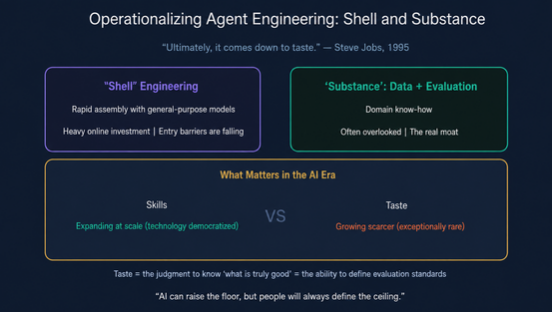
Traditional software testing generally has relatively clear inputs, rules, and expected results. The inputs and outputs of a large model in a professional setting are more like a short essay: does a contract summary omit a material risk, does a sales recommendation understand the customer’s intent correctly, and does an answer from the knowledge base provide sufficient evidence? In many cases, there is no single standard answer. Fluency, complete formatting, and response speed can measure part of the performance, but the final result must still be judged in light of professional knowledge, the consequences of errors, and the way it will actually be used.
The interview summarizes this capacity for judgment as “taste.” Here, taste means a business expert’s ability to determine what counts as correct, complete, and usable, and which errors would have unacceptable consequences. AI lowers the barrier to generating content and building applications, but the quality ceiling an enterprise can reach still depends on the experience, capacity for abstraction, and sense of responsibility of its business personnel.
The sixth question ultimately asks the enterprise: How can business experts’ judgment of “what counts as good” be converted into an evaluation mechanism that can operate continuously?
Previous issues have already connected knowledge development with business evaluation
Previous issues have discussed how knowledge enters specific work. In Issue 7, “When AI Deployment Becomes a Product: The Deployment Logic and Applicable Boundaries of the Agent Workspace,” we observed that after an enterprise purchases document, search, and knowledge-base tools, it still must solve the problem of how knowledge enters business actions. One value of an agent workspace is that it reorganizes information scattered across tools and systems into context an agent can invoke for a specific task.
This offers a more concrete path for addressing the fourth question. The enterprise can begin with a frequent, clearly bounded task and organize the questions users may ask, the results the digital employee must produce, and the product materials, business rules, and historical experience on which each type of question depends. On this basis, the enterprise can determine whether current knowledge covers the workflow, what content remains missing, and which questions must be handed to employees. The knowledge base thereby shifts from a collection of materials to a knowledge space that serves a specific task.
Once the knowledge space has been bounded, the agent workspace discussed in Issue 7 can also help address the fifth question. The enterprise must confirm which materials are authoritative, which information is subject to access restrictions, and which knowledge is maintained by business personnel, while allowing digital employees to continue using the identities, permissions, and business records in existing systems. New questions and human corrections arising in actual use must also re-enter the knowledge-maintenance process. The enterprise can thus form a knowledge-engineering mechanism through which business experience is continuously validated and updated as digital employees operate.
Issue 12, “From a 300-Person Trial to 98% Team Adoption: Morgan Stanley’s Five Steps for Moving AI into Production,” offers a more specific evaluation method for the sixth question. Morgan Stanley asked advisers and relevant experts to evaluate the accuracy and coherence of AI-generated content. As experience accumulated, it added translation evaluations and adjusted retrieval methods to accommodate a continually expanding document library. Questions and feedback from real users also continued to help the team improve the product.
In enterprise practice, business experts can first select representative tasks, establish the baseline that people achieve when performing those tasks, and then define evaluation dimensions such as accuracy, completeness, traceability of evidence, and risk. The enterprise should also record representative failure cases, specify which results may be used, which require human review, and which errors should trigger a pause or redesign. New questions enter the evaluation set; experience from human corrections returns to knowledge engineering; and the next round of testing determines whether the problem has truly been resolved.
The fourth through sixth questions therefore form a continuous path: the enterprise first builds a relatively complete knowledge space around a specific task, then uses knowledge engineering to process its contents into executable and verifiable “AI fuel,” and finally relies on business evaluation to determine whether the agent’s output can enter real work. New problems that arise in operation continue to return to the knowledge space and knowledge engineering, driving ongoing updates to content and standards.
Once AI enters the organization, management must redesign work, responsibility, and the measures of value at the same time
The first six questions help an enterprise determine how a digital employee enters the business and how knowledge and evaluation support it in completing tasks. Alibaba Cloud’s CIO’s seventh through tenth questions turn to the organization operating around AI: the seventh and eighth concern how digital employees are managed and how employees enter new ways of working; the ninth and tenth concern how business ideas enter production systems and whether local development acceleration from AI can reduce labor across the full delivery chain.
Once a digital employee takes on real tasks, it needs a clear comparison baseline and clear accountability
When a digital employee enters the business, the enterprise’s existing job, performance, and accountability systems must accommodate a new work unit. Alibaba Cloud’s CIO’s seventh question therefore centers on two issues: Against whom should a digital employee be compared, and who should manage it?
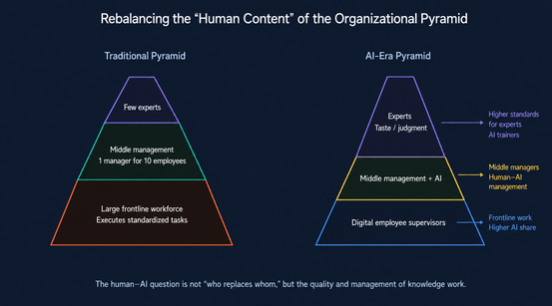
First, “against whom should it be compared?” Some enterprises compare digital employees directly with a small number of experts, expecting them to reach expert-level business performance at launch. The interview instead describes the enterprise as a capability pyramid: a few experts form judgments and codify experience, while many employees complete repetitive tasks according to rules and SOPs. At this stage, digital employees are better suited to taking on clearly bounded, verifiable work from that base. Evaluation should return to the task’s existing levels of quality, cycle time, cost, and human intervention. Expert performance can serve as a long-term ceiling, while the task’s actual baseline is more useful for current launch and adjustment decisions.
Next, “who should manage it?” IT can provide models, system connections, and operational support; once a digital employee enters a specific sales, customer-service, or finance process, its performance directly affects business results. The interview therefore recommends that the business function manage the digital employee and measure it jointly with IT. Task assignment, result review, and exception handling must still map to named employees and managers, so that accountability does not become blurred as AI enters the process.
The seventh question ultimately asks the enterprise to maintain a concise digital-employee management record: what task it performs, which baseline it is compared with, who manages and reviews it, and which business metrics are used to evaluate it.
If the time released by AI has nowhere new to go, communication alone will not dispel job anxiety
After digital employees take on part of the work, the change continues through employees and roles. The interview describes this process as a change in the “human content” of the corporate pyramid: repetitive knowledge tasks at the base require progressively less human participation; middle managers may manage both employees and digital employees; and professionals must take on more judgment, review, training, and exception handling. Employees’ concerns expand accordingly: they begin to wonder—and even fear—what they will be responsible for in the future, and how the enterprise will evaluate and deploy them after their previous work diminishes.
One large enterprise in the conversation observed that after developers were equipped with AI, overall output did not increase significantly. If time released in a local step is not redirected into new tasks, growth in usage and individual efficiency will struggle to carry through to team results.
The eighth question therefore presents management with a work-redesign problem. The enterprise must state which tasks have been handed to AI, which judgments, reviews, and exception responsibilities remain with employees, where the time saved will be redirected into higher-value work, and how new capability requirements will enter training and performance standards. Only when employees can see their place in the new work can the organization turn anxiety about job change into an adjustment it can advance collectively.
The business can build a demo quickly, but IT must still move it into a stable system
Alibaba Cloud’s CIO’s ninth question asks why an AI demo created by a business team is still so difficult to move reliably into a production system. AI has lowered the barrier to application assembly: business teams can quickly combine models, data, and automation tools to demonstrate a workflow that appears to function. IT teams must then assume responsibility for system stability, data security, and long-term operation. One CIO in the interview therefore complained: “How can IT make the business understand that the demo they build is not the same as a system engineered for production?”
The gap between the two centers on whether the real business has been fully mapped into system requirements. A demo usually presents the main process and expected result; in production, the same requirement must also cover real data, system interfaces, access permissions, exceptions, acceptance criteria, and operational accountability. Anything omitted from the system requirements may resurface during development, testing, or launch.
InfoQ calls this process the “first translation,” from the real business into system requirements. The business must explain how the actual work occurs; IT must explain how existing systems can support it and which conditions need to be added. The ninth question the enterprise must answer is: When the business can rapidly build a demo, can the enterprise expand its ideal path into a complete set of system requirements that can be delivered and operated over the long term?
Even after code generation accelerates, R&D efficiency must still be measured by end-to-end labor input
Once a business need has become a set of system requirements ready for the development process, the tenth question asks how much AI can actually accelerate system delivery. AI coding tools can generate large amounts of repetitive code, documentation, and proofs of concept, significantly increasing output speed in local development tasks. Yet code-completion speed covers only one part of software engineering; enterprises must still confirm requirements, design solutions, align teams, rework tests, and prepare for launch.
InfoQ offers a component estimate in the interview: in internet-application development, only about 20% of time is spent coding. Even if the adoption rate of AI-generated code reaches 80%, end-to-end person-month efficiency may show little change because requirements discussions, solution design, communication and alignment, and testing and rework remain. Complex business logic that determines system performance must also still be designed and reviewed by experienced people. These proportions are best used to illustrate how much software development happens outside coding; they should not be treated as a fixed benchmark for every enterprise.
The tenth question therefore expands the measurement of R&D efficiency from coding to the full delivery chain. Alibaba Cloud’s CIO proposes comparing the end-to-end person-months consumed by similar requirements from submission to launch—that is, the amount of staff time invested in completing a requirement. Only when total labor across requirements, design, development, testing, and rework declines can the enterprise conclude that AI’s local acceleration has become system-delivery efficiency. The ninth question checks whether a business idea has been fully mapped into system requirements; the tenth tests whether the delivery cycle for the complete system actually shortens after those requirements enter development.
Previous issues have addressed organizational absorption and production deployment; end-to-end R&D efficiency still needs validation
The management of digital employees and job changes addressed by the seventh and eighth questions received a concrete case in Issue 13, “Frontier Firms, Pacesetters, and Organizational Evolution in the AI Era.” BNY assigns digital employees in production an independent identity and a human supervisor, and uses real-time dashboards to observe throughput, processing time, missed transactions, and approval outcomes. After digital employees take over repetitive verification, employees continue to review results and handle exceptions while gradually shifting toward data analysis, client strategy, and AI tool design. BNY also uses role-based learning and problem-driven bootcamps to help employees build capabilities around the redesigned work. These practices show that digital-employee evaluation, accountability, and employee role adjustment must be developed together around the same real workflow.
The gap between demos and production systems revealed by the ninth question directly corresponds to Issue 12, “From a 300-Person Trial to 98% Team Adoption: Morgan Stanley’s Five Steps for Moving AI into Production.” That issue divided AI deployment into five gates: use-case selection and demo, proof of concept, limited pilot, pre-launch evaluation and acceptance engineering, and formal launch and continuous operation. A demo merely turns a business problem into a workflow that stakeholders can observe together; each subsequent gate adds evidence about technical feasibility, real-environment performance, permissions, risk, acceptance, and operational accountability. Issue 5, “An AI Deployment Path Built Around Completing the Digital Foundation: Chow Tai Fook’s Transformation of Traditional Jewelry Retail,” also reminds enterprises that system connections, data definitions, and process digitization may need to be completed progressively around a specific use case. Together, the two issues offer a method for turning business goals into complete production requirements through staged validation while identifying the conditions that existing systems still lack.
The tenth question adds a topic that previous issues have explored less fully. We have discussed how AI systems complete technical validation, production acceptance, and continuous operation, but we have not systematically studied whether AI coding tools reduce the end-to-end person-month input required to take a software requirement from submission to launch. The volume of generated code, adoption rates, and output per developer explain only local changes. To determine whether R&D efficiency has truly improved, enterprises must continuously record the time that similar requirements consume in requirements confirmation, design, coding, testing, rework, and launch. This question deserves further research.
From determining “against whom digital employees should be compared and who should manage them,” to helping employees enter new ways of working, converting business demos into production systems, and measuring R&D acceleration end to end, the seventh through tenth questions make one point together: once AI begins to perform real work, the enterprise’s management responsibilities, collaborative relationships, and efficiency metrics must change with it.
The ten questions raised by Alibaba Cloud’s CIO and more than 40 enterprises outline a set of practical constraints on enterprise AI deployment in China. Enterprises must define the work assigned to digital employees, complete their systems, data, and knowledge foundations, establish evaluation, redesign roles, coordinate the business with IT, and remeasure value with metrics that cover the full workflow. We have already examined many of these questions through enterprise cases and research reports in the first thirteen issues of the Enterprise AI Deployment Signals Weekly; readers can follow the issue references in this article for the corresponding methods. We have also observed several important questions that the Weekly has not yet addressed in dedicated coverage. How an enterprise knowledge base continues to update as the business changes will determine whether AI can obtain effective knowledge over the long term. How job changes move further into staffing and career transitions will affect whether employees find a stable place in new ways of working. Whether AI coding tools truly reduce end-to-end person-month input will determine whether local development acceleration becomes enterprise-wide R&D efficiency. These questions are equally important conditions for enterprise AI deployment to achieve sustained operation, and NextAI+ Praxis will continue tracking and examining them in future issues.
Further Reading
External Sources for This Issue
- InfoQ: “Alibaba Cloud’s CIO Spent Months Talking with 40 Enterprises—and Unearthed Rarely Disclosed Truths About AI Deployment” (March 2026). The principal source for this article, distilling the “Ten Questions for CIOs” from discussions between Alibaba Cloud’s CIO and executives at more than 40 enterprises across ten major industries.
- UK market research firm The Business Research Company: Digital Human Global Market Report (Digital Human Global Market Report). A broad view of the digital-human market, including virtual avatars, virtual assistants, virtual characters, and enterprise applications.
- Global professional-services firm PwC: 29th Global CEO Survey (PwC’s 29th Global CEO Survey, January 2026). Provides context on the continuing gap between enterprise AI investment and revenue or cost returns.
Previous Issues
- Issue 1, “Enterprise AI’s Real Inflection Point: Once Standardized Processes Enter Production, Governance and Collaboration Become the New Constraints”: Discusses the standardized processes most likely to enter production first and the division of labor among large models, smaller models, and traditional systems.
- Issue 5, “An AI Deployment Path Built Around Completing the Digital Foundation: Chow Tai Fook’s Transformation of Traditional Jewelry Retail”: Discusses how enterprises can build data-management and process-operations foundations around specific use cases.
- Issue 7, “When AI Deployment Becomes a Product: The Deployment Logic and Applicable Boundaries of the Agent Workspace”: Discusses how enterprise knowledge enters an agent’s working context and is invoked through existing identities, permissions, and business systems.
- Issue 12, “From a 300-Person Trial to 98% Team Adoption: Morgan Stanley’s Five Steps for Moving AI into Production”: Breaks the journey into five gates—use-case selection and demo, proof of concept, limited pilot, pre-launch acceptance, and continuous operation.
- Issue 13, “Frontier Firms, Pacesetters, and Organizational Evolution in the AI Era”: Uses BNY to examine the organizational absorption, controlled operation, and organizational-learning capabilities required after digital employees enter production.
Cite as · Enterprise AI Deployment Signals · 8 September 2026