
In earlier installments of our Deep Reads series, we examined how Microsoft and Kyndryl describe leading enterprises in the AI era. In 2026 Work Trend Index Annual Report: Agents, Human Agency, and the Opportunity for Every Organization, Microsoft presents the organizational profile of a “Frontier Firm”: individual AI capability is supported by corporate culture, managers, talent practices, and governance, allowing employees and agents to take on increasingly complex work together. As repeated use generates new experience, the enterprise must also convert successes, failures, and performance drift into shared processes, standards, and organizational knowledge. Over time, it becomes a system capable of continuous learning.
Our reading of Kyndryl’s 2026 People Readiness Report: Beyond AI Adoption offered a second profile, represented by the “Pacesetter.” Kyndryl breaks people readiness into role redesign, capability building, and formal change management. Role redesign clarifies the division of work between people and AI and identifies the skills required. Training and user feedback then continue to refine roles and workflows, while change management embeds those adjustments in performance, workforce allocation, and career development. These elements reinforce one another and help employees enter new ways of working.
Both reports locate the long-term value of AI in an enterprise’s capacity to adapt. Kyndryl focuses on how roles, people, and management systems absorb changes in work. Microsoft also treats those organizational conditions as essential, then looks further at how an enterprise learns from live operations so that experience from one deployment informs the next. Governance, managerial accountability, and human–AI work design connect the two perspectives: they shape whether employees can work safely with AI and whether errors, corrections, and exceptions in production are recorded reliably.
Taken together, the two reports point to three connected systems that enterprises need in order to adapt to AI-driven change:
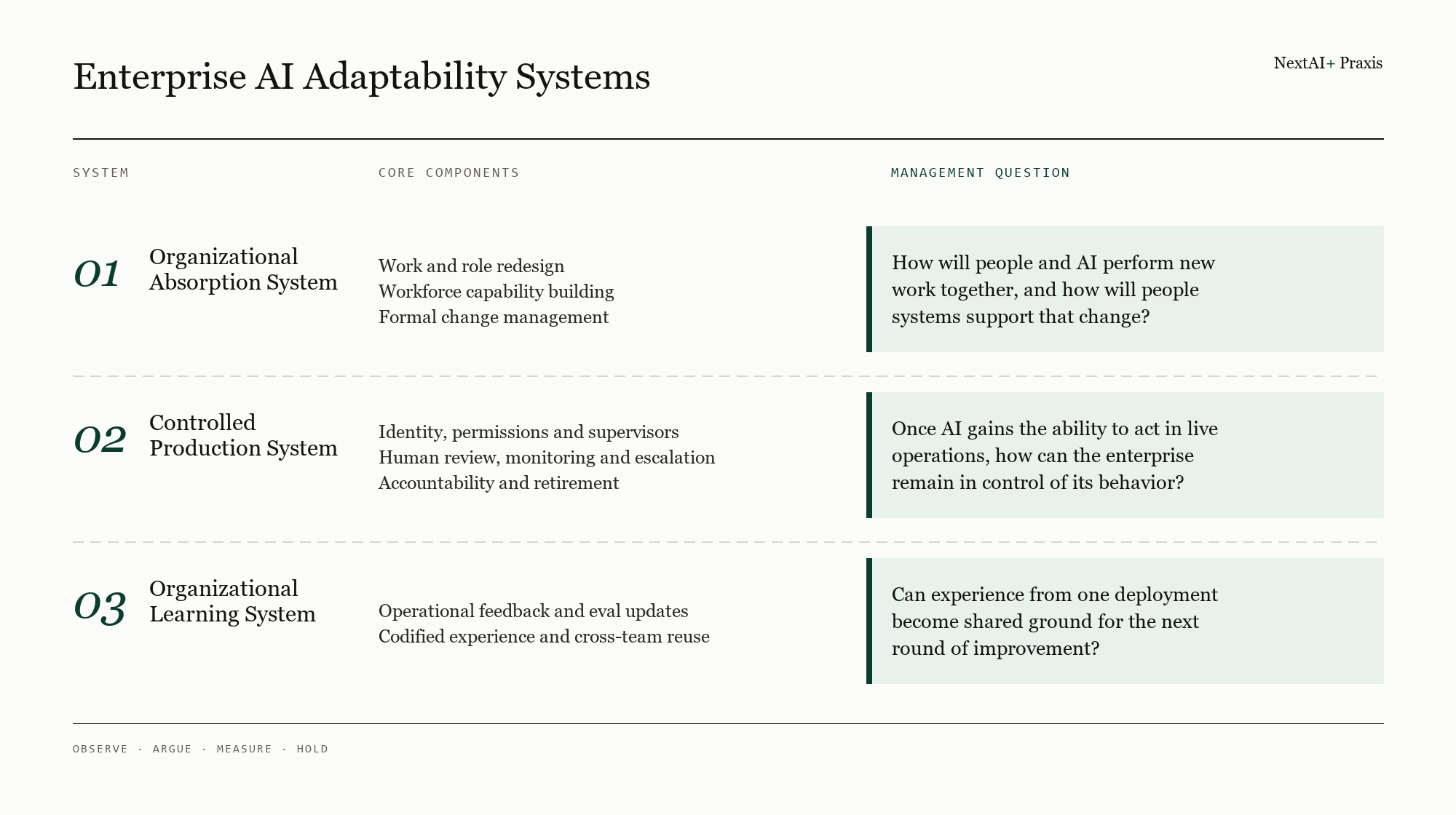
These three systems form the Enterprise AI Adaptability Framework that this article synthesizes from the two reports. They do not wait for one another to reach completion; they influence one another throughout deployment. The Organizational Absorption System determines whether the enterprise can design a workable division of labor between people and AI. The Controlled Production System carries those arrangements into live operations and leaves evidence that can be inspected. The Organizational Learning System then feeds successes, errors, and human judgment back into role design, capability building, and management practice. The result is a continuing cycle, rather than a change program that ends at go-live.
A framework of this kind still has to be tested against the realities of an operating enterprise. In NextAI+ Praxis research on enterprise AI deployments worldwide, Bank of New York Mellon (BNY) provides a comparatively complete case through which to examine it.
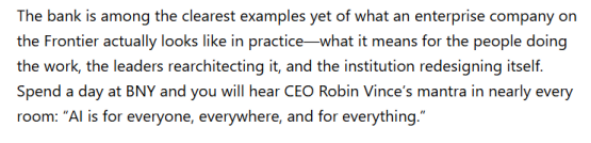
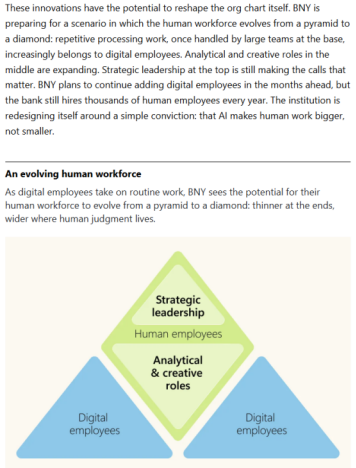
Microsoft describes BNY as one of the clearest current examples of a Frontier Firm in The Making of a Frontier Firm: How AI Is Redesigning Work at BNY. BNY has built an enterprise AI platform, Eliza, and introduced AI into payments, reconciliation, contract review, and client onboarding. By mid-2026, the company had publicly reported close to 140 “digital employees.” They have login credentials, employee IDs, and designated managers, and work alongside human employees within the enterprise governance framework. BNY has also begun adjusting employee capabilities, job content, and management practices around them.
Kyndryl has not publicly identified BNY as a Pacesetter in its survey, and the available evidence is insufficient to show that BNY meets every Pacesetter criterion. The two reports nevertheless provide a useful combined lens: after digital employees enter production, how does BNY adjust work, roles, and employee capabilities at the same time? How does it place AI within identity, permission, and managerial-accountability structures? And can it turn experience generated in live operations into capabilities that the enterprise can continue to use? Following the three systems through BNY’s case helps us see both what an enterprise at the front edge of AI deployment has already built and which organizational elements still require further development.
Organizational Absorption System | BNY works on roles, capabilities, and management mechanisms together
BNY begins by allowing employees’ work to change as AI enters the workflow. When selected tasks move to AI, the enterprise has to reallocate the work employees retain, build the capabilities required by their new responsibilities, and use formal change management to extend these adjustments across more teams.
Human work and role redesign begin with one concrete workflow
In The Making of a Frontier Firm: How AI Is Redesigning Work at BNY, Microsoft notes that BNY calls agents that execute defined tasks, receive assignments from human managers, and submit their outputs for review “digital employees.” The payments team’s first dedicated digital employee was given a deliberately limited task: read the supplier address in a cross-border transaction, call a mapping API to identify the country, validate the country code, and submit the corrected payment information for employee review.
The deployment addressed thousands of manual interventions handled by the payments team each day. Employees previously had to resolve missing country codes, malformed addresses, and routing-field exceptions. Traditional automation also required engineers to write rules step by step and maintain them across complex systems. After the digital employee was introduced, a payment validation that had taken five or six minutes could be completed in under 30 seconds, while outstanding payment investigations fell by almost 80 percent.
Employees’ work changed with the process. Team members who had long spent their time repairing payment exceptions manually began devoting more attention to identifying patterns in data quality, comparing data performance across clients, contributing to client-strategy discussions, and helping design and test new AI tools. This change reflects two central requirements of role redesign: rework the workflow around AI, then reassign tasks and decision rights between people and AI. AI performs repetitive validation; employees retain responsibility for reviewing results and handling exceptions, while moving toward work that requires more analysis, judgment, and business experience.
The capabilities employees need should follow the work that has changed
Once employees move from manually resolving exceptions to reviewing AI outputs, analyzing data patterns, and improving processes, general AI literacy is only a starting point. They also need to understand where AI is appropriate in the specific business context and know how to check results, report problems, and validate prototypes. BNY therefore introduced a 40-hour AI bootcamp completed during paid work time. Since its launch in April 2025, about 2,300 employees have graduated. Each participant must identify a real problem in their own business area and build a working AI prototype by the end of the program.
In Unlocking Value with BNY’s Enterprise AI Platform, published on October 20, 2025, BNY also reported that it was establishing role-based AI learning paths. Its problem-driven bootcamps bring business, technology, and other relevant functions together to develop deployable minimum viable products around priority use cases. Employees begin to participate in use-case identification, prototype building, and outcome validation, then carry issues discovered in use back into workflow design. These arrangements address a core requirement of people readiness: capability building must be linked to changes in the job and give employees practical experience in the new way of working.
A new division of labor between people and AI must enter formal organizational management
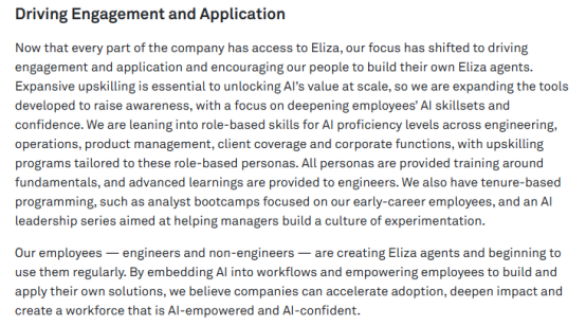
As AI reaches more teams, BNY is using executive communication, peer learning, and internal practitioner networks to spread concrete experience. Frontline managers also need to bring business, technology, and risk specialists into the same discussion, encourage employees to experiment, and feed problems discovered in use back into adjustments to roles and workflows. Changes in work therefore move beyond a small number of projects and become part of team collaboration and managerial responsibility.
BNY’s developing Digital Employee Agency goes further by incorporating the division of labor between people and AI into workforce-allocation decisions. Managers can use it to determine how a task should be divided among human employees, external contractors, and AI, and to establish corresponding onboarding, evaluation, and retirement mechanisms. This is the work of formal change management: the new operating model enters managerial responsibility, cross-team coordination, and workforce-allocation systems, becoming less dependent on isolated projects and a small number of employees.
BNY offers concrete practices in role redesign, employee capability building, and formal change management, although the public materials do not fully disclose changes to performance systems, workforce allocation, or career-transition mechanisms. Based on what is available, BNY has redesigned roles around real work, trained employees for the resulting responsibilities, and used formal change management to extend new ways of working across more teams. Together, these practices show a substantive capacity for organizational absorption. The coverage and maturity of the supporting systems will require further public evidence to assess.
Controlled Production System | Identity, permissions, and accountability keep AI controllable in production
Once AI can call tools, read and write systems, and advance business processes, the enterprise has to control it as a production participant capable of taking action. Microsoft’s 2026 Work Trend Index Annual Report argues that IT should treat agents as “managed entities” with identities, permissions, policy enforcement, and lifecycle management, while security teams embed monitoring and auditability in the system. Kyndryl’s 2026 People Readiness Report: Beyond AI Adoption further emphasizes human oversight, escalation thresholds, AI-system registration and monitoring, and accountability after errors.
This article brings those requirements together as a Controlled Production System. The enterprise needs to know which AI is acting, how far it may advance a task, who supervises it, and how it will be corrected or retired if performance falls short. BNY gives this system a more concrete form.
Every AI system that enters production needs an identifiable identity and a responsible human
Microsoft reports in The Making of a Frontier Firm: How AI Is Redesigning Work at BNY that BNY uses a 16-step governance process—including review committees, compliance gates, and model-risk assessment—to move AI ideas into production. After the required reviews, a digital employee must also enter live business operations in a form the enterprise can identify.
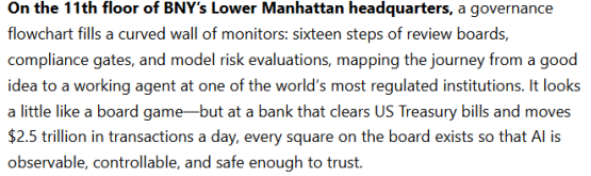
By the publication of Microsoft’s case in May 2026, BNY had deployed close to 140 digital employees internally. Each has separate login credentials and an employee ID in the corporate directory, and each is assigned work and reviewed by a human manager. These arrangements link a digital employee’s actions to a specific identity and responsible person. When an exception occurs, managers can determine what acted, who should investigate, and where the relevant record belongs.
The approach makes Microsoft’s concept of the managed entity concrete and gives effect to Kyndryl’s emphasis on accountability: AI in production needs a traceable identity, and each action needs an identifiable owner.
Task boundaries and human approval determine how far AI may act
Identity and supervision answer only the question of who is acting. The enterprise must still determine which steps AI may complete independently. The payments digital employee described above can read the supplier address in a cross-border transaction, call a mapping API to identify the country, and validate the country code, but the corrected payment information must still be submitted to an employee for review. AI handles repetitive validation; the final outcome remains subject to human judgment.
BNY uses a similar design for client payment inquiries. When a client emails to ask why a transfer has not settled, a digital employee can read the message, assess its urgency, retrieve records from several internal systems, and draft a reply in an appropriate tone. The reply then enters a review queue for a human manager to check before deciding whether it should be sent. AI can process a task continuously across several systems, but it cannot independently complete the final client communication.
This arrangement reflects a shared requirement in the two reports: AI autonomy should be bounded by task risk, while people retain responsibility for approving and using consequential outputs.
Performance management and retirement mechanisms must follow AI into production
Microsoft treats monitoring, auditability, and lifecycle management as infrastructure for agents operating at scale. Kyndryl likewise identifies centralized registration and monitoring of AI systems, human oversight, and accountability for errors as signs of governance maturity. The two reports therefore converge on the same question: after AI enters production, how will the enterprise continue to judge its performance, decide whether it still fits the task, and determine when it should be adjusted or retired?
BNY’s human managers can use real-time dashboards to view digital employees’ volume, cycle time, missed transactions, and approval outcomes. When the payments team sees reviewers reject certain responses, it investigates why. Some rejections come from employees continuing to follow old work habits; the team then adjusts the human–AI operating model through coaching, recalibration, and training. Operating records become common evidence for identifying both system problems and workflow friction.
This continuous management extends across the digital employee’s lifecycle. BNY’s Digital Employee Agency is intended to bring onboarding, performance scoring, and structured retirement into a formal process. Managers can judge whether a digital employee still fits its current task, whether its performance needs adjustment, and when a new version should replace it. The result is a continuous record from organizational entry through evaluation to retirement, allowing the enterprise to maintain control throughout actual use.
BNY has therefore assembled a comparatively complete Controlled Production System around identity, accountability, action boundaries, and continuous oversight. AI with the ability to act can enter real business processes under defined rules and clear human responsibility.
Organizational Learning System | Make one deployment the starting point for the next
BNY begins by making experience from one deployment portable beyond its original project, so that other teams and the next round of application development can use it. Successes, errors, and human corrections in production need to be recorded and then converted into reusable solutions and working methods through a shared platform, experience exchange, and business participation.
Operating feedback has to become a problem that can be worked on again
As noted above, BNY’s payments team uses real-time dashboards to observe digital-employee outcomes and investigate why human reviewers send certain outputs back. A return may indicate that the output needs adjustment, or it may reveal that employees are still following an earlier way of working. The team uses that evidence for coaching, recalibration, and training, allowing operating records to change both the system and the human–AI operating model.
This is the raw material of organizational learning. The enterprise needs to retain where AI succeeds, which results people modify, whether a problem comes from the system or the workflow, and what changed after an intervention. Only when experience can be identified and explained can later teams use it to improve their own applications.
A shared platform allows one team’s method to become another team’s starting point
BNY explains in Unlocking Value with BNY’s Enterprise AI Platform that Eliza was designed from the outset as an enterprise platform. Employees can work with different models under a shared data, risk, legal, and compliance framework, then build AI applications around their own business needs. BNY argues that this platform approach reduces duplicate investment in similar tools and supports the internal sharing of tools, proven practices, and solutions.
Eliza therefore serves as both technical infrastructure and a carrier of experience. A tool, development method, or control requirement validated by one team can be retained for others to use. Most AI builders now come from outside engineering, which also allows employees in payments, operations, product, client service, and other business functions to turn their process knowledge into applications. Experience no longer remains concentrated in the technology organization.
This pattern meets a further requirement in Microsoft’s Frontier Firm: experience gained by individuals and teams through AI use has to become knowledge the organization can call on repeatedly. The enterprise can then build on capabilities it already has and reduce the distance other teams must travel from identifying a problem to forming a workable solution.
When business experience keeps producing new applications, deployment becomes a learning loop
BNY places a shared AI access point, role-based learning, problem-driven bootcamps, hands-on development, gamified activities, and practitioner communities within one enablement model. Employees can move from first exposure to building applications around real problems, then carry practical experience back into the organization.
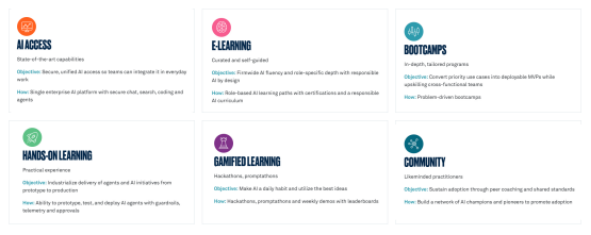
The six mechanisms operate in parallel and reinforce one another. AI Access provides a shared enterprise entry point. E-learning establishes baseline fluency and role-specific depth. Bootcamps and Hands-on Learning turn business problems into testable, deployable solutions. Gamified Learning and Community spread practical experience through demonstrations, peer coaching, and shared standards.
These mechanisms also allow business employees to become builders of AI applications. BNY reports that most AI builders now sit outside engineering. Employees can identify problems in familiar workflows, build agents on Eliza, and make the methods and solutions developed through use available to other teams. Organizational learning enters live business activity, while knowledge dispersed across roles begins to become an enterprise capability that others can continue to use.
Microsoft also reports in The Making of a Frontier Firm: How AI Is Redesigning Work at BNY that BNY is exploring a new workflow tool. An employee can record an existing process; Eliza analyzes the steps, identifies inefficiencies, and generates initial work instructions for a digital employee. The tool remains exploratory, but it indicates how organizational learning may develop further: employees’ practical experience of work can be converted into a process description and an application prototype, then moved into testing and operations.
BNY is gradually forming a learning loop that can continue to run:
REAL BUSINESS PROBLEM → LEARN & BUILD → RUN THE APPLICATION → FIND & FIX ISSUES → SHARE & REUSE EXPERIENCE → CREATE THE NEXT APPLICATION
The shared Eliza platform, AI builders distributed across business functions, and continuing mechanisms for development and exchange already connect production feedback with the next round of application building. At BNY, the experience created by one deployment can become the starting point for another.
Two management maps for AI deployment: how the project advances, and how the organization keeps pace
In Issue 12, From a 300-Person Trial to 98% Team Adoption: Morgan Stanley’s Five Steps for Taking AI into Production, we followed the development of one AI application through use-case selection and demo, proof of concept, limited pilot, pre-production assessment and acceptance engineering, and formal launch with continuous operation. The stages unfold in project order. Each step introduces a new question: Is the use case worth the investment? Is the technology feasible? Can the system work in a real environment? Are the conditions for production in place? And can it continue operating after launch?
When management needs to decide whether a specific project should proceed, pause, or return to an earlier stage, the five-step framework is the more direct tool. It locates the project, tests whether the evidence supports the next decision, and prevents a smooth demonstration from being mistaken for production readiness. In simple terms, the framework views deployment from the application side and manages the path of a specific use case from concept to production.
The three systems introduced in this issue widen the lens to the enterprise organization. The Organizational Absorption System looks at how employees’ work changes as AI enters workflows. The Controlled Production System keeps AI with the ability to act within explicit boundaries. The Organizational Learning System carries experience from actual use into the next round of improvement. These systems have no fixed sequence and do not emerge automatically after one project goes live. As deployment expands, all three need continuing adjustment and must support more applications entering the business together.
When management is advancing several AI projects at once—or sees projects reach production but fail to scale—the three systems provide a more useful organizational check. The common constraint may be that roles and capabilities have not caught up, that operating accountability remains unclear, or that other teams are rediscovering a problem one team has already solved. Pushing each project forward in isolation will not remove those shared constraints. Management must examine whether the organization itself can absorb the next round of deployment.
The two frameworks can also be used together. Management can use the five stages to set the review cadence for an individual project and check the three systems whenever the project is about to expand its users, data, or authority to act. During a limited pilot, employee tasks and review responsibilities should become increasingly clear. As production approaches, AI identity, permissions, and exception handling need to enter formal operations. After launch, feedback and corrections should become experience that other teams can use. The systems should deepen as the project advances. They need not be complete at the demo stage, but they cannot wait until after go-live to begin.
The five deployment stages answer, “What should happen next in this project?” The three organizational systems answer, “Can the enterprise absorb the project’s next step?” The first takes a use case into production on the strength of evidence; the second enables the organization to absorb the change created by deployment. Used together, the two maps help an enterprise advance specific projects while building the capacity to deploy AI repeatedly.
Further reading
The following public sources and previous NextAI+ Praxis articles were cited or are recommended for further reading. Publication dates and external links follow the official sources.
Core Reports
- Microsoft, 2026 Work Trend Index Annual Report: Agents, Human Agency, and the Opportunity for Every Organization, published May 5, 2026; accessed August 5, 2026. A useful overview of Frontier Firms, human–AI collaboration, organizational learning, and agent governance.
- Kyndryl, 2026 People Readiness Report: Beyond AI Adoption, published June 25, 2026; accessed August 5, 2026. Useful for understanding role redesign, workforce capability building, formal change management, and governance practices among Pacesetters.
BNY Case Materials
- Microsoft WorkLab, The Making of a Frontier Firm: How AI Is Redesigning Work at BNY, published May 12, 2026; accessed August 5, 2026. Covers BNY’s payments digital employee, changes in employee roles, AI bootcamps, production-governance process, and digital-employee lifecycle management.
- BNY, Unlocking Value with BNY’s Enterprise AI Platform, published October 20, 2025; accessed August 5, 2026. Covers the Eliza platform, employee AI learning mechanisms, business participation in application development, and the internal sharing of tools and experience.
NextAI+ Praxis Archive
- NextAI+ Praxis, Deep Reads, Agents, Human Agency, and the Opportunity for Every Organization, 2026. A systematic reading of Microsoft’s 2026 Work Trend Index Annual Report, with a focus on employee capabilities, organizational absorption, organizational learning, and agent governance.
- NextAI+ Praxis, Deep Reads, Beyond AI Adoption: People Readiness, Work Redesign, and the Enterprise’s Second Readiness Test, 2026. A systematic reading of Kyndryl’s 2026 People Readiness Report, with a focus on people readiness, role redesign, change management, and the organizational practices of Pacesetters.
- NextAI+ Praxis, Enterprise AI Deployment Signals Weekly, Issue 12, From a 300-Person Trial to 98% Team Adoption: Morgan Stanley’s Five Steps for Taking AI into Production, 2026. Breaks down use-case selection and demo, proof of concept, limited pilot, pre-production assessment and acceptance engineering, and formal launch with continuous operation. Read it alongside the three organizational systems proposed in this issue.
Cite as · Enterprise AI Deployment Signals · 2 September 2026