
Many businesses have already put considerable thought into marketing to attract more customers. Their websites have been refined repeatedly to explain their products and services more clearly; accumulated customer case studies have been organized to help prospective customers build trust; advertising and content updates have continued, with the aim of helping more people with relevant needs find them. These efforts follow a familiar path to customer acquisition: once customers have a need, they search online for relevant products or services, discover a business, learn more about what it offers, and gradually develop a specific intention to buy as they compare their options. Along this path, managers naturally focus on whether the website is attracting more visits, whether product descriptions are persuasive enough, and whether inquiries ultimately turn into orders.
However, as the NextAI+ Praxis team continues to track signals of enterprise AI adoption and business practices, we have noticed a change worth watching: some customers have begun using AI to find and compare products. They give AI their requirements, budgets, and conditions of use, asking it to help work through solutions and compare options before deciding which sellers to explore further. For these customers, initial product research and shortlisting are extending into AI conversations. Whether businesses receive subsequent visits and inquiries is also beginning to be influenced by this stage.
For businesses selling products or services, this creates a situation that is easy to overlook: a product may meet a customer's requirements, and the website may describe it thoroughly, but its relevant strengths may not be accurately represented in comparisons developed with AI assistance. Once omitted at this stage, the customer may continue exploring other shortlisted options, before the business has even had an opportunity to introduce itself. The product and service information that businesses have carefully prepared needs an opportunity to be seen and accurately understood when customers use AI to explore their options.
Among the signals we are seeing, some retailers have already begun adjusting. In August 2026, Google's Think with Google platform interviewed Paul Toms, chief marketing officer of U.S. home retailer Wayfair, in “How Wayfair stays on the leading edge of AI Search”. He discussed continuously enriching and validating product information, and advised brands to check whether their web pages can be readily read by agents searching for products on users' behalf. That same month, U.S. software company Adobe released its “AI Traffic Trends Report”, which also documented changes in consumers' use of AI for shopping and in AI referrals to U.S. retail websites. These developments suggest: in the AI era, competition for customer acquisition has moved ahead of the customer's visit—businesses need to work to be seen and understood while customers are using AI to compare solutions and shortlist sellers.
Customers Use AI to Compare First, Moving Business Competition Earlier
An Adobe survey of more than 5,000 U.S. consumers conducted in July 2026 found that 42% of respondents had used AI assistants for online shopping. The same report's analysis of U.S. retail websites also showed that, in July 2026, AI-driven traffic to retail websites grew 62% year over year. The first set of figures reflects whether consumers have tried this way of shopping, while the second records changes in the visits it directs to retail websites.
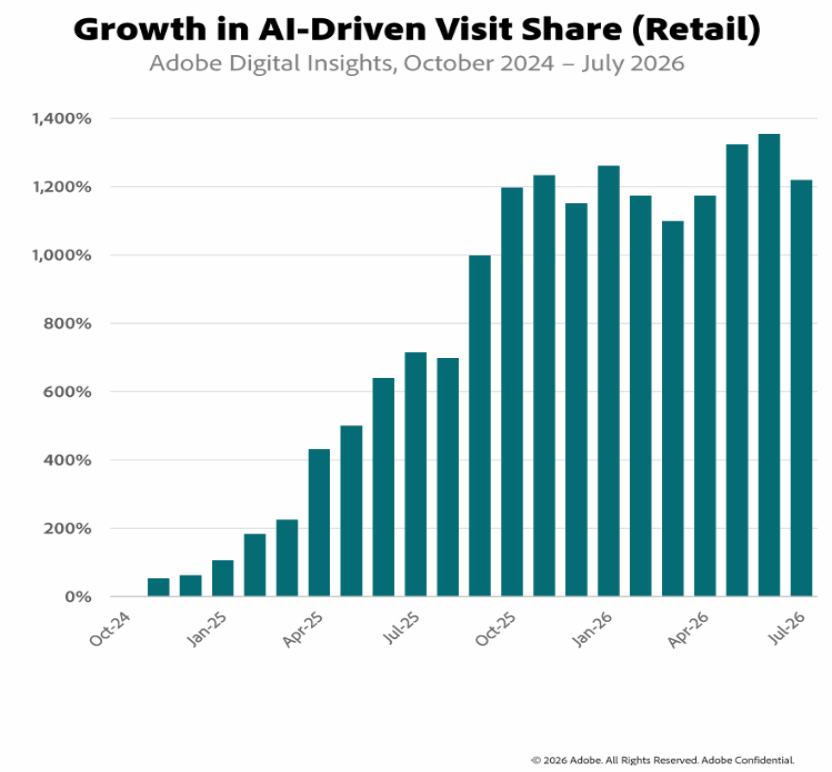
A specific purchase journey can help explain this way of shopping. With furniture, for example, a customer may initially know only that they need a desk suitable for a small space, without knowing which specifications to focus on. Through conversation, AI can help translate room size, everyday use, and budget into clearer purchase criteria, then find relevant products and compare dimensions, features, and prices. As the customer adds delivery location and installation requirements, the available options can be narrowed down further.
In this process, AI participates in two connected tasks: helping customers clarify their purchase criteria, then organizing product comparisons around those criteria. AI can help organize some of the information that customers would otherwise need to find, record, and compare across pages. For example, two desks may have similar listed prices, but different delivery areas, installation fees, and arrival dates, allowing the customer to ask follow-up questions about the actual purchase conditions and determine which is more suitable. By the time a product comes into the customer's view, it may already be accompanied by explanations of its suitability, strengths, and limitations.
Traditional search, e-commerce platforms, and other channels still play a role in customer decisions. What AI adds is a connection between clarifying needs, integrating information, and comparing products within a conversation that allows continued follow-up questions. Along this purchasing path, how AI understands a business and its products is beginning to influence which options customers see, and how they perceive those options.
Helping AI Understand Products Requires More Specific, Complete, and Credible Information
To support such comparisons, a business's public materials need to provide sufficiently specific business information. “High quality” “Fast delivery” “Comprehensive service” can convey the image a business wishes to project, but on their own they provide little basis for judging whether a product meets a particular need. Taking “Fast delivery” as an example, the areas covered, typical lead times, differences between in-stock and custom products, and whether installation is included are the conditions needed for further comparison. Businesses need to translate broad statements of their strengths into product and service descriptions with defined scopes and specific conditions.
This information also needs clear, stable public access points, and must remain consistent across locations. Product pages, service descriptions, and FAQs can each have a different focus, but conflicting versions should be avoided when they refer to the same specification or commitment. Dimensions may have been changed while old descriptions remain; delivery coverage may have changed while other pages have not been updated, and external AI searches may therefore encounter different answers. For businesses, maintaining accurate and consistent information is a foundational task in helping their products be understood correctly.
Beyond specific descriptions, businesses can use evidence-based content to explain how their capabilities work in practice. Customer case studies can describe the problems a project faced, the products or services used, and the conditions under which they apply; technical explanations can describe why a design suits a particular setting, and which limitations need to be considered in use. Compared with repeatedly claiming “extensive experience”, these materials offer a more substantive basis for judgment, and make it easier for customers to follow the sources in AI answers to verify information further.
The industry often uses terms such as GEO (generative engine optimization) and AEO (answer engine optimization) to describe how business information appears in AI answers. This work overlaps considerably with SEO (search engine optimization): ensuring that web pages can be retrieved, and that content is clear and accurate, are important foundations. In “Optimizing your website for generative AI features on Google Search”, Google Search Central explicitly states that its AI search is built on existing search ranking and quality systems, and that the relevant optimization remains SEO; Bing, while also emphasizing SEO foundations, uses GEO to describe optimization for content's inclusion in AI answers, and provides tools to help businesses see how their pages are cited. Specifically, businesses can continue to use SEO to improve how their websites appear in search results, tracking whether customers can find them and whether they click through to the website; at the same time, in the AI answer contexts that GEO and AEO address, they can check whether the business or its products are mentioned, whether descriptions are accurate, and whether relevant pages are cited. Both types of work can draw on existing website and content foundations, while separately observing performance in search results and representation in AI answers, and making improvements accordingly.
Different platforms' retrieval and display mechanisms need to be observed separately, but businesses can begin by improving the information foundations they provide: whether product conditions are complete, whether important explanations are easy to find, and whether key commitments are supported by evidence. This turns preparation for AI-driven customer acquisition into a specific task—organizing the business's actual product capabilities and service conditions into public materials that can be retrieved, understood, and verified.
Wayfair's Preparation Begins with Helping a Vast Product Catalog Be Understood Accurately
For retailers with extensive product catalogs, explaining information clearly is itself an ongoing operational task. Wayfair's example shows that this preparation already extends to the richness and accuracy of product information.
In the Think with Google interview, Wayfair's chief marketing officer Paul Toms explained that Wayfair's catalog contains more than 40 million items. Wayfair uses AI to enrich and validate product information: on the one hand, it uses AI to provide fuller product information, making it easier for search systems to understand product features and match them to customers' specific requirements; on the other, the company is testing Gemini to check the consistency of dimensional information, comparing text descriptions, images, and supplier-provided measurements for the same product to identify conflicting descriptions or values. Other AI quality assurance tools are also used to cross-check product data.
This dimension check also addresses a specific operational problem in home retail. Toms noted that, for many large items, not fitting through the front door is the leading reason for returns. Product information therefore needs to help customers judge whether furniture will fit in a room and whether it can be brought into the home. Checking text, images, and supplier data together helps identify information conflicts that may affect these judgments, connecting dimension validation to practical delivery difficulties.
Beyond information maintenance, Toms also explained that the company uses an experimentation platform to test new approaches within days or weeks, identifying both attempts that deliver incremental growth and directions that do not. This continuous testing provides a basis for deciding whether marketing approaches warrant further investment.
Wayfair's example thus offers businesses two complementary lessons: use AI to expand the coverage of product information maintenance, while testing the actual value of marketing approaches through experimentation. Ensuring that more products have sufficient, accurate information is part of preparing for customer acquisition; which new ways of reaching customers deserve continued investment still needs to be answered by business results.
Small and Medium-Sized Businesses Can Start with a Set of High-Intent Purchase Questions
Wayfair deals with a vast product catalog and a complex supplier network. Businesses with limited resources can narrow their starting point to one core product or service, and a set of real purchase questions. Here we suggest a lightweight approach: follow the customer's journey from comparing products to contacting the business, identify gaps in existing information, then observe performance after revisions.
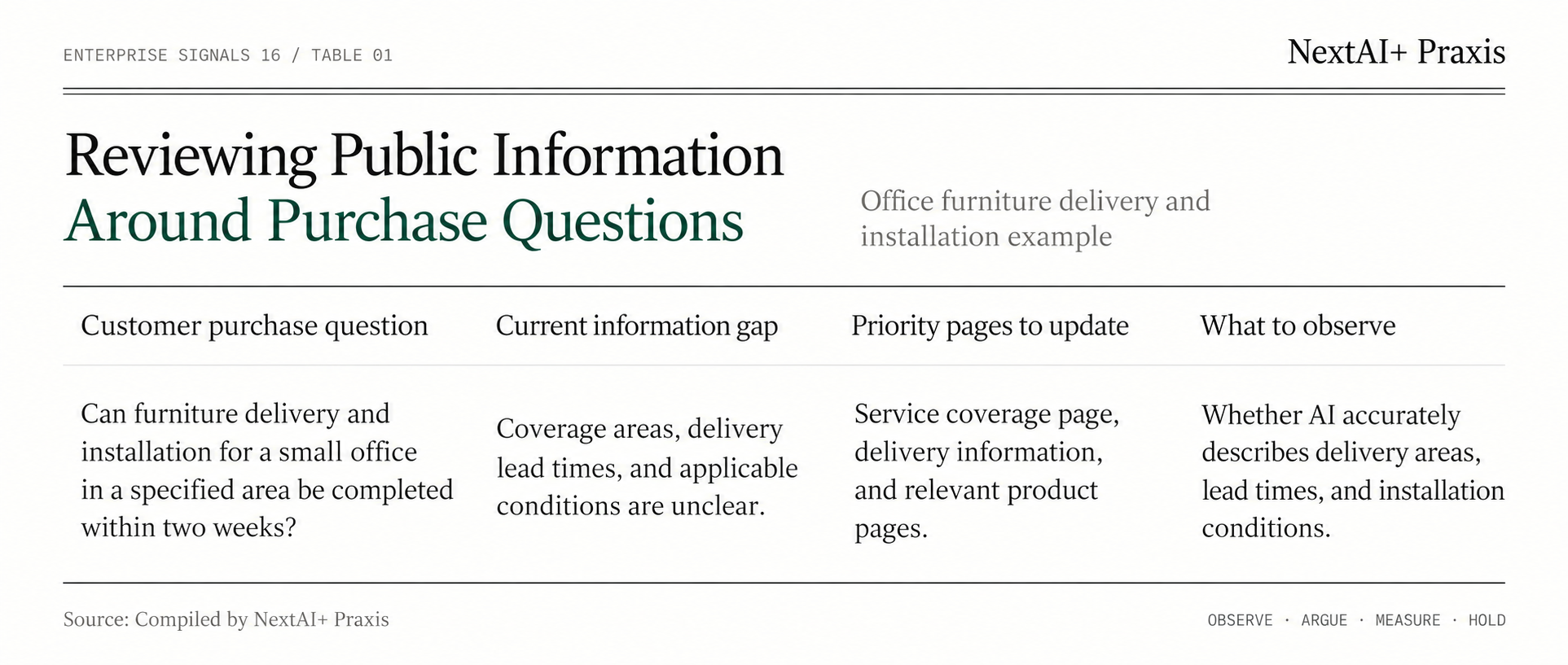
Purchase questions can first be drawn from existing sales conversations. What do customers usually need to confirm before deciding to request a quote? Which conditions most often cause hesitation, and which misunderstandings require repeated explanations from salespeople? These questions already contain purchase intent, and are closer to the opportunities businesses hope to capture than generic tests such as “recommend a few good businesses”.
After compiling the questions, check whether the website, product materials, and public business pages provide consistent, complete answers. If delivery lead times exist only in salespeople's verbal explanations, service coverage is scattered across different versions of materials, or case studies list only customer names without describing the applications, these information gaps can be addressed first. Public content should reflect the business's actual capabilities, and materials involving customer projects and feedback also need appropriate authorization for use.
Next, conduct a small-scale review using real questions on platforms that target customers are likely to use, recording the date, the conditions specified in the question, whether the business or product appears, whether the description is accurate, and which sources the answer cites. The review should include errors and omissions: a business being mentioned but described as offering services it does not provide also requires attention. AI answers vary by platform, question, and time, so keeping records helps identify recurring problems.
Finally, use these records to correct information the business can control, and continue updating it in light of subsequent inquiries. This leaves a list of information improvements organized around purchase questions, and a set of observation records that can be reviewed. Businesses can use these to assess which adjustments resolved real information barriers, then decide whether to extend the work to other products and services.
After Making the Recommendation List, Opportunities Still Need to Become Real Business
Whether the new channel warrants investment ultimately depends on what happens after customers arrive at the website. Adobe's report shows that, in July 2026, across the U.S. retail websites it analyzed, AI-referred visitors converted at a rate 60% higher than non-AI visitors, meaning the former's conversion rate was approximately 1.6 times the latter's.
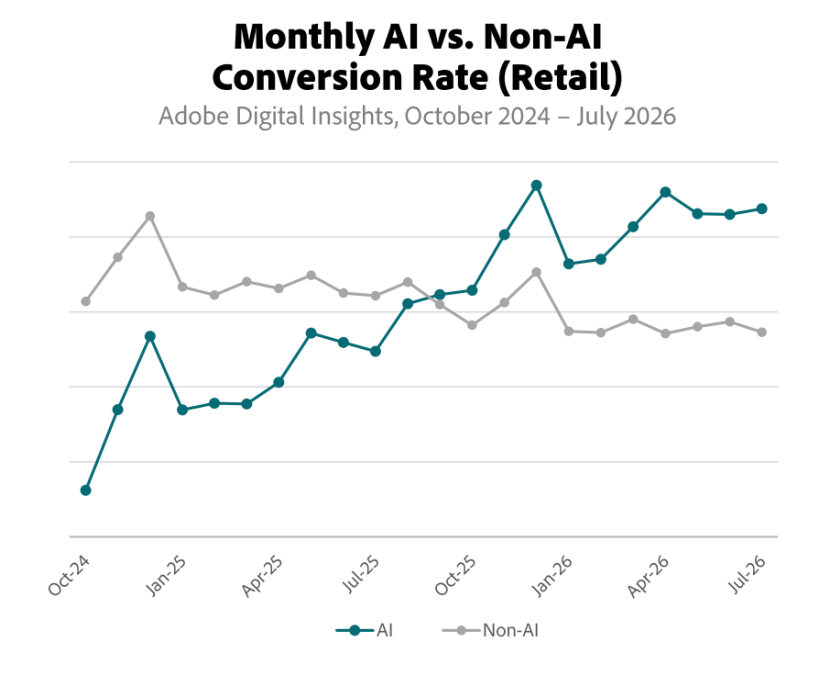
These market observations make AI-referred traffic worth tracking carefully. For an individual business, visits from AI, qualified inquiries, and subsequent quotes and sales can be recorded separately. Qualified inquiries should come from customers with reasonably clear needs, who fall within the business's service scope and are willing to continue the conversation, so customer acquisition effectiveness cannot be judged solely by visits or inquiry counts. Where technical records allow, referral links can be tracked; for inquiries that cannot be attributed accurately, a brief question can help establish how the customer found the business, while retaining an unknown-source category.
Improvements to public information therefore need to connect with how customers are served afterward. When customers follow a recommendation link to a page, they should be able to go directly to the product or service they were interested in, verify key conditions, and move smoothly into an inquiry or purchase. If a recommendation points to a broad, cluttered homepage, customers must search for the product again; if delivery commitments differ from the actual quote, the trust formed earlier may also be affected. Only when the new channel connects to a complete customer experience can the opportunity continue toward a sale.
Meanwhile, businesses still need to manage their own brands, websites, and direct customer relationships. After customers discover a business through AI, the business remains responsible for specific quotes, professional explanations, delivery, and service. Owned channels provide a stable place to verify these commitments, while direct communication helps businesses understand why customers choose them, why they walk away, and what to improve next time. AI creates new opportunities to reach customers, and businesses need to turn those opportunities into customer relationships they can continue to develop.
Further Reading
This article cites or draws on the following publicly available articles and reports, for readers wishing to learn more about how AI affects customers' product research, seller shortlisting, and purchase decisions, and how businesses can improve public information, monitor AI citations, and respond to new customer acquisition opportunities:
- Think with Google, Google's marketing insights platform, “How Wayfair stays on the leading edge of AI Search”, August 2026. Through an interview with Paul Toms, chief marketing officer of U.S. home retailer Wayfair, the article explains how the company uses AI to enrich product information and validate dimensions, and tests the actual effectiveness of marketing investment through ongoing experimentation, providing a case study for businesses preparing for AI search and agentic shopping channels.
- Adobe Digital Insights, part of U.S. software company Adobe, “AI Traffic Trends Report: August 2026”, August 19, 2026. Combining U.S. website visit data with consumer surveys, the report analyzes AI's role in shopping research, referrals, and purchase conversion, and is the main data source for this article's discussion of consumers' use of AI for shopping, growth in AI-referred retail traffic, and conversion performance.
- Google Search Central, “Optimizing your website for generative AI features on Google Search”, published in May 2026. The guide explains the relationship between Google's generative AI search and its existing search ranking and quality systems, emphasizes that SEO foundations still apply, and offers guidance on content value, technical accessibility, and page experience, helping businesses understand how to prepare websites and public information for AI search.
- Microsoft Advertising, Microsoft's advertising platform, “Optimizing Your Content for Inclusion in AI Search Answers”, October 8, 2025. While emphasizing traditional SEO foundations, the article discusses how clear content structure, specific factual descriptions, and explicit meaning help AI understand and select web content, providing guidance for businesses improving product pages, FAQs, and technical explanations.
- Microsoft's official Bing blog, “Introducing AI Performance in Bing Webmaster Tools Public Preview”, February 10, 2026. The article explains how businesses can view citation counts, cited pages, and trends for their website content across Microsoft Copilot, Bing AI summaries, and selected partner platforms, providing a tool reference for observing whether public information appears in AI answers and identifying directions for further content improvements.
Cite as · Enterprise AI Deployment Signals · 21 October 2026