
—An Interpretation of Kyndryl’s “2026 People Readiness Report”
Once AI Enters Core Business Processes, Organizational Capacity Determines How Far It Can Go
Kyndryl opens its “2026 People Readiness Report” (2026 People Readiness Report) with the observation: “Artificial intelligence has ushered in an era of extraordinary possibility.” In a growing number of enterprises, that possibility has moved from early experiments to observable progress. AI is helping employees complete everyday tasks and is gradually entering enterprise knowledge, processes, and decision-making. Leaders’ expectations for AI are changing accordingly: productivity gains remain important, while innovation, growth, customer service, and core business performance are also becoming objectives of AI strategy.
This change has unfolded through a gradual process of deepening adoption. Generative AI assistants were initially invoked mainly by employees to search for information, summarize content, generate text, and support analysis. Employees posed questions, checked the output, and then decided how to use it; even as these tools were connected to enterprise knowledge bases and office systems, AI’s primary role remained the provision of content and decision support. The first thing to change was the speed and manner in which individuals and teams completed tasks.
AI agents then acquired the ability to act. They can complete multistep tasks around an objective, call tools or APIs, read from and write to business systems, and continue acting on intermediate results. As AI moves from providing answers to advancing a process, a single deployment may span multiple systems, roles, and decision points, while the consequences of errors and permissions expand along the workflow. Employees need to understand their work anew; management needs to adjust roles, performance measures, and resource allocation; and governance teams need to revisit questions of access, oversight, and accountability. These organizational changes usually take longer to form and are more likely to expose gaps in skills, processes, and risk controls as deployment expands.
Kyndryl calls this gap the “people readiness gap.”
“People readiness” here includes both whether employees can collaborate with AI and whether roles, processes, performance measures, and accountability mechanisms have changed with deployment. For example, when AI begins to handle information organization and preliminary analysis, employees need to know which results must be reviewed, which exceptions must be escalated, and how their own judgment and responsibilities will change.
The enterprise survey shows that 57% of respondents say AI has been widely deployed or embedded in core business processes, and 77% say generative AI has been scaled across multiple functions. At the same time, only 23% of leaders believe their current workforce is ready for AI, down 6 percentage points from the previous year; 79% of surveyed leaders worry that AI will advance faster than their workforce, governance systems, and operating models can adapt.
These figures reveal the signal on the workforce side that deserves the most attention today: enterprise AI deployment is creating a pronounced difference in speed. Tool capabilities, autonomous permissions, and technology investment continue to advance, while people readiness, work redesign, and governance mechanisms are still catching up. The number of processes that tools can enter no longer explains, by itself, how much value an enterprise can obtain from AI. An organization’s ability to understand, absorb, and manage these changes is beginning to determine how far AI can ultimately go.
More specifically, we believe:
- As the scope of AI deployment expands, efficiency gains appear first; higher-value outcomes still depend on organizational capacity. Tools can quickly change local tasks, but innovation, revenue growth, and changes in business models require roles, processes, and collaboration mechanisms to be updated in concert.
- People readiness needs to become part of AI investment itself. Skills inventories, role redesign, change management, and career-transition arrangements together determine whether an enterprise can convert tool use into stable execution capability.
- The expansion of autonomous authority is pushing governance into the production environment. When AI can read from and write to core systems, participate in customer interactions, and make important decisions, boundaries, oversight, escalation, and accountability need to enter the operating mechanism along with the system.
- Pacesetters lead because of their order of execution and continued adjustment. They redesign work first, then establish formal change mechanisms, then build workforce capability, and continue to revise their organizational foundations as new issues arise.
Efficiency Gains Arrive First; Innovation and Growth Must Travel Through a Longer Chain of Work
As enterprises increase their investment in AI, management’s expectations for results rise as well. Faster information processing and greater individual output are only part of the picture. Enterprises also expect AI to improve customer experience, reduce costs, advance innovation, and generate new revenue growth. Kyndryl’s survey shows that most organizations have developed and communicated an AI strategy, yet few have actually achieved their priority objectives: only 32% say they have achieved one of their two highest-priority goals, and only 11% have achieved both.
The results also differ markedly by outcome. Thirty-eight percent of organizations have used AI to improve operational efficiency and productivity, making this the most commonly realized outcome to date; 27% have improved customer experience, 19% have reduced costs or improved margins, and 18% have improved risk management, security, or fraud detection. Achievement rates fall as the objective moves closer to growth and innovation: 14% report additional revenue growth from AI, while only 11% report innovation in new products, new services, and new business models.
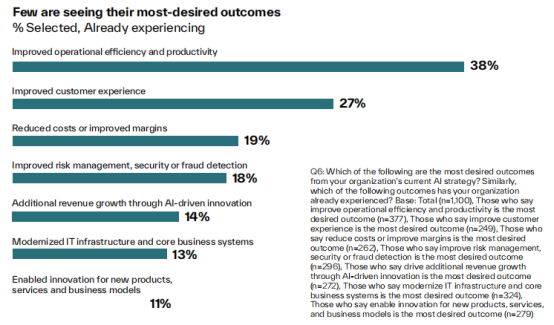
The report presents these differences but does not directly explain what causes them. One possible explanation is that efficiency gains usually occur in local tasks with clearer boundaries. Information retrieval, content summarization, text generation, and the automation of standard tasks all have relatively clear inputs and outputs, and enterprises can more easily observe changes through processing time, task volume, and human effort. These activities can improve within existing roles and processes, which makes them the first visible part of AI’s value.
Innovation and growth, by contrast, require AI to travel through a longer chain of work. Improving customer experience may involve front-office response, back-office processing, data quality, and service responsibility at the same time; product innovation requires connections among needs identification, solution design, internal approval, product delivery, and market feedback; and revenue growth further requires AI-generated insights or proposals to change product value, customer choice, or the business model. Even if AI improves efficiency at one stage, the improvement may remain local to the chain of work if downstream roles, processes, and decision mechanisms do not change with it. Management ultimately needs to observe whether AI-generated improvements can continue through the full chain of work and enter deeper strategic outcomes such as customer experience, product innovation, and revenue.
People Readiness Is the Key Condition for AI Value to Travel Through the Full Chain of Work
For AI-generated improvements to continue through the full chain of work, someone at every stage must understand what AI can take on, how its output should be checked, and how the result should enter the next step. Data and systems determine whether AI can operate at a given stage. What Kyndryl calls “people readiness” encompasses employee skills as well as role design, workflows, performance mechanisms, and change management; it affects whether the results of AI’s work can be understood, accepted, and used in the next step. Together, these two sets of conditions shape whether an enterprise can absorb local efficiency gains into day-to-day operations and carry them forward into customer experience, product innovation, and revenue outcomes.
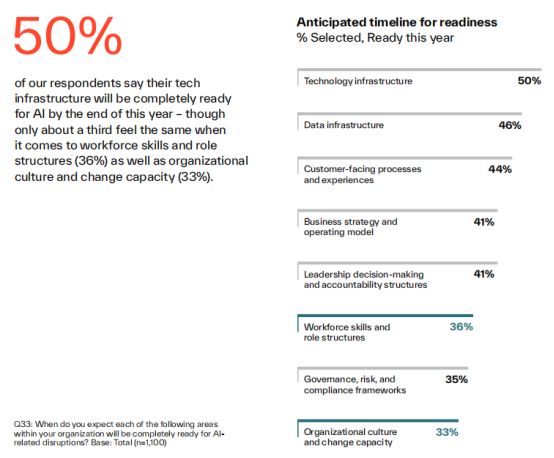
However, a clear gap has already emerged between the pace of technical readiness and the pace of people readiness. On the technical side, 35% of leaders believe their IT infrastructure is ready to support AI, and 50% of respondents expect their technology infrastructure to be fully ready within the year. At the same time, leaders express much less confidence in workforce and organizational conditions: only 23% believe the current workforce is ready, and 25% say the same of organizational culture; 36% expect workforce skills and role structures to be fully ready within the year, while 33% expect organizational culture and change capacity to reach that point. Technology infrastructure is moving more quickly toward a usable state, while the conditions that support employee adaptation and organizational coordination still require more time to form.
Management recognizes the importance of workforce capability, but enterprises have made limited progress in obtaining the employee skills required by their AI strategies. Some managers have turned to external hiring, yet 52% of leaders say it became more difficult over the past 12 months to find new employees with the right skills for their AI strategy. This suggests that enterprises cannot readily treat external hiring as a stable way to fill capability gaps quickly, perhaps because talent supply is limited, market competition is intensifying, and skill requirements are changing rapidly. On internal development, 94% of leaders believe upskilling existing employees will be preferable to external hiring, but many enterprises have yet to translate that preference into a formal mechanism: only 34% maintain an accurate inventory of employee skills, 31% have established a formal budget and proactive upskilling strategy, 28% have created an enterprise-wide workforce resourcing plan, and 25% offer career-transition pathways to employees affected by AI.
These gaps directly affect how AI moves through the chain of work. Without a skills inventory, an enterprise has difficulty determining which roles are already capable of working with AI and where the chain may break because capability is insufficient; without resourcing and career-transition plans, training can also remain at the level of general-purpose tools and fail to connect with specific changes in roles. Even employees who know how to use AI tools may still not know which tasks can be assigned to AI, which results require review, or how their own performance measures and responsibilities will change.
The report also shows that managers closer to execution are more likely to see difficulties involving people and processes. Fifty-five percent of non-C-suite managers regard skills or talent gaps as a major challenge, compared with 43% of C-suite executives; on redesigning roles or workflows around human-AI collaboration, the shares are 48% and 42%, respectively. This difference should serve as a warning to C-suite executives: as the principal decision-makers for AI strategy, they cannot assess organizational readiness solely through deployment progress, tool procurement, and overall adoption rates. The breaks between tasks, capability shortfalls, and blurred responsibilities identified by frontline managers also need to enter the feedback mechanism for AI deployment.
People readiness therefore needs to become part of enterprise AI investment itself. When planning investments in tools, data, and systems, enterprises also need to arrange skills inventories, role adjustments, training budgets, workforce transitions, and execution feedback. Only when these conditions continue to develop with the scope of deployment can AI’s local improvements be absorbed by the full chain of work and then converted into deeper business outcomes.
As Roles Change, Employees Need to Understand Their Place in the New Work
People readiness ultimately has to be reflected in roles and ways of working. Training can help employees acquire foundational skills, but it cannot redesign work by itself. When AI begins to enter a complete chain of work, the enterprise must also explain which tasks AI will take on, which judgments employees will continue to make, who will review AI output, how people and AI will hand work off to each other, and how performance standards and lines of accountability will change. Only when employees can see their place in the new process can the capabilities they learn become a stable way of working.
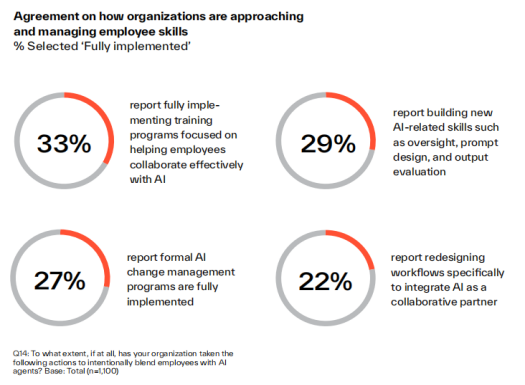
Kyndryl’s survey shows that leaders can already see the direction of role change, while formal enterprise arrangements still lag behind that awareness. Ninety-five percent of surveyed leaders agree that roles are evolving toward human-AI collaboration; 82% believe decision rights are increasingly shared between people and AI. Compared with this awareness, few enterprises have completed the accompanying adjustments: 22% have fully redesigned workflows and embedded AI in them as a collaborator; 27% have fully established a formal AI change-management program; and 33% have fully implemented human-AI collaboration training. Role change has entered management’s field of view, but workflows, workforce mechanisms, and training systems have not advanced at the same pace.
The report therefore recommends that enterprises treat human-AI collaboration as a distinct design task and assign it clear management responsibility. Kyndryl’s own “human-machine systems architect” role begins from this premise. It treats the collaboration layer between people and AI agents as an integrated system to be designed, maps workflows across systems and teams, and separately identifies and clarifies the responsibilities that should remain with people, those that can be assigned to autonomous agents, and those that can be strengthened through human-AI collaboration.
At the same time, the design of human-AI collaboration also needs to involve the employees who actually perform the work. The report shows that only 19% of enterprises fully involve employees in AI implementation. Frontline employees know the tacit judgments, exceptions, and handoffs in real work, and are more likely to identify friction that a process diagram does not show. Involving them in workflow mapping, pilot feedback, and role adjustment can help those responsible determine where AI truly reduces workload, where it creates new review work, and whether the intended division of labor between people and AI can continue to operate in a production environment. Management responsibility provides unified design and coordination; employee feedback tests that design against real work.
This also adds survey evidence to the argument we made in Issue 6, “Role Redesign after AI Deployment: From Workflow Absorption to Workforce Absorption”: once a process can accommodate AI, the enterprise still needs to reorganize roles and people so that employees understand the new division of labor and can take on new tasks. Only then can deployment outcomes be truly absorbed by the organization.
Once AI Begins to Act for the Enterprise, Governance Must Enter the Production Environment
Role redesign explains what employees and AI will each take on; governance needs to encode those arrangements in system permissions and operating mechanisms. When AI primarily provides content and decision support, employees can usually check the result before using it. When autonomous agents begin to call tools, read and write business systems, and advance downstream processes, AI’s impact extends from a single output to system actions and their business consequences. The scope that enterprises must manage expands accordingly: which data may be accessed, which actions may be completed independently, and when a person must intervene all need to be explicit before the system begins to operate.
AI is gaining permission to act faster than enterprises are learning to trust it. Eighty-one percent of surveyed leaders believe that autonomous AI agents will make decisions with a material impact on the business within the next 12 months; 66% of organizations already allow AI to read from and write to core systems of record autonomously, without requiring approval from a person each time. Agents are therefore beginning to access customer data, transaction records, and operating status, and may directly change what happens next in a process.
At the same time, only 25% of leaders fully trust AI to make decisions or take action without supervision, and only 24% fully trust agents to interact with customers without employee oversight. Trust alone cannot show whether a system is safe, but it reveals a practical tension in enterprise management: organizations have granted AI considerable room to act, while many leaders still cannot confirm that those actions will remain reliable without human oversight. The distance between permission and trust needs to be narrowed through governance mechanisms that can be executed and checked continuously.
For governance to keep pace with AI action, it needs to adjust whenever permissions expand. Each time an agent gains a new form of data access, system-writing authority, or business decision-making authority, the enterprise should also specify what it may do, when human approval is required, what conditions trigger a stop or escalation, and who is ultimately accountable. Boundaries should be set before authorization; records should be retained during operation; escalation and rollback should be possible when exceptions arise; and the relevant permissions should be reviewed again after the model, data, or process changes.
An enterprise can use this approach to establish a concise “autonomous action checklist” for every agent entering production, recording the systems it may access, permitted and prohibited actions, human-approval conditions, exception thresholds, accountable owners, and rollback procedures. Management can then continue to confirm which permissions have been opened, where human control remains, and what must be reviewed again after the system changes, even as the scope of AI action expands.
When AI begins to act for the enterprise, governance must enter every access event, decision, and process execution. Only when permissions and controls expand together can the enterprise keep agents operating in core business processes.
Pacesetters Lead Because Their Order of Execution Is Clearer
Kyndryl identifies a group of “Pacesetters” in its sample as examples of organizations with strong people readiness. These organizations meet three conditions at the same time: they have redesigned roles and functions around AI, fully implemented formal change management focused on AI adoption, and believe their workforce is fully prepared for AI-related change. Only 9% of surveyed organizations meet all three conditions.
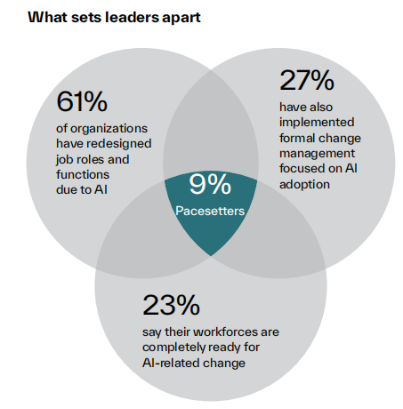
The report shows that among organizations that have completed at least one of the three actions above, 94% followed the same path: first redesigning roles and workflows around AI, then establishing a formal change-management mechanism, and subsequently building workforce skills and readiness. Work redesign first explains which tasks are changing and how people and AI will collaborate; change management then incorporates those changes into performance measures, resource allocation, training budgets, and career-transition arrangements; workforce capability development then identifies the skills that need to be retained or added in light of the new role requirements. Each step gives the next a concrete object, reducing the risk that training, role adjustment, and governance mechanisms will proceed independently of one another.
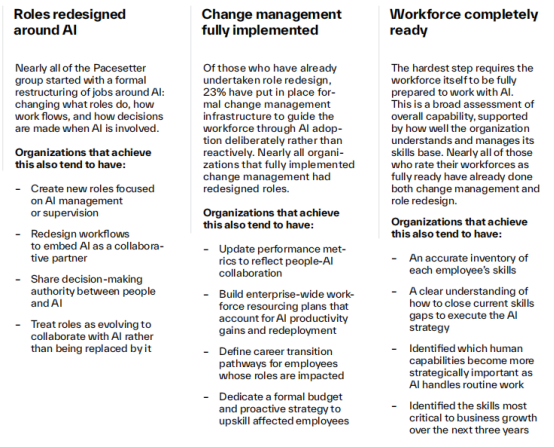
Pacesetters also continue to revise these organizational foundations in response to new issues that appear during deployment. One interesting finding is that, although they have taken more preparatory actions and have higher overall readiness, they express greater concern about the work that remains. This vigilance means that people readiness has no fixed end point. As AI enters more processes and gains more authority, role allocation, capability requirements, performance mechanisms, and governance boundaries all need to keep changing.
These differences in execution also appear alongside higher-value business outcomes. Forty-one percent of Pacesetters say they have achieved innovation in new products, new services, and business models, compared with 26% of other organizations; 40% say they have achieved revenue growth through AI, compared with 27% of other organizations. These survey data cannot establish that the order of execution directly caused those outcomes, but they support the report’s central conclusion: the earlier an enterprise incorporates roles, change mechanisms, and workforce capability into AI deployment, the more likely it is to carry local efficiency gains through the full chain of work.
For management, the key is to determine where the organization currently stands and make the next investment build on the results already achieved. Clarify how work is changing first, then adjust management mechanisms and workforce capability; as deployment expands, continue to revise all three foundations in response to actual feedback. The Pacesetters’ experience therefore offers a repeatable path for organizational execution.
Conclusion and Reflection | People Readiness Is an Organizational Capability That Must Be Continually Renewed
The most important contribution of Kyndryl’s “2026 People Readiness Report” is that it brings the people problem in enterprise AI deployment to the foreground. Fifty-seven percent of organizations have widely deployed AI or embedded it in core processes, while only 23% of leaders believe their workforce is ready. Adding more tools alone cannot close this distance.
Enterprises need to treat people readiness as part of the operating system for AI: role redesign explains how work will change; change management aligns performance, resources, and transition pathways with that change; skill development helps employees acquire new capabilities for collaboration; and governance mechanisms ensure that AI remains controllable, auditable, and accountable after it enters core systems.
The report also leaves some questions unanswered. It does not compare the actual effectiveness of different approaches to role redesign, nor can it establish that the organizational actions taken by Pacesetters necessarily produce better business outcomes. Whether industry differences arise from digital maturity, regulatory pressure, task risk, or legacy systems likewise requires further evidence. The report is therefore best understood as an organizational diagnostic map: it helps management identify where differences in deployment speed appear and decide which capabilities need to be built next.
Durable people readiness comes from an enterprise remaining clear-eyed about change and ready to adjust at any time. Whenever AI enters a new process, gains a new permission, or assumes a new responsibility, roles, skills, performance measures, and governance all need to be reviewed again. Only by continuing to do this can an enterprise convert changing AI capabilities into stable organizational execution.
Further Reading
The following public research and historical NextAI+ Praxis materials are cited in the analysis or considered worth sharing. Publication years and links should be checked against the official sources:
- Kyndryl, “2026 People Readiness Report: Beyond AI Adoption” (2026 People Readiness Report: Beyond AI Adoption), 2026.
- Microsoft, “2026 Work Trend Index Annual Report” (2026 Work Trend Index Annual Report), 2026.
- NextAI+ Praxis, “Agents, Human Agency, and the Opportunity Before Every Organization.”
- NextAI+ Praxis, “Role Redesign after AI Deployment: From Workflow Absorption to Workforce Absorption,” Enterprise AI Deployment Signals Weekly 6, 2026.
This article draws primarily on Kyndryl’s 2026 “2026 People Readiness Report: Beyond AI Adoption” (2026 People Readiness Report: Beyond AI Adoption) and combines it with NextAI+ Praxis’s historical observations of enterprise AI deployment for compilation, paraphrase, and analysis. The report’s data come from a survey of 1,100 business and technology leaders across eight markets and are based on respondents’ self-reported results; the sample structure and company size affect the scope of applicability. The data, concepts, and views from the Kyndryl report referenced in this article remain the property of their respective rights holders. NextAI+ Praxis has organized the relevant material, stated the evidentiary boundaries, and added interpretation from the perspective of enterprise AI deployment. This article does not represent Kyndryl’s official position.
This article is intended solely for research, commentary, and exchange. If there are questions concerning inaccurate wording, incomplete source attribution, or copyright arising from the compilation, paraphrase, or use of images, please contact us through the platform or at [email protected]; we will review the matter promptly and revise or remove the material as appropriate.
Please send us a direct message or leave a comment to tell us which enterprise AI implementation issues concern you. You are also welcome to leave a message at nextaipraxis.com or contact us at [email protected]. We hope to begin with real enterprise processes and concrete difficulties and work together to identify executable paths for AI deployment.
Cite as · Deep Reads · 24 September 2026