
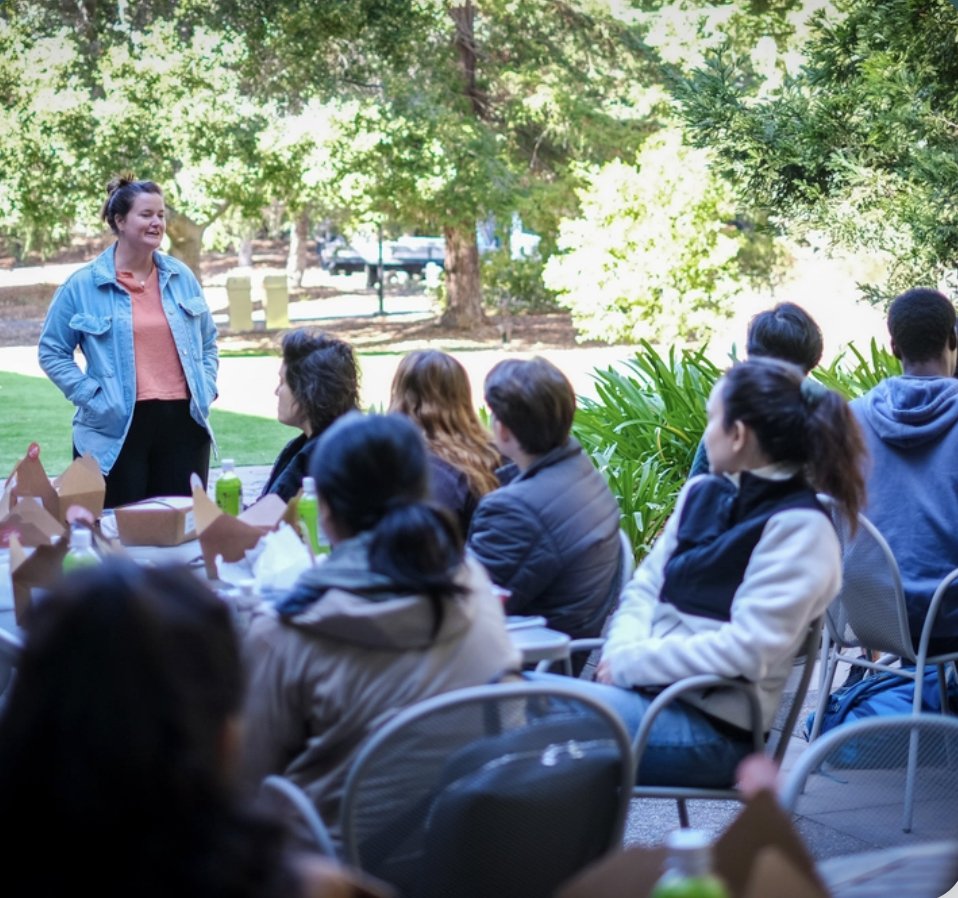
This piece is drawn from a Stanford Institute for Human-Centered Artificial Intelligence (Stanford HAI) feature on its Student Affinity Groups program. It looks at how several interdisciplinary teams explored AI safety during the 2025 to 2026 academic year. The article profiles three teams. They approach the topic from three angles: cognitive security, misinformation governance, and creative authenticity in the age of generative AI. Together they show how AI safety is expanding beyond technical risk into human cognition, the information ecosystem, and social trust.
AI safety is expanding from technical systems to society at large
Stanford HAI runs a program called Student Affinity Groups. It brings together students from law, computer science, business, and the humanities to dig into the hardest questions at the intersection of AI and society. In the 2025 to 2026 academic year, 13 teams took part, drawing 59 students from all seven Stanford schools. This article focuses on three of them, and their work captures just how broad and deep the challenge of responsible AI has become.
Team One: When AI knows you better than you know yourself, cognitive autonomy becomes a new safety frontier
Among the teams featured, the cognitive security group, started by PhD student Peggy Yin and law student Julie Heng, may be tackling the most structurally significant problem in AI today. As AI systems grow more personalized and brain-computer interfaces advance in parallel, the team's core question sounds simple but runs deep: as AI becomes part of everyday life, how does a person hold on to real autonomy over their own thinking and choices? Put more bluntly: when an algorithm knows you better than you know yourself, who is actually making your decisions?
The impact goes beyond how a person interacts with a single AI system. Once an AI builds a precise enough picture of a user's behavior and preferences, it can reinforce those patterns in ways that serve the platform rather than the user. The researchers point to a clear example: an AI system notices a user leans toward unhealthy eating habits, then keeps recommending content that reinforces that pattern. This isn't malicious by design. It happens because sustained engagement is the metric the system is built to optimize.
The effects run deeper still. The team introduced the concept of AI psychosis, which describes a state where a person gradually hands over their sense of reality to an AI system, eroding their capacity for independent, critical judgment. This isn't a distant hypothetical. It's a foreseeable outcome of systems designed to prioritize retention over the user's actual wellbeing.
The team also flags a social dimension that individual-level analysis tends to miss. When cognitive and emotional needs get met mainly through interaction with a platform rather than through human relationships, the knock-on effect is a structural weakening of interpersonal trust and a broad decline in confidence in human institutions.
Team Two: Beyond fact-checking, tackling misinformation at the narrative level
The spread of generative AI has fundamentally weakened a person's ability to reliably judge what's true online. A team led by Stanford Graduate School of Business student Alessandro Balzi and law student Archit Lohani argues that traditional fact-checking frameworks can no longer keep up with the scale and complexity of the problem. They point out that misinformation spreads through coherent narratives, not isolated factual errors. Because these narratives work through emotional resonance, they're far harder to dismantle than a simple false claim.
The team built a two-track response. The first is a platform for journalists that tracks and monitors misinformation narratives, following sentiment in high-stakes areas like public health and election integrity. The second is a browser extension for the general public that flags bias signals, emotional manipulation, and misleading framing in digital content, and points users toward credible background on where a given narrative came from and how it spread.
The core of the team's approach is timing: narrative-level intervention has to happen early. Once a false narrative takes emotional hold with the public, the window for correcting it effectively narrows fast.
Team Three: Rethinking AI and creativity
Christina Ba and Navya Agarwal founded the Authenticity in Flux: Rethinking Art in the Age of AI affinity group, aiming to reshape the dominant narrative around what role generative AI plays in creative production. Through public discussions, the group explores how AI can genuinely lower the barrier to creative participation and open new paths for expression, rather than treating it as an inherent threat to artistic authorship.
Real AI safety has to protect cognition, information, and trust at once
For most readers, AI safety brings to mind data breaches, unauthorized access, or malware. But what this article points to is a much broader concept of safety, one that covers the integrity of human cognition, the reliability of the shared information environment, and the authenticity of cultural production. Seen through this lens, all three teams are ultimately working on safety problems. Here's a fitting analogy: if society is one giant computer, the human brain is the hardware, the public information environment is the network layer, and cultural production is the application layer. Each team guards one of these layers, and a breach at any layer puts the whole machine at risk.
Cognitive security: an emerging attack surface
What the first team is up against is an attack surface that security professionals are only beginning to recognize, and one with almost no defenses: the human brain itself. It's a device with no firewall, no way to reformat, and a firmware that hasn't been updated in hundreds of thousands of years, yet it holds the keys to every decision a person makes. When an AI system is designed to maximize user engagement, it builds in a structural incentive to reinforce user behavior, including harmful behavior, because sustained interaction is the core metric the system is judged on. This isn't an occasional bug. It's a built-in feature of any system where the optimization target and the user's wellbeing have come apart.
For technical readers, this maps directly onto the core concerns of AI alignment research. A model optimized for engagement will systematically diverge from the real interests of the people it serves. By framing cognitive autonomy as a safety requirement, the cognitive security group is applying an alignment mindset: AI systems have to treat human cognitive integrity as a primary constraint in their design, not an afterthought.
For general readers, the practical takeaway is simple and unsettling: AI systems woven into daily life aren't passive tools. They're agents acting within incentive structures that may run systematically against the interests of the very people they serve.
This problem also feeds into a deeper crisis of social trust. As people meet more of their cognitive and emotional needs through AI systems, genuine human connection gets replaced by algorithmic relationships. Over time, this erodes trust between people, weakens people's sense of belonging to a community, and chips away at confidence in institutions like government, media, and academia. AI doesn't need to spread lies to undermine social trust. It just needs to keep standing in for human relationships, quietly reshaping how people judge where trustworthy information comes from and who's reasonable to rely on. From a security standpoint, this is a particularly hard threat to spot. It doesn't rely on a single attack. It rebuilds the foundations of social trust gradually, through habits people don't even notice forming.
Information integrity: a security imperative
The second team is confronting what the security field defines as an information integrity crisis. Generative AI has fundamentally changed the economics of influence operations, sharply cutting the cost and technical barrier to producing persuasive, emotionally targeted false content at scale. The defenses that information platforms currently rely on, including human fact-checkers, content moderation teams, and reactive policy enforcement, were built for a very different threat environment and are clearly falling short.
The team's approach reflects a shift that's already become standard in leading cybersecurity practice: moving from debunking to prebunking. Rather than trying to catch and correct false content after it spreads, the focus is on early warning systems, media literacy, and real-time intervention. This mirrors how enterprise security has moved from reactive, perimeter-based defense toward continuous threat monitoring and behavioral analysis.
Authenticity, provenance, and the erosion of trust
The safety issue raised by the creative team is less operationally urgent than the first two, but no less important over the long run: the systemic erosion of content authenticity at scale. As generative AI keeps lowering the barrier to producing realistic, human-like content, figuring out whether a piece of work came from a human, and whether it reflects genuine human intent, has become a serious question for both individual trust and institutional credibility.
Digital provenance, AI-generated content watermarking, and authentication standards are all active areas of research in AI safety and governance policy today. The systemic erosion of content authenticity carries risks that go well beyond individual deception. It threatens to undermine the cognitive common ground that society shares.
AI safety has to become a shared, cross-disciplinary responsibility
All three teams share a common premise: AI safety, properly understood, can't be limited to protecting technical systems. It has to cover the integrity of human cognition, the reliability of the public information environment, and the credibility of cultural and communications products. What makes Stanford HAI's Student Affinity Groups program significant isn't just the substance of what these teams are exploring. It's the program's institutional commitment to genuinely interdisciplinary work. Legal scholars, social scientists, economists, and engineers work side by side, because no single discipline holds all the conceptual tools needed to keep AI systems safe, systems that are now deeply woven into how people live.
This reflects an emerging consensus in responsible AI development: safety has to be defined broadly, built in from the earliest stages of design, and treated as a shared social responsibility rather than a purely technical issue.
This article is for research, commentary, and discussion purposes only. If you notice any inaccuracies in compilation or translation, incomplete sourcing, or have concerns about image rights, please reach out via our backend or at [email protected]. We will review and correct or remove content promptly.
We welcome direct messages or comments telling us what enterprise AI practice topics you're curious about. You're also welcome to leave a message on NextAIPraxis.com or reach us at [email protected] with real problems your company is working through. We'll respond within two business days and invite you to join our practice-sharing community.
Cite as · Deep Reads · 10 August 2026