
With GPT-6 Astra formally released in recent days, OpenAI, the U.S. artificial intelligence company, has once again pushed forward the boundary of work that models can perform. From directly operating computers to handling a range of complex tasks, the new model’s performance in real-world applications continues to raise expectations and imagination about the upper limits of AI capability.
At the same time, an official guide article published on August 12 by this closely watched frontier company in the field of artificial intelligence, “Enterprise Signals: What Frontier Firms Are Doing Differently,” attracted our team’s attention. It offers a rare observation window from the service-provider side, using actual usage data from its own customers to document how enterprises are putting AI to work.
One conclusion worth noting is: more work is being delegated to agents. In the past, employee interactions with AI centered more on Q&A, discussion, and content generation; after receiving suggestions or a first draft, employees would then operate software themselves, organize materials, and complete the deliverable. Now, agents are beginning to take over more of those steps: finding relevant files, processing data, modifying content, and continuing the work based on execution results. The work corresponding to a single request is also expanding from one conversation into a task that takes time to complete. In “How Agents Are Transforming Work,” published by OpenAI on June 25, this change is described as “a shift from single-turn interactions to task delegation over longer time horizons.”
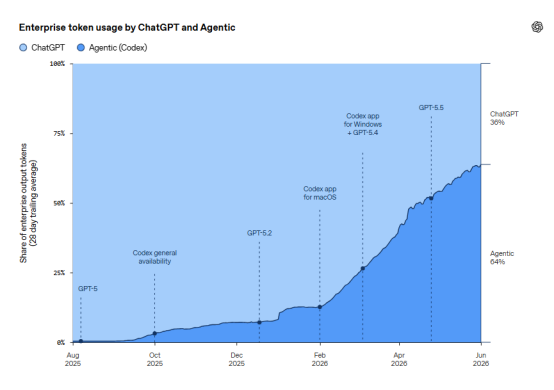
This shift is already visible in the output structure of enterprise customers. As of June 2026, OpenAI’s statistics show that output tokens generated by agent-executed tasks had surpassed chat-based use, accounting for 64% of the combined output of the two. These data indicate that the way enterprises use AI is changing: output from tasks executed by agents has become the main component of the combined output of these two product categories.
Agent Adoption Is Expanding Beyond R&D Departments
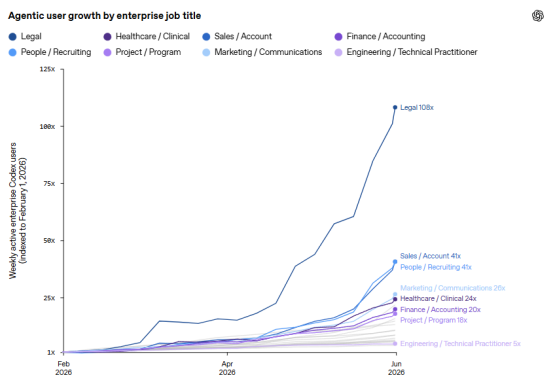
This shift is moving into more knowledge-work roles. OpenAI’s enterprise signals show that, since February, weekly active enterprise Codex users have grown to 108 times their previous level in legal, 41 times in both sales and recruiting, 26 times in marketing, and 5 times in engineering. Knowledge work outside software development has become an important source of growth in agent users.
Software engineering entered this stage earlier because of the nature of the work itself. A codebase provides a clearly defined object of work, compilation and testing provide feedback, and there are corresponding checks for whether a change breaks existing functionality. An agent can repeatedly work on a problem and use the information obtained from each execution in the next step.
Other forms of knowledge work, however, depend more heavily on business context. Whether a sales recommendation is appropriate may depend on concerns a customer has previously expressed; whether an operating analysis is useful may depend on which product rules were just changed. A single document in front of the employee is often insufficient to define the task clearly, and the work may also lack explicit validation criteria. The report treats improvements in model capability and progress in adapting models to real-world work tasks as important drivers of agents entering these domains.
As a result, agents are beginning to move deeper into the processing of knowledge work. Around a specific business problem, an agent can combine dispersed materials and communication context, continuously carry out information organization, analytical comparison, and material preparation, and adjust the result based on additional information or employee feedback. The work enterprises can delegate to AI is therefore expanding from one-off Q&A and content generation into knowledge tasks that require understanding context, connecting multiple steps, and producing a deliverable. Employees can then build on those results to complete professional judgment and decision-making.
A Shared Shift in Usage Is Widening the Gap Between Enterprises
The broader diffusion of AI applications does not naturally mean that enterprises are deepening their use at the same pace.
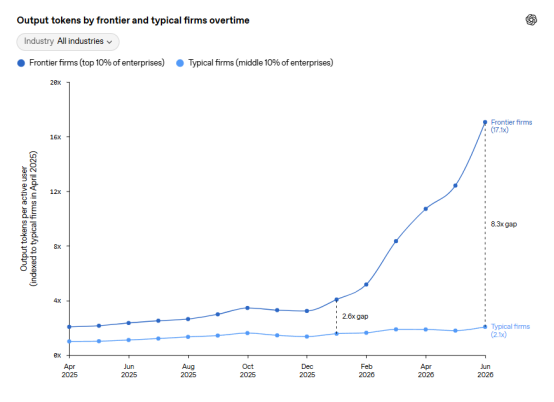
OpenAI ranks enterprise customers by output tokens per monthly active user, defining the top 10% as “frontier firms” in the report and comparing them with enterprises in the 45th to 55th percentiles. In this article, we render the former group as “high-intensity token-use enterprises” to correspond to the statistical meaning used in the report.
In January 2026, the two groups differed by 2.6 times in output tokens per active user; by June of the same year, that gap had expanded to 8.3 times. Under the same technological progress, enterprises are beginning to diverge in their actual intensity of AI use.
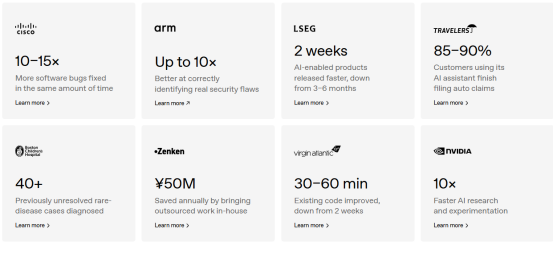
To understand this divergence, it is also necessary to look at what work enterprises are actually putting AI into. The report lists a series of AI use cases and interim outcomes among “high-intensity token-use enterprises.” One example is the U.S. insurer Travelers, which has advanced AI deployment into a customer-facing claims-reporting service.
In “Travelers Deploys AI-Powered Claims Countrywide with OpenAI,” published by OpenAI on June 2, Travelers is described as using the Realtime API to build a voice assistant connected to its existing claims infrastructure and internal tools. After a car accident, customers can ask questions about their policy, provide accident information, and complete a first notice of loss through natural conversation. The project started in eight states and expanded nationwide within two months; among customers who used the assistant, 85%-90% completed their claim submission through AI, while claims professionals focused on complex cases requiring human expertise.
Here, customers receive a service that can directly complete a task. After understanding the customer’s request, AI connects the relevant information to the back-end claims-reporting process, allowing the conversation to progress into an actual business submission. The interim outcomes of this deployment therefore become concrete: customers can access claims-reporting support around the clock, and most customers who use the assistant are able to complete their submission; claims professionals can devote more attention to complex cases that require professional judgment. The value of AI to the enterprise thus begins to appear both in the availability of customer service and in freeing the capacity of professional staff.
High-Intensity-Use Enterprises More Often Rely on Advanced Capabilities to Complete Real Work
High-intensity-use enterprises also show differences in the features they choose. The report shows that, among weekly active users, 21% of users in this group use plugins, compared with 9% in the comparison group; the corresponding shares using Skills are 19% and 3%.
Understanding these differences requires distinguishing work instructions from tool use. Skills primarily organize task-specific working methods, instructions, and supporting resources into reusable workflows; plugins are installable resource packages that can combine Skills with tool connections and other capabilities. Through the connections provided by plugins, AI can access materials in enterprise systems and use the relevant tools to advance the task. The two can work together: working methods guide the process, while tool connections provide the actual data and operational capabilities.
The functional-use diagram in the report shows how this combination is used across different types of work, covering finance, data analysis, sales, marketing, operations, engineering, design, and security. Sales and operations provide particularly clear examples of how AI moves from following instructions toward calling tools and processing business materials.
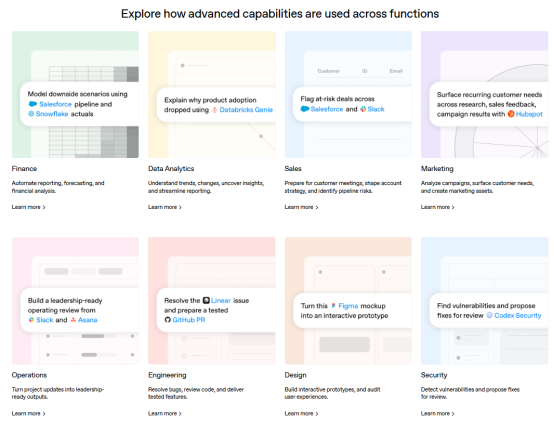
For example, in sales, AI can combine opportunity records in Salesforce with communication information in Slack to identify deal risks that require attention. Salesforce is a customer relationship management tool, while Slack carries the team’s day-to-day communications. By connecting these two types of information, AI can help sales staff understand the current status of an opportunity and its relevant context, producing risk prompts for their review. If the team further organizes risk-assessment rules and reporting requirements into Skills, those rules can participate in the analysis together with the latest customer information.
In operations, AI can combine communication records in Slack with project tasks in Asana to prepare operational review materials for management. Asana is a project management tool; task records and day-to-day discussions together provide the context of project progress. AI can help organize dispersed updates into materials that management can read and discuss, reducing the work operations staff spend searching for and consolidating information across different systems. Here, tool connections are responsible for obtaining the relevant materials, while processing instructions guide how the results are organized and presented.
These uses make the value of advanced capabilities concrete in actual work: employees can hand AI a task that requires work across multiple tools, then use the organized business materials as the basis for review, communication, and judgment. Enterprise AI use therefore reaches deeper into work steps that previously had to be connected manually by employees.
What Kind of Work Environment Do Agents Need in Order to Complete Work?
After an enterprise identifies suitable application scenarios, it still needs to give agents the conditions required to complete the task. What background a task involves, which tools can be used, and what checks and revisions it must go through all affect what the agent can ultimately deliver. OpenAI explains how enterprises can support agents from three dimensions: “context, tools, and continuous execution.”
Context: Let Agents Understand the Business Situation in Front of Them
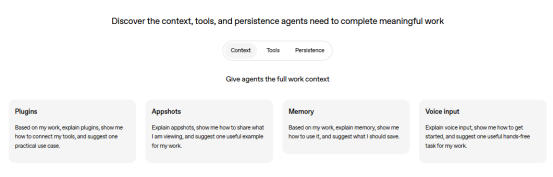
When an employee asks to “prepare next week’s operating analysis,” many requirements are not written into that sentence. Who the analysis is for, what management has been focusing on recently, and which changes require special explanation often reside in earlier files and team discussions. Agents need access to this background in order to judge what to look for, what to focus on, and how to organize the result.
Plugins provide one way to connect this information. By connecting to the business tools employees use every day, agents can retrieve relevant materials during the task, reducing repeated downloading, copying, and uploading. For the page or material currently being viewed, app screen sharing (Appshots) provides more direct context: employees can make requests around the content in front of them, allowing the agent to understand the specific object it needs to process.
Some information is also suitable for continued use in later work. Relatively stable business context and personal preferences, for example, can be retained through Memory; temporary requirements that need to be added can be explained quickly through voice input. Enterprises can therefore distinguish information that should persist over the long term from new conditions specific to the current task, allowing agents to work with familiar context while also keeping up with current changes.
Tools: Turn Work Requirements into Concrete Actions and Deliverables
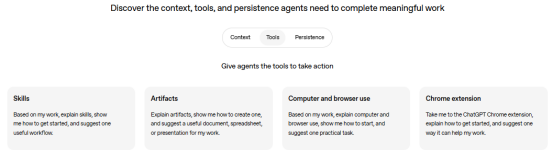
After understanding the business context, an agent also needs to know how to handle the task and be able to act on the relevant files and systems. The Skills mentioned above provide reusable task guidance here: the processing steps, review standards, and delivery requirements a team has already established can be reused in similar work. Each time an employee initiates a task, they can therefore specify a concrete goal on top of an existing method.
These methods ultimately need to result in deliverables. In the report, Artifacts correspond to deliverables such as documents, spreadsheets, and presentations, allowing AI-processed results to enter work formats employees already know. Employees can open the file, review the content, continue editing it, and use it in subsequent discussions. Whether a task is complete also becomes tied to a concrete object.
Computer and browser operation further connects these steps, allowing agents to enter applications or websites, search for information, edit content, and save results; the Chrome extension provides an entry point for using the relevant capabilities in the browser. At the same time, enterprises need to specify which actions agents may execute directly and which require employee confirmation. Editing an internal draft and sending formal materials externally should have corresponding permission and review arrangements. These operations also depend on the enterprise’s existing digital foundation: whether relevant materials can be accessed and understood, and whether business systems can be connected, will affect the tasks agents can take on. Enterprises can inspect these conditions around selected scenarios and prioritize gaps that directly affect execution.
Continuous Execution: Keep Tasks Moving Through Feedback and Scheduling
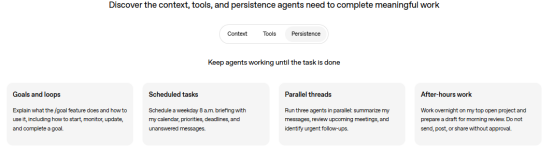
Many kinds of work require multiple rounds of processing. After a report has a first draft, additional material may need to be added, figures checked, and content revised according to feedback. Goals and loops allow these steps to continue around the same task: the agent handles the current problem, checks intermediate results, and then decides the next step, while the employee needs to explain what result counts as complete and under what circumstances the task should be handed back to a person.
Continuous execution also involves how work is scheduled. Scheduled tasks are suitable for routine work carried out at fixed times, such as preparing a daily brief or periodically summarizing pending items. Parallel threads are suitable for parts that can advance independently, allowing tasks such as material organization and meeting review to proceed at the same time before their results are used in subsequent processing. Enterprises need to choose an arrangement based on dependencies among tasks so that each step receives the input it needs.
After-hours work extends preparation into periods when employees are offline. For example, material organization and first-draft preparation can be scheduled overnight and left for review the next day, allowing employees to continue from existing results when they begin work. Actions such as external sending, publishing, and sharing should still retain explicit approval requirements. This arrangement allows agents to continue undertaking preparation and execution work, while employees can take the task back at points that require judgment and confirmation.
Business Experience and AI-Use Experience Can Flow in Both Directions Within a Team
Whether these arrangements can spread also depends on how enterprises encourage experience-sharing among employees, so that business experience and AI-use experience complement each other and become working methods the team can reuse. OpenAI’s accompanying working paper finds that, among enterprise employees already using ChatGPT, early-career employees and people in internship or training stages send about 8-9 more messages per week than the average active user in the same enterprise. This suggests a possibility enterprises should pay attention to: business seniority and AI-use experience do not necessarily accumulate in parallel; some less-experienced, younger-generation employees who use AI frequently in their daily work may also have methods for spreading AI use that are worth sharing across the team.
Enterprises can allow these two kinds of experience to complement each other. Senior employees understand business requirements and can explain why a task is handled in a particular way and which judgments require special caution; newer employees who have accumulated practical AI experience can share how tasks are delegated to agents, how tools are combined, and which operations are worth reusing. Experience transfer can therefore work in both directions: newer employees learn the enterprise’s business methods, while senior employees also have the opportunity to learn new AI practices from them.
This exchange is well suited to a real task. The two sides complete the work together, use business experience to check whether the result is reliable, and then organize effective AI practices into shared instructions, examples, or workflows. In this way, individual usage techniques have the opportunity to become methods the team can continue to practice and improve, allowing later participants to start from existing experience.
Conclusion
From assistance to delegation, enterprises are beginning to hand AI longer and more specific pieces of work. OpenAI’s usage data show how enterprises are diverging within this shift, while functional use cases and real-world examples show that the differences ultimately appear in how employees prepare tasks, call on information, operate tools, and check results each day. For enterprises, the goal worth pursuing is to give more valuable work appropriate AI support and turn practices that have already proved effective into capabilities the team can use continuously. When employees can begin their judgment from more complete results, collaboration between enterprises and AI moves forward as well.
Further Reading
The public research and enterprise cases cited or referenced in this analysis are listed below for further reading. Dates and content are based on the official sources.
- OpenAI, “Enterprise Signals: What Frontier Firms Are Doing Differently,” updated August 12, 2026. This is the principal source for this article, presenting the structure of enterprise AI use, differences between high-intensity-use enterprises and the comparison group, and the context, tools, and continuous-execution conditions agents require.
- Aaron Chatterji et al., “How Organizations Use AI: Evidence from ChatGPT,” working paper, updated August 11, 2026 and released on August 12 through OpenAI’s research publication page. The paper can be downloaded from that page; see in particular Section 4.3.2 for analysis of usage intensity across job functions and career levels, together with the corresponding sample and methodology notes.
- OpenAI, “How Agents Are Transforming Work,” published June 25, 2026. Discusses how AI use is expanding from single-turn interactions to task delegation over longer time horizons, and observes changes in agent use across different departments within OpenAI.
- OpenAI, “Travelers Deploys AI-Powered Claims Countrywide with OpenAI,” published June 2, 2026. Describes how Travelers uses the Realtime API to connect voice interactions with its existing claims systems, enabling customers to complete a first notice of loss after a car accident, together with the project’s rollout scope and claim-submission completion rates.
Sources and Copyright Notice
This article is primarily based on OpenAI’s publicly released Enterprise Signals, the accompanying working paper, and related enterprise cases, and was compiled, paraphrased, and analyzed in Chinese by NextAI+ Praxis. Enterprise usage data come from OpenAI’s own products and customer samples; the core usage metrics in this article run through June 2026, while the accompanying working paper’s data run through March 2026. Usage metrics are used to observe the structure and intensity of AI use; case outcomes are cited according to the disclosures of the publishing parties; functional-use examples illustrate possible ways of working. The extended discussion of complementary team experience and enterprise deployment arrangements constitutes analysis by this article.
Rights to the cited original text, charts, and related marks belong to their respective rights holders. This article does not represent the official position of OpenAI or any related enterprise and is intended solely for research, commentary, and discussion. If there are questions regarding inaccurate wording, incomplete source attribution, or copyright arising from the compilation, paraphrasing, or use of images, please contact us through the back end or at [email protected]. We will review the matter promptly and, where appropriate, correct or remove the relevant content.
We welcome you to share in the comments the work you are trying to delegate to AI and the difficulties you are encountering in practice; we also welcome discussion with NextAI+ Praxis about specific enterprise AI deployment issues.
Cite as · Deep Reads · 16 September 2026