
Boston Consulting Group (BCG) published AI Transformation Is a Workforce Transformation in 2026. The “2025” referenced in the report refers to the name of the annual research initiative itself; the article was published in early 2026 and draws on findings from that research cycle. Based on its large-scale global study of C-suite executives, BCG puts forward a counterintuitive yet compelling argument: only about 10% of the value companies derive from AI comes from algorithms themselves, 20% comes from the technology and infrastructure required for implementation, and the remaining 70% comes from redesigning and investing in the “people” dimension.
In other words, the real bottleneck in AI transformation is not technology—it is people.
Only 5% of Companies Are Generating Real Financial Returns from AI—Yet Their Returns Are Four Times Those of Laggards
In this round of BCG’s global research, only about 5% of organizations have achieved substantial financial value from AI—defined as improvements in revenue or cash flow, as well as significant gains in process and workforce efficiency. Yet these 5% of “future-built” companies have delivered average three-year total shareholder returns roughly four times those of AI laggards.
What accounts for this gap? BCG’s answer points to an area that most organizations underestimate: future-built companies plan to provide AI skills training to more than 50% of their workforce, compared with only 20% at lagging companies. They are also four times more likely to have structured AI learning programs and are more likely to allocate dedicated time for employees to learn.
Seventy Percent of AI Value Comes from Workforce Transformation — and It Can Be Broken Down into Four Actions
BCG proposes a simple framework: 10% of AI value comes from algorithms, 20% from technology infrastructure, and 70% from workforce transformation. That 70% can be further broken down into four concrete actions.
First, align leadership around strategy. Senior leaders need to provide strong governance over AI investments and ensure that AI initiatives serve the company’s broader strategic priorities rather than existing as isolated “AI transformation projects.” Leaders should focus on a small number of core priorities—typically three or four—rather than spreading resources across dozens or even hundreds of use cases.
Second, drive behavioral change among employees. Policies and directives alone will not persuade employees to embrace AI. Companies should build comprehensive change programs around a compelling narrative that explains how AI will improve performance and help the organization achieve its goals. This narrative needs to extend throughout the organization so employees at every level understand the “why” behind the transformation.
Third, proactively assess AI’s impact on the workforce. Future-built companies are five times more likely than laggards to conduct strategic workforce planning. They anticipate future talent needs and redesign job architectures and organizational structures around AI. This planning process is essential for determining where to invest and ensuring that efforts to upskill existing employees actually deliver results.
Fourth, build an AI-enabled operating model. Companies need to define how human employees and AI will work together, including roles and responsibilities, governance mechanisms, and organizational design. Workflows must also be redesigned to capture AI’s full potential.
At Future-Built Companies, 88% of Managers Lead by Example in Using AI—Compared with Just 25% at Laggards
What employees see in these organizations is not simply a mandate handed down from headquarters. They see their direct managers actually using AI in their day-to-day work.
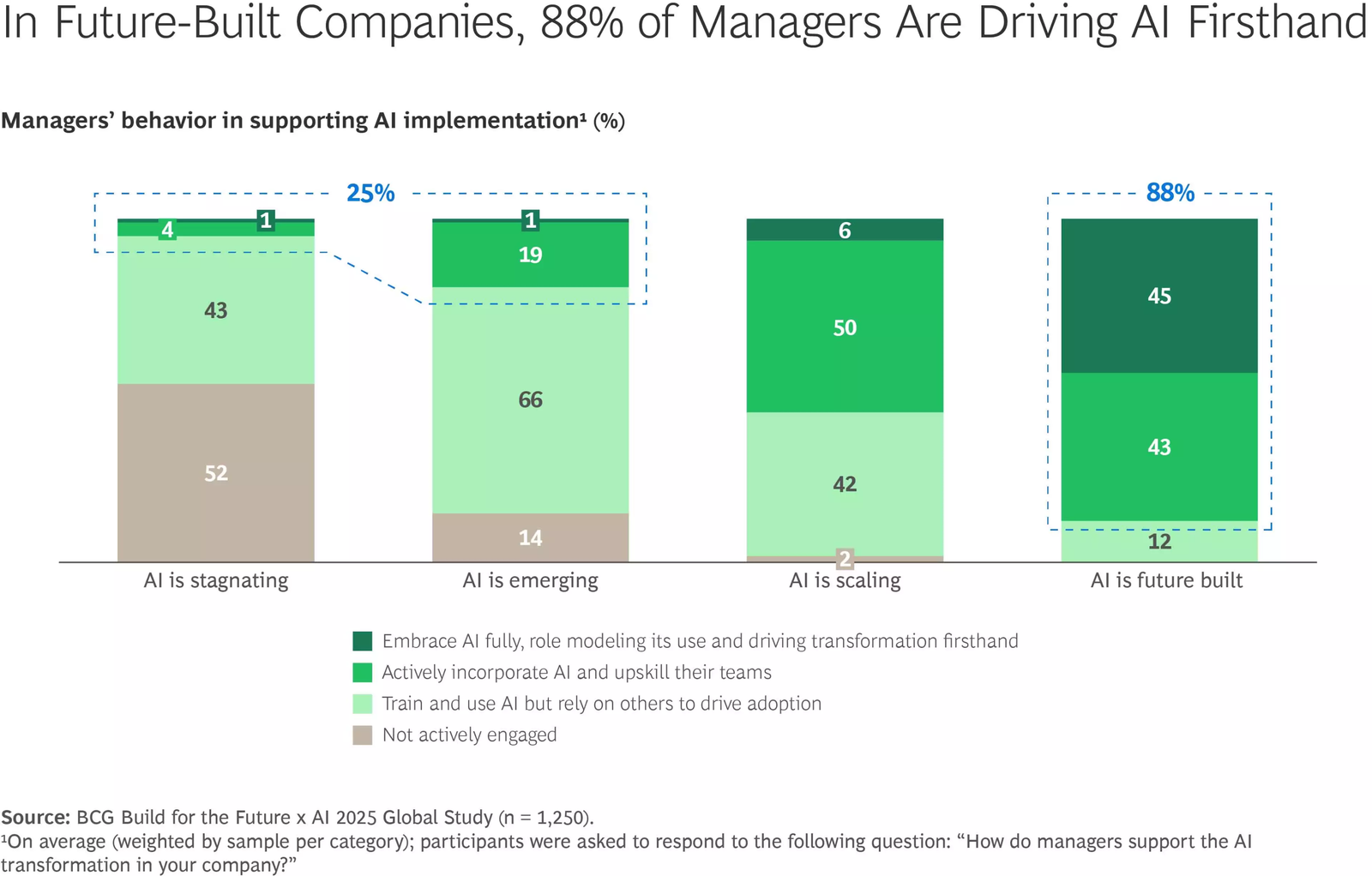
Senior executive involvement is equally indispensable. Companies that treat AI as a CEO-level priority scale faster and create more value than those that treat it merely as another technology tool. Leaders need to articulate where the organization is heading and continually explain why the transformation matters, how AI can improve company performance, and what role employees at every level will play in the transition.
Effective Upskilling Is Less About Prompting and More About Contextual Judgment, Problem Framing, and Interpretation
BCG provides a clear definition of “effective upskilling” and distinguishes it from conventional training programs. Prompt writing and basic AI literacy are necessary starting points, but three higher-order capabilities ultimately determine whether AI creates meaningful value: contextual judgment, problem framing, and interpretation of results. These capabilities allow employees to unlock the value of AI across an entire workflow rather than simply during individual interactions with an AI system.
Contextual judgment is the ability to determine whether an AI-generated recommendation makes sense in a particular situation. For example, if AI generates a pricing recommendation, an employee must consider local market conditions, seasonal factors, and customer relationships before deciding whether to use or modify it.
Problem framing is the ability to transform an ambiguous business objective into specific tasks that AI can address. “Improve customer satisfaction” is not, by itself, an actionable instruction for AI. An employee must first break the objective into concrete, testable questions—for example, identifying which stages of the customer journey have the highest churn rates—and then use AI to analyze those specific problems.
Interpretation means evaluating the reliability of AI-generated outputs, identifying their limitations or biases, and translating those outputs into actual business decisions rather than accepting them at face value. If AI produces a sales forecast, for example, an employee must determine whether it accounts for recent market changes before deciding whether to adjust inventory.
These capabilities matter because they determine whether the time and output generated by AI ultimately lead to better decisions or are wasted on activities that create little value. This is why BCG argues that effective upskilling requires three conditions. First, learning must be embedded into everyday workflows, allowing employees to use real tools on real tasks and receive real feedback rather than relying on annual workshops and simulations. Second, programs should be grounded in behavioral science: employees need to see leaders model the change, understand why the transformation is happening, and experience results early. Third, organizations need robust tracking mechanisms that measure not only whether employees have acquired AI skills, but also whether capabilities such as contextual judgment and problem framing have actually developed.
When all three conditions are in place, upskilling stops being an isolated learning initiative and becomes part of the organization’s continuous evolution.
Organizational Change in the AI Era—and Its Human Cost
The value of BCG’s article lies in its use of rigorous data to unpack a proposition that is frequently discussed but rarely understood in depth: true AI transformation is fundamentally an organizational transformation, and at the center of organizational transformation are people.
The following analysis examines this transformation from four perspectives.
The Work Paradox: AI Has Upgraded Efficiency Without Redesigning Work
BCG’s research highlights an important phenomenon: AI can significantly improve employee efficiency, but efficiency does not automatically translate into business value. What ultimately determines whether AI creates value is not how much time employees save, but whether companies redesign how work gets done.
This is one of the most easily overlooked aspects of AI transformation. Technology can automate tasks and reduce execution time, but it cannot redefine employees’ roles on its own. When organizations treat AI simply as a productivity tool without simultaneously redesigning responsibilities, optimizing workflows, and developing new capabilities, the time released by AI often fails to translate into innovation, better decisions, or higher-value business outcomes.
As BCG emphasizes, AI transformation is fundamentally a workforce transformation, not merely a technology upgrade. The real competitive advantage does not come from employees completing the same work faster. It comes from organizations reconsidering a more fundamental question: once AI takes over part of the work, where should people redirect their time—to higher-value judgment, collaboration, creativity, and customer service? Only when work itself is redesigned can AI-driven efficiency gains become sustainable business value.
The Value of Human Work Is Shifting from “Completing Tasks” to “Defining Tasks”
AI is not merely taking over repetitive tasks; it is also redrawing the division of labor between humans and machines. As information gathering, data analysis, and content generation are increasingly handled by AI, the value of human work is shifting from “completing tasks” toward “defining tasks.” In the future, what matters most will no longer be who can process information fastest, but who can ask the right questions, exercise judgment within a specific context, and translate AI outputs into real business decisions.
This means the challenge posed by AI is not simply learning how to use new tools. It is adapting to an entirely new way of working. If organizations merely give employees access to AI without simultaneously redesigning roles, workflows, and capability development, AI will improve efficiency—but not necessarily organizational competitiveness.
Jobs Are Diverging: Judgment-Intensive Roles Gain Value While Routine Roles Face Automation Pressure
BCG’s research suggests that many jobs in the United States will be significantly reshaped by AI over the next two to three years, but reshaping does not necessarily mean replacement. A more accurate description is that jobs are diverging.
Roles centered on judgment, integrated analysis, and accountability are becoming more valuable and influential. Meanwhile, highly procedural roles requiring little human judgment face increasing automation pressure. This divergence is particularly visible in entry-level jobs: automation of routine tasks is changing the nature of many junior positions, requiring companies to develop innovative career pathways and apprenticeship models for new graduates.
The consequences of this structural shift extend beyond individual career anxiety. They point toward a broader restructuring of the labor market. For experienced employees who already possess sophisticated judgment, AI can act as an amplifier. For junior employees who are still developing foundational experience, AI may become a barrier. As the traditional career path of “master the basics, accumulate experience, and gradually advance” comes under pressure, redesigning how talent develops will become one of the most consequential human-capital challenges of the coming decade.
At the same time, the premium placed on AI skills is rising rapidly. The ability to work effectively with AI is becoming an increasingly visible dividing line in the labor market. Those capable of harnessing AI may see their compensation and influence rise quickly, while those unable to make the transition risk being marginalized. Without effective organizational intervention and broader social support, this divergence could develop into a new form of structural inequality.
Employee Resistance to AI Often Reflects Fear of Replacement, Not Rejection of Technology
BCG repeatedly emphasizes a central observation: technology changes much faster than human behavior. The implications of this statement extend far beyond its literal meaning.
In most organizations, there is a structural gap between the speed at which AI is deployed and the speed at which employees can psychologically adapt. The technology may already be in place, while people are still unprepared. This lack of readiness is not limited to skills; it also concerns meaning and identity. When professional expertise accumulated over years is partially replaced by AI within a short period of time, employees may face profound questions about their own value, their sense of belonging within the organization, and their confidence in their future careers.
The crisis of trust created by large-scale workforce transformation is often underestimated by management. Employee resistance to AI frequently stems not from hostility toward the technology itself, but from fear of replacement, frustration that the rules are changing without their participation, and uncertainty about whether the organization genuinely cares about their future. This is why strategic clarity matters. When employees understand the direction of change, they are more likely to understand and trust the transformation, significantly improving the effectiveness of AI adoption.
Human Development Should Be Treated as a Strategic Asset Equal in Importance to Technology Investment
BCG’s article ultimately points toward a simple but profound conclusion: technology does not automatically create value—people do. Seventy percent of AI value comes from workforce transformation, and workforce transformation ultimately means enabling people to find their place, develop their capabilities, and rebuild trust in their work and organization within an environment of accelerating technological change.
This is not a problem that can be solved by tools alone, nor can it be solved by training alone. It requires organizations to make a fundamental strategic commitment: human development must be treated as a strategic asset equal in importance to technology investment, rather than as a cost associated with transformation.
Organizations that understand this early—and act on it—will not only gain an advantage in the AI race. They will also build a much harder-to-replicate competitive advantage in attracting talent, strengthening organizational resilience, and creating long-term value.
Cite as · Deep Reads · 9 September 2026