
Unlike previous issues, which took a horizontal view of enterprise AI deployment trends, this issue focuses on The Home Depot, the well-known U.S. home improvement retailer, and follows its nearly two-year path of advancement since April 2024, tracing how the company progressively embedded AI into key links such as digital knowledge assistants, project guidance, inventory and in-store navigation, telephone customer service, and transaction execution, and examining how these deployments were converted into verifiable operating results in real business scenarios.
There is also a clear reason for choosing The Home Depot as the sample for this issue: the company’s recent AI deployments have continuously released strong result signals. Unlike the situation discussed in the previous issue, in which most corporate CFOs were dissatisfied with AI outcomes, The Home Depot explicitly stated in its 2025 financial reporting and investor communications that its AI capabilities successfully improved the customer experience and drove higher online conversion and sales; Google Cloud also identified The Home Depot, in its customer case materials and official statements at Next 2026, as a representative real generative AI use case in retail, arguing that it is extending AI expertise across online, phone, and in-store touchpoints to form a smoother shopping and service chain. For enterprises currently preparing to launch AI deployment, this is precisely where The Home Depot’s reference value lies. It shows how an enterprise can follow a clear business chain, allow AI to move step by step toward process advancement, and ultimately settle into practical capability that can be validated through business results.
Core Focus
In The Home Depot’s growth strategy there has long been one persistent idea — to create a “frictionless interconnected shopping experience” for customers. For many retailers today, the real shopping process rarely stays within a single channel, and instead spans multiple online and offline touchpoints. The core problem The Home Depot is trying to solve is how to keep this cross-channel shopping process continuously connected, smooth, and efficient at all times.
As early as April 2024, when The Home Depot deepened its partnership with Google Cloud, the article published in Google Cloud News, The Home Depot Extends Relationship with Google Cloud to Drive Innovation in Interconnected Retail, had already clearly revealed this strategic aspiration of The Home Depot: it hoped to use Google’s machine learning, computer vision, and generative AI technologies to continuously improve large-scale cross-channel coordinated operations, understand customer preferences and needs through AI-driven data analysis, and comprehensively enhance the customer shopping experience. In other words, The Home Depot’s AI deployment plan belongs to the long-term mainline of “interconnected retail”, with continuous investment centered on channel-linkage efficiency and the ability to move customers forward along the customer journey.
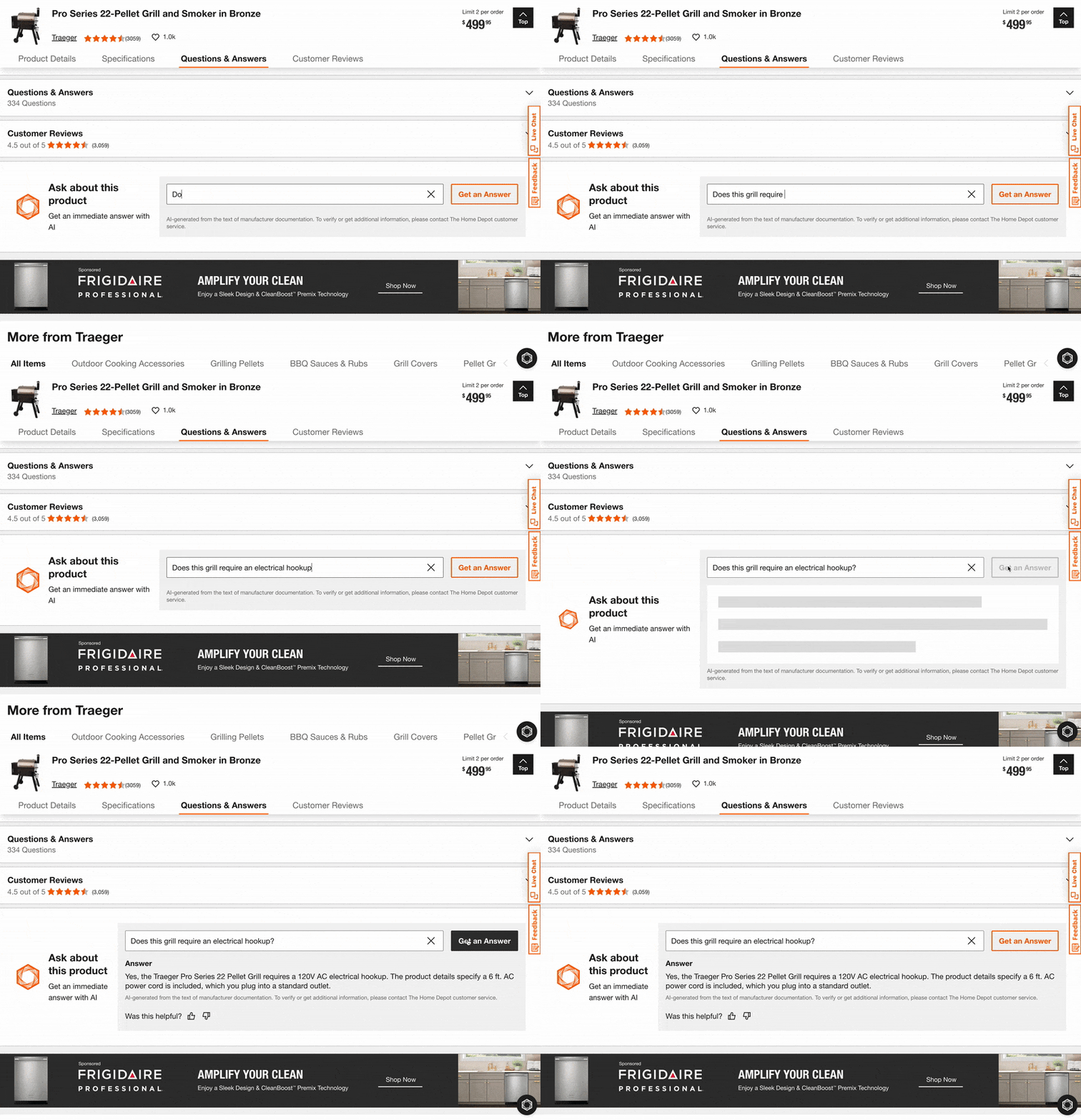
Along this mainline, The Home Depot’s AI deployment path was highly targeted. The “Magic Apron” launched in March 2025, detailed in Unveiling Magic Apron: The Home Depot’s Smartest Tool Yet, first took on AI capability-building at the knowledge-entry layer: it was launched in The Home Depot’s official app and across millions of product pages, helping customers interpret product uses, summarize review content, and move the professional knowledge of frontline store associates online, forming a complete “how-to guide”. For interconnected retail, the significance of this step was very clear: before entering a store, customers could already obtain explanations in digital channels that came much closer to the level of a store associate, compressing early-stage comprehension costs and allowing project decisions to happen earlier. By the 2025 annual report, The Home Depot had already placed Magic Apron within the same digital framework as search, recommendations, cart-building, catalog data, fulfillment, and after-sales support, and explicitly stated that such capabilities improved the customer experience, translated into higher conversion and sales performance, and at the same time supported double-digit online business growth, the highest conversion rate in the company’s history, and higher customer satisfaction. At this point, it was already possible to see that this AI deployment had begun to produce clear operating results along the real business chain.
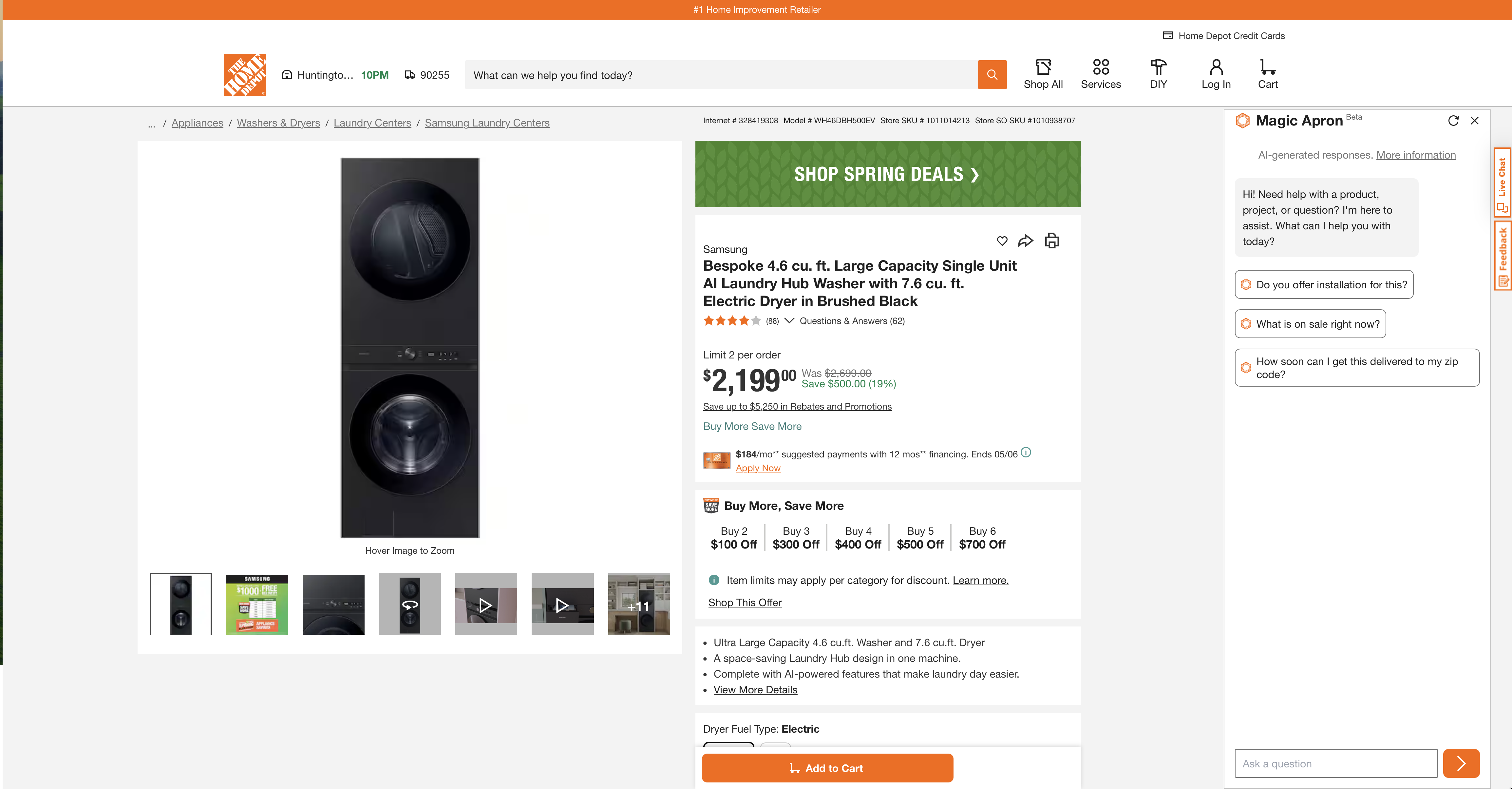
In January 2026, The Home Depot pushed this set of capabilities one step further, entering the stage of demand understanding and decision support. In the new collaboration announced by the company and Google Cloud, The Home Depot and Google Cloud Launch Agentic AI Tools to Help Customers and Associates Bring Projects from “How-to” to “Done”, Magic Apron had expanded from a simple assistant on product pages into a conversational digital companion spanning The Home Depot’s digital platform. Customers could directly describe a project in natural language, and the system no longer stopped at returning search results, instead providing project guidance and personalized recommendations, linking them with local store inventory, product locations, and aisle-level guidance; for professional customers, it could also generate materials lists to help accelerate quoting and procurement preparation. By this point, the position of the Magic Apron AI assistant had changed: it had moved beyond being a front-end tool that explained products, and had begun to move closer to project understanding, in-store guidance, and procurement preparation, all of which sit nearer to actual business actions.
This week, the AI voice agent introduced by The Home Depot pushed its AI capabilities further toward the service entry point and action triggering. According to the company announcement — The Home Depot Delivers Customer Store Phone Support Four Times Faster Using Google Cloud’s Gemini Enterprise for Customer Experience — this system can already understand customer intent through natural conversation in the telephone channel, support multiple languages, handle common issues such as order status, inventory confirmation, and store information, and can also generate carts with real-time inventory based on customer descriptions and proactively initiate purchase or other service requests. Early results from the 50-store pilot showed that the system could determine why customers were calling within 10 seconds, enabling customers to resolve problems four times faster than through traditional phone menus, and store employees were thereby freed up to spend more time serving in-store customers. Seen in this light, The Home Depot first let AI take on knowledge explanation, then moved it into project decision-making, and finally pushed it to the service entry point and the triggering of subsequent actions. Mapped onto the customer journey, this means moving from “understanding the product”, to “determining the solution”, and then to “completing the purchase or initiating a service”. The significance of this deployment route at The Home Depot also continues to answer its original intention of “creating a frictionless interconnected shopping experience” for customers.
Deployment Patterns
If The Home Depot’s AI advancement path over the past two years is abstracted into a deployment model with broader reference value, it looks more like a three-stage approach driven by a clear objective and progressively moving forward along the customer journey. This path remained aligned with its original business goal and consistently revolved around a “frictionless interconnected shopping experience”: when customers switch among channels, it first solves information-understanding problems, then solution organization and resource matching problems, and finally service-entry and downstream action-handoff problems. For that reason, The Home Depot’s AI deployment reads less like a loose stack of features and more like the continuous strengthening of capabilities at different levels along the same business chain.
Stage One: Move store knowledge online, and first shore up the knowledge entry point
The core task at this stage was to organize the knowledge originally scattered across product pages, review content, and frontline employee experience into a digital explanatory capability that customers could call upon directly. The reason The Home Depot started from this layer was practical: in the home improvement retail scenario, the earliest friction customers encounter usually comes from “not understanding, not feeling confident, and not knowing what to choose”. As long as this layer remains unsolved, in-store guidance, order conversion, and service handoff further downstream will all struggle to proceed smoothly. Thus, supplementing the knowledge entry point was, in essence, about establishing a stable comprehension layer at the very front of the customer journey. For an enterprise, the easiest value to release at this stage lies in lower early-stage comprehension costs, higher efficiency in surfacing product information, and purchase decisions that happen earlier.
If mapped to the open-source stack, this stage is closer to a “retrieval-augmented shopping knowledge assistant” architecture: LlamaIndex or Haystack can be used to build knowledge retrieval and question-answering flows, LiteLLM and AgentsFlare are well suited to unified multi-model invocation, and Phoenix or Langfuse are better suited to tracing which model calls, retrieval steps, and tool uses took place during a single Q&A exchange, helping teams continuously calibrate answer quality and latency performance. In The Home Depot’s context, this kind of capability is especially well suited to product explanation, project Q&A, and other knowledge-intensive shopping assistance interactions.
Stage Two: Let AI understand demand, and connect decisions with resources
Once the knowledge entry point has been established, the friction customers face naturally moves upward: the question is no longer simply “What is this product?”, but “What exactly should this home improvement project look like, what should I buy, and where do I begin?”. What The Home Depot advanced at this stage was allowing AI to move beyond explaining products and into demand understanding, solution organization, and resource connection. In other words, the system began to take on more complete task context and connect its suggestions with inventory, store locations, and procurement preparation. This stage matters because it pushed digital-channel understanding capability further into the decision-formation stage, and customers were no longer only getting simple informational answers, but were beginning to receive executable plans. For an enterprise, the value at this layer is already closer to the business mainline: once customer procurement needs gradually become clearer, AI can help them complete solution organization and product matching more quickly, thereby improving project conversion rates, shortening procurement cycle times, and making the handoff among online decision-making, in-store execution, and downstream transactions smoother.
When mapped to the open-source stack, this stage looks more like a stateful task orchestration system: LangGraph is well suited to this kind of agent workflow that carries context and advances step by step, LiteLLM and AgentsFlare continue to handle multi-model access and routing, and Phoenix or Langfuse are responsible for tracing the retrieval, reasoning, and tool-calling processes behind a single set of project recommendations. Through this kind of deployment, the system can compress its output into concrete recommendations that customers can directly act on.
Stage Three: Push AI to the service entry point, and begin to take on downstream actions
Once the system is already able to help customers understand products and organize solutions, the new friction continues to move further back: customers may still get stuck at order confirmation, inventory verification, store contact, service initiation, and next-step action arrangement. What The Home Depot advanced at this stage was allowing AI to move further into the service entry point and action handoff stage. The system began to understand customer intent in real time through the high-frequency service touchpoint of the telephone, and to connect downstream actions such as order status, inventory information, store information, cart generation, and service requests, taking over the first round of triage and response work that had previously required human labor. For an enterprise, this layer of capability already maps more directly to service efficiency and business outcomes: issue triage becomes faster, pressure on human reception is lower, customers resolve problems and move toward purchase more quickly, and the handoff between front-end service and downstream transaction becomes smoother.
When mapped to the open-source stack, this stage is closer to a real-time voice and action-execution system: Pipecat, AgentNest Voice Agent, and LiveKit are better suited to real-time voice interaction and audio transport, LangGraph can handle service-oriented workflow orchestration that advances step by step, OpenFGA is well suited to fine-grained permission control involving orders, services, and user information access, and Phoenix or Langfuse can be used to trace model calls, tool use, and exception nodes across an entire conversation. Through this kind of deployment, the system begins to gain the ability to identify needs in real time at the service entry point, invoke relevant resources, and turn customer problems into concrete actions that can be executed.
Where Budget Lands
If this is understood around a single center, then where The Home Depot’s budget ultimately lands is the “frictionless interconnected shopping experience” itself. What the budget is truly purchasing is a continuous experience in which customers can more easily understand, decide, and continue moving forward when switching among channels.
The Home Depot’s way of forming budget follows the nodes along the customer journey that most easily generate friction, and gradually consolidates investments originally scattered across digital guidance, project recommendations, inventory visibility, in-store navigation, phone support, and service response into a set of capability-building efforts centered on channel-linkage efficiency. In the earlier phase, budget first landed on making it easier for customers to understand products and form project understanding; later, it continued to land on enabling the system to connect project needs, product recommendations, materials lists, inventory information, and store paths; by this week, it had moved further to the phone entry point and service handoff, enabling the system to directly recognize customer intent, handle high-frequency issues, generate carts, and trigger follow-up service requests. What makes The Home Depot worth referencing is that it kept pressing budget into the places along the customer journey that are most likely to jam up, and also most likely to be validated through business results.
Accordingly, if this section is to be distilled into a clearer judgment, it can be summarized as follows: The Home Depot’s AI budget ultimately lands on improving the continuity of the cross-channel shopping chain. What it is purchasing is a channel-coordination capability that can continuously compress customer understanding costs, decision frictions, and service breaks. For enterprises beginning AI deployment today, the implication is clear: the places where budget is most likely to be approved are usually the key capabilities that can directly improve the quality of customer-journey handoffs, and that can be explained through conversion rate, response speed, service efficiency, and customer satisfaction. The practical significance of The Home Depot’s path lies precisely here: as long as budget continues to revolve around the same business strategic objective, AI investment is more likely to settle from local experiments into long-term operating capability.
Bottlenecks and Frictions
What is hardest to replicate behind The Home Depot’s path lies in whether digital foundation capability is strong enough to support continuous deployment under the same strategic goal. The reason The Home Depot has been able to continue advancing AI from the knowledge entry point to project decision-making, and then to the service entry point and action handoff, along the mainline of a “frictionless interconnected shopping experience”, is that its confidence rests on a full set of long-running digital and operational capabilities: stores, supply chain, digital assets, product data, inventory visibility, delivery networks, mobile applications, in-store navigation, orders, and after-sales support have all been continuously invested in and managed within the same system. External evaluations provide very direct evidence of this: Forrester characterized The Home Depot as a “model of pragmatic digitalization”, and Harvard Business School likewise summarized it as a digital transformation case centered on customer experience and aimed at becoming a “best-in-class interconnected retailer”. It is on the strength of a set of digital coordination capabilities that have been validated over a long period that The Home Depot’s AI route today has been able to keep unfolding under the same objective.
This is precisely the practical threshold many enterprises encounter when taking The Home Depot as a reference. Many companies likewise want to advance AI around customer experience, channel coordination, or service efficiency, but when it comes to real implementation, they often run into another situation: product information is scattered across different systems, inventory visibility is insufficient, online and in-store data are inconsistent, and customer service processes lack standardized interfaces, with the result that even though the strategic objective is clear, AI struggles to penetrate step by step along a continuous business chain. The Home Depot’s annual report in fact stated this challenge quite plainly: delivering an “interconnected shopping experience” to customers requires continued investment in operating and IT systems, and the continuous development and execution of new processes, systems, and support mechanisms. For enterprises with weaker foundations, the real obstacle lies in whether there is a sufficiently stable business chain into which AI can be steadily embedded and through which results can continue to be amplified.
For that reason, what enterprises currently need to fill in is a deployment path suited to their own conditions. The inspiration The Home Depot provides is strong, yet it is more of a mature sample than a template that can be copied directly. NextAI+ Praxis is better suited to take on the role of helping enterprises first break this mainline apart: which customer journeys already have sufficiently good digital conditions and can be prioritized; which key nodes hold high value but are held back by data fragmentation, system disconnections, or unclear processes; and which foundational capabilities need to be built first in order to support AI as it continues to advance under the same strategic objective. Only by sorting use case discovery, ROI analysis, process prioritization, data-readiness assessment, and implementation roadmaps within the same framework can enterprises become more likely to form an AI deployment chain of their own. The conclusion most worth taking away from The Home Depot case also lands here: a unified objective is certainly important, and what ultimately determines deployment quality is whether an enterprise can organize the underlying conditions, the sequence of advancement, and the capability boundaries into an executable plan around that objective.
Cite as · Enterprise AI Deployment Signals · 29 April 2026