
--As AI and agents take on more execution work, our own agency expands. The question is whether organizations are built to capture that opportunity.
The Core Managerial Question of the AI Era Is How to Redesign Work Itself
Every era of business is defined by a dominant managerial question. The industrial era asked how to scale production; the information age asked how to digitize and coordinate the enterprise. In the AI era now unfolding, work is increasingly organized around people, agents, and the systems that connect them. The question facing enterprises is therefore changing as well: when intelligence can be embedded, distributed, and increasingly delegated, how should work itself be redesigned?
This question has begun to enter the view of corporate management. Some perceptive leaders have already sensed the managerial question of the AI era, yet very few truly understand how to respond to the change. Many companies already have AI tools and have seen improvements in individual efficiency and local processes, but these changes often remain scattered use cases and pilots. They have not yet been institutionalized into stable working methods, job responsibilities, and governance mechanisms. Microsoft’s 2026 Work Trend Index Annual Report, published in May 2026, focuses precisely on this gap. Its concept of the “Frontier Firm” seeks to explain how enterprises should reorganize the relationships among employees, leaders, organizational systems, and IT and security governance.
This edition of the weekly report therefore offers a detailed reading of Microsoft’s report and, from the perspective of enterprise AI consulting, distills the implications most relevant to enterprise AI deployment, organizational redesign, and agent governance. Specifically, we believe:
The starting point of a Frontier Firm is to move AI use from individual tool operation to the redesign of work itself. As agents begin to take on more tasks, enterprises must first redraw the boundary between humans and AI: AI expands execution and analytical capacity; humans set intent, judge quality, and remain accountable for outcomes.
The key to a Frontier Firm is a reinforcing loop between employee AI capability and organizational readiness. Employees knowing how to use AI does not automatically translate into organizational capability. Leaders must adjust goals, incentives, processes, and safety boundaries at the same time, so that employees’ new capabilities can be absorbed by teams, embedded into processes, and diffused into new ways of working.
The true moat of a Frontier Firm is the ability to turn scattered AI practices into an organizational capability that can learn, scale, and be governed. Individual productivity gains and local pilots can become an enterprise’s own intelligence only when they are converted into workflow templates, job responsibilities, quality standards, review mechanisms, and agent governance frameworks.
The Starting Point of a Frontier Firm Is Employees Redefining Their Division of Labor with AI
AI Is Expanding Who Can Do High-Value Work
AI is raising the ceiling on individual capability and prompting employees to rethink how they work with AI. A privacy-preserving analysis of more than 100,000 chats in Microsoft 365 Copilot found that 49% of all conversations supported cognitive work—helping workers analyze information, solve problems, evaluate, and think creatively. The rest were distributed across working with people, producing work, and finding information.
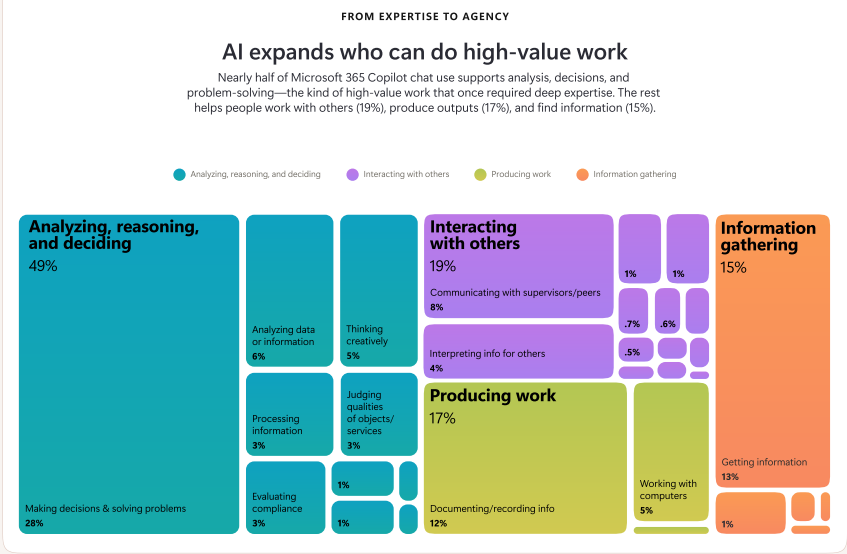
This result shows that AI’s position in the enterprise has moved significantly forward. It is no longer merely helping employees organize information, generate text, or complete basic office tasks. It is beginning to enter analysis, judgment, and solution formation—work that sits closer to high-value activity. Among the AI users Microsoft surveyed, 66% said AI allowed them to spend more time on high-value work, and 58% said they were producing work they could not have produced a year earlier. This means that employees at every level now have a partner that can help them analyze, synthesize, and deepen their own expertise, while also helping them build a foundation of capability in areas where they were previously less familiar.
Treat AI Output as a Starting Point, Not a Final Answer, and “Stay Responsible for the Thinking”
As AI raises the capability ceiling for all employees, the real differences among employees also begin to change. The distinction is no longer mainly about who uses AI more frequently; it increasingly lies in who can direct AI more maturely, judge AI output more effectively, and place AI inside real workflows. Microsoft’s report identifies “Frontier Professionals” as the group most worth watching under this shift. They use agents for multi-step workflows and build multi-agent systems; they also routinely rethink workflows and identify where agents can augment or automate. Although they represent only 16% of the AI users surveyed, they are disproportionately valuable.
They Can Reassess Work Boundaries
Once AI enters analysis, evaluation, and solution formation, employees face not only an efficiency gain but also a redefinition of responsibility boundaries. The faster outputs are produced, the more easily errors can be amplified. The deeper agents participate, the more someone must judge whether the objective is clear, whether the output is reliable, and whether the result can move to the next step.
This is why Microsoft’s report emphasizes human judgment. When asked which human skills would become more important as AI takes on more work, AI users ranked the top two as quality control of AI output (50%) and critical thinking — that is, objectively analyzing information and making reasoned judgments (46%).
The advantage of Frontier Professionals is that they turn this understanding earlier into a stable way of working. The report shows that Frontier Professionals score higher across measures related to critical thinking and quality control. In other words, they understand more clearly that AI output is not equivalent to a final result; it must pass through goal calibration, quality review, and responsibility confirmation. AI can accelerate execution, but whether something can be delivered, whether it meets the objective, and whether it contains bias still require human judgment.
They Know How to Choose the Right Human-AI Collaboration Mode
As employees’ AI use matures, the key question becomes how AI should participate in a given task. The most effective AI users will be those who redefine their value around what only humans can do: setting clear intent, defining the desired outcome and quality standard, and designing how the work gets done across humans and AI. They apply judgment and taste, build trust, and shape systems that produce better outcomes.
The maturity of Frontier Professionals is reflected precisely in this ability to use AI selectively. Compared with non-Frontier Professionals, they are more likely to say they intentionally do some work without AI to keep their skills sharp (43% vs. 30%), and more likely to say they intentionally pause before starting work to decide what should be done by AI and what should be done by a human (53% vs. 33%).
Microsoft’s four modes of working with AI—asking, delegation, collaboration, and exploration—can also be understood within this framework.
These four modes depend on two dimensions: whether humans are primarily directing the work or supervising quality, and whether AI acts more like an assistant or more like a teammate.
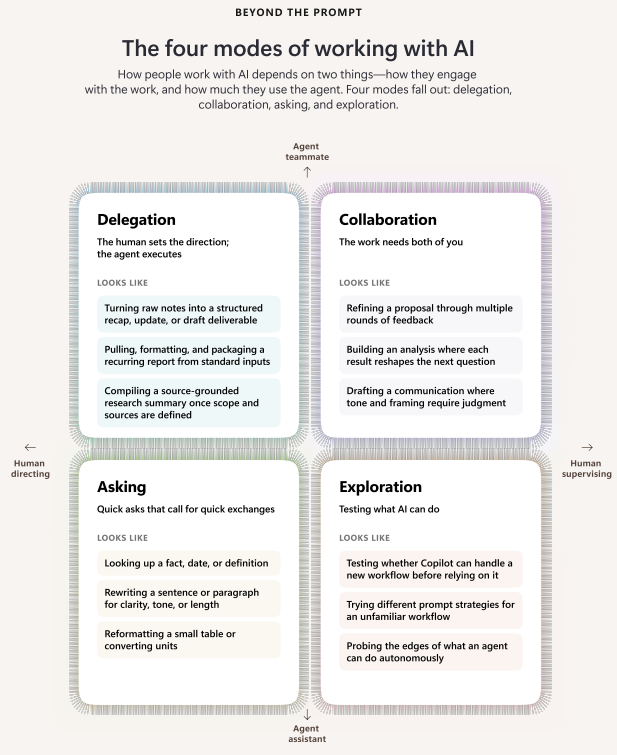
In the asking mode, AI mainly handles information retrieval and basic organization. It is suitable for clearly bounded tasks such as looking up a fact, confirming a date, rewriting a sentence, or reformatting a table. Here, humans are responsible for asking the question and judging whether the result is usable, while AI acts more like a fast-response information assistant.
In the delegation mode, humans set direction while AI undertakes a more complete execution task. Examples include turning raw notes into a structured summary, generating a recurring report from standardized inputs, or compiling a source-grounded research brief. These tasks usually have clear goals, stable formats, and checkable results, making them better suited for AI to take on a higher share of the execution work.
In the collaboration mode, the work needs humans and AI to move forward together. Employees can use multiple rounds of feedback to refine a proposal, ask AI to help construct an analysis, and use each result to surface the next question. The key here is continuous interaction: AI is not merely providing a one-off answer; it participates in shaping ideas and refining solutions.
In the exploration mode, employees test the boundaries of AI’s capabilities. For workflows that have not yet matured, employees can first ask AI to attempt the work, and then judge which parts can be augmented and which still require human leadership. These tasks are more open-ended and depend more heavily on human control over quality, tone, framing, and risk.
The capability of Frontier Professionals does not lie in using one fixed AI mode. It lies in choosing the right human-AI relationship according to the certainty, complexity, and quality requirements of the task. Frontier Professionals refuse to outsource their thinking: they know that long-term success means continuing to build human skills, not allowing those skills to atrophy through overreliance on AI.
Employee Capability Upgrades Begin with Task Judgment Before Each Piece of Work
For ordinary employees, the first step toward becoming Frontier Professionals is to complete a task judgment before starting each piece of work. When facing a specific task, employees should first judge whether the goal is clear, whether the result is checkable, whether the process is stable, and whether the quality risk is controllable. Work with clear goals and stable processes can be handed more readily to AI through asking or delegation. Work that still requires judgment, framing, tone control, and accountability should be advanced through collaboration and exploration.
This shift moves employees from “starting execution directly” to “first designing how the work will be completed.” Employees need to incorporate AI into their own working methods: define the goal, choose the collaboration mode, review the output, and remain responsible for the result. Only when employees form this habit will the capability expansion brought by AI truly translate into individual capability upgrading.
The Key to a Frontier Firm Is Leaders Redesigning the System Around Employees
Most Organizations Are Not Yet Built to Absorb the Expansion of Individual AI Capability
Employees can redefine their division of labor with AI and gradually develop toward Frontier Professionals. But whether this change can truly become enterprise capability depends on whether the system around them changes in parallel. If a company continues to manage them with old goals, old processes, and old performance systems, these capabilities will easily remain the personal experience of a small number of employees and will be difficult to diffuse into new ways of working at the team and organizational levels.
Microsoft’s report examines AI users along two dimensions: individual AI capability and organizational AI readiness. The former reflects employees’ ability to use AI, direct AI, judge AI output, and learn from it. The latter reflects whether the organizational environment around employees has the conditions to support AI use, process redesign, and experience diffusion. Based on the relative positions of these two dimensions, the report divides surveyed AI users into five groups.
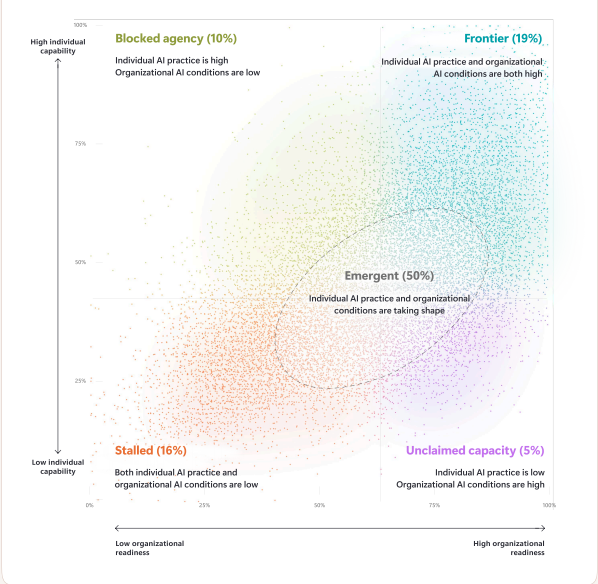
The data shows that only 19% of AI users are in the Frontier zone, where both individual AI capability and organizational readiness are high and mutually reinforcing. 10% fall into the blocked-agency zone: they have built relatively strong individual AI capability but lack an organizational system that can absorb and apply it. 5% are in the unclaimed-capacity zone, where organizational conditions are strong but employee capability has not yet caught up. 16% are stalled, with both individual capability and organizational support at relatively low levels. The largest share, 50%, sits in the emergent zone, where individual practice and organizational conditions are still taking shape together.
The value of this chart is that it makes the systemic differences in AI transformation visible. The advantage of Frontier Firms comes from the mutual reinforcement between individual AI capability and organizational readiness. Employees can use AI to redesign work, while the organization can absorb this new capability through culture, management practices, process rules, and incentive mechanisms. Together, the two form a positive cycle.
However, Microsoft’s interpretation of this chart—that “workers are ready, their organizations aren’t”—requires a more careful reading:
First, the survey sample excluded respondents who never use AI or do not know whether they use AI. The chart therefore describes knowledge workers who already use AI, not the overall state of all employees within enterprises. The claim that “workers are ready” is therefore somewhat sweeping.
Second, among these AI users, the largest group is not the high-individual-capability, low-organizational-support “blocked agency” group, but the “emergent” group, where individual practice and organizational conditions are taking shape together. The phrase “organizations aren’t keeping up” risks overstating the degree of disconnection between employees and organizations.
A more accurate judgment is therefore this: among knowledge workers who already use AI, most individual AI practices and organizational support systems are co-evolving, while a subset of highly mature users has already exposed the problem of insufficient organizational absorption capacity. What leaders truly need to address is the positive cycle between individual AI capability and organizational support: employees’ new capabilities need to be absorbed by the organization, and new organizational mechanisms need to amplify employees’ AI practices in return. This is consistent with our judgment on “people absorption” in Enterprise AI Deployment Signals Weekly 6: after AI enters workflows, enterprises need to reorganize how they absorb AI around role capabilities, training mechanisms, and related organizational arrangements.
The Core of the Transformation Paradox Is That Legacy Performance Systems Continue to Reinforce Legacy Ways of Working
The report shows that among surveyed AI users, only 26% say leadership is clearly and consistently aligned on AI. 65% of AI users fear falling behind if they do not use AI to adapt quickly, yet 45% say it feels safer to focus on current goals than to redesign work with AI. Only 13% of AI users say they are rewarded for reinventing work with AI even if results are not met.
This set of data points to a clear organizational pressure point: employees already feel the pressure to adapt to AI and see the possibility of redesigning work, but performance goals, incentive mechanisms, and risk rules still pull them back toward old ways of working. What leaders need to do is make AI-driven work redesign a kind of work that is allowed, visible, evaluated, and rewarded. Employees need to know which AI experiments they may attempt, which processes can be redesigned, which failures can be accepted, and which new ways of working will be reflected in performance evaluation. Without these signals, employees who possess AI capability will still prioritize current goals and avoid the risk of taking on work redesign.
Therefore, what leaders must first change is the evaluation system behind the old way of working. AI-driven work redesign must become work that is allowed, visible, evaluated, and rewarded. Only when goals, incentives, and safety boundaries are adjusted together will employees have the motivation to move AI from an individual productivity tool into process redesign and updated team working methods.
Manager Modeling of AI Use Directly Changes How Employees Understand AI
Next, managers must personally demonstrate how AI enters real work. A Microsoft-led study of 1,800 workers globally found that when managers actively modeled AI use, employees reported a 17-point lift in AI value, a 22-point lift in critical thinking about their AI use, and a 30-point lift in trust in agentic AI. When managers created psychological safety around experimentation, employees reported up to 20 points higher AI readiness and AI value, and were 1.4 times more likely to be high-frequency users of agentic AI.
These data show that manager modeling directly changes how employees understand AI. When managers use AI openly, AI enters real work processes. When managers discuss the quality of AI output, teams begin forming new quality standards. When managers allow experimentation and review, employees gain room to try redesigning work. Managers in the AI era need to show how AI participates in task decomposition, quality judgment, process redesign, and outcome review, so that teams can see what high-quality AI use looks like as a way of working.
This adjustment directly affects whether Frontier Professionals can emerge. Microsoft’s report shows that, compared with non-Frontier Professionals, Frontier Professionals are more likely to say their managers openly use AI (85% vs. 64%), set quality standards for AI work (83% vs. 57%), create space for experimentation (84% vs. 61%), and encourage more ambitious work redesign (87% vs. 61%). They are also more likely to say they are rewarded for reinventing work with AI even if outcomes are not met (26% vs. 11%).
This comparison shows that Frontier Professionals tend to emerge in management environments that are clearer, safer, and more encouraging of reinvention. Employees need to learn to work like Frontier Professionals, and leaders also need to create the conditions for more employees to become Frontier Professionals. When managers model AI use openly, set quality standards for AI-assisted work, allow employees to experiment, and encourage more ambitious redesign of work, AI can move from an individual productivity tool into a team working method.
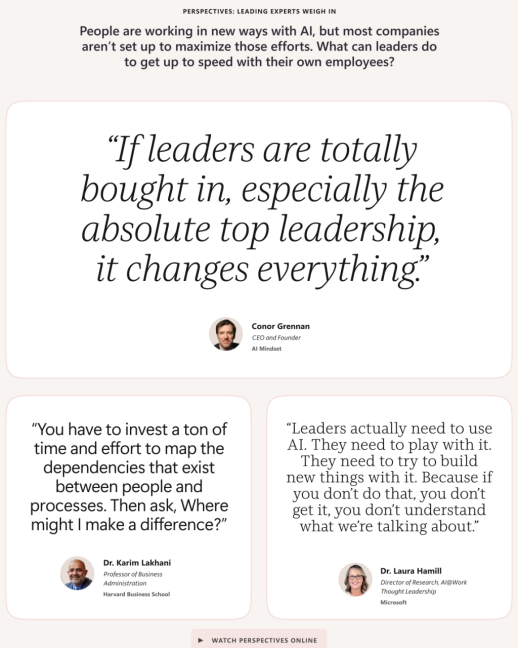
The role of leaders is to move employees’ AI practices from individual exploration into team practice. They need to set direction, adjust incentives, model methods, and establish standards so that employees dare to redesign work and know how to judge the quality of AI-assisted work. The next layer of change happens at the organizational level: enterprises need to capture these AI practices and institutionalize them into processes, standards, and organizational knowledge, thereby becoming Learning Systems capable of continuously absorbing AI experience.
The Moat of a Frontier Firm Is Turning AI Practice into a Learning System
Organizational Factors—Culture, Manager Support, and Talent Practices—Explain Twice as Much AI Impact as Individual Effort Alone
Employees can redefine their division of labor with AI, and leaders can redesign the system around employees. But whether a company can truly become a Frontier Firm also depends on a third capability: whether the organization can capture AI practices scattered across employees, teams, and processes, and turn them into organizational knowledge that can be reused, diffused, and governed. Microsoft’s report summarizes this point in one sentence: Every firm is a Learning System.
The key to this statement is not the concept of “learning” itself, but whether the enterprise has the capacity to absorb AI experience. Microsoft’s report measured 29 factors affecting AI impact, and the top three were all organizational factors. The single strongest factor was organizational AI culture. Organizational factors explain roughly twice the AI impact of individual factors, at 67% versus 32%. Organizational AI culture is about 2.5 times as strong a signal as the strongest individual factor.
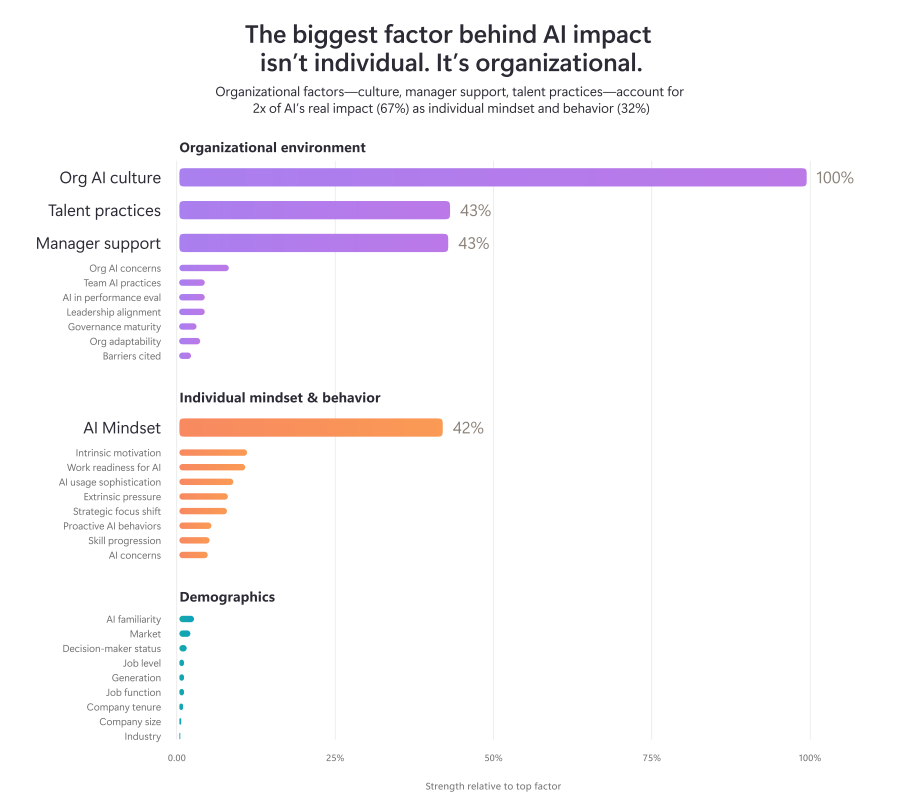
This data shows that the release of AI capability cannot rely solely on individual employee initiative. Whether employees can consistently apply AI to high-value work, share experience, review mistakes, and form standards depends to a greater degree on whether the organization provides an environment capable of absorbing these behaviors. In our analysis of agent workspaces in Enterprise AI Deployment Signals Weekly 7, we saw a similar mechanism: a truly valuable agent workspace centers on enabling business teams to continuously create, provide feedback on, and reuse agents around real tasks, so that individual experience enters team workflows. Frontier Professionals can provide the starting point, and leaders can provide direction, but the organization must further turn individual practice into a shared method.
Microsoft’s team-level data further supports this point. Compared with non-Frontier Professionals, Frontier Professionals are more likely to say their teams brainstorm and refine business processes together to identify AI opportunities (63% vs. 32%), share AI tips, new agents, learnings, and mistakes (61% vs. 36%), and discuss quality standards for AI-assisted work (54% vs. 29%).
These actions form the basic units of organizational learning. Process discussion moves AI opportunities from individual experience into business scenarios. Sharing experiences and mistakes moves AI practice from individual use into team review. Discussing quality standards determines which AI outputs can be accepted, reused, and scaled. A Learning System is not an abstract slogan; it happens in these specific team behaviors.
More importantly, AI practices need to be documented. Microsoft’s report shows that, compared with non-Frontier Professionals, Frontier Professionals are more likely to report that agent workflows, human-agent handoffs, and quality standards are documented and repeatable: at the team level (26% vs. 19%), function level (29% vs. 17%), and organization level (25% vs. 14%).
This data points to the real moat of Frontier Firms. AI workflows, handoffs, and quality standards become organizational assets only when they enter documents, training, processes, and institutions. Otherwise, companies will accumulate many AI practices that are “effective but not replicable”: individual employees know how to use AI, individual teams have made it work, but the practice cannot continue once it moves to another person or another department.
Every Frontier Firm Needs to Build Owned Intelligence
When Frontier Firms can continuously capture signals from AI work, turn effective experience into shared processes, and form repeatable standards at the team, function, and organization levels, they begin to build what Microsoft calls Owned Intelligence: institutional know-how that compounds over time, is unique to the firm, and is hard to replicate. In Enterprise AI Deployment Signals Weekly 3, we referred to this kind of capability as an “enterprise operating asset.”
At the organizational level, AI transformation ultimately needs to solve the question of how experience is institutionalized. Employees are responsible for reassessing the human-AI division of labor; leaders are responsible for creating a system that permits reinvention; the organization is responsible for turning effective practices into long-term capability. Microsoft’s “AI-ready environment” can be understood in this way: culture makes AI a strategic advantage, managers bring AI into real work, and talent practices give employees both the capability and the space to use AI continuously. Only when these three conditions appear together can companies turn scattered AI practices into their own organizational Learning System.
The Foundation of a Frontier Firm Is an Infrastructure for Agents That Can Be Evaluated and Governed
Once organizations begin to turn AI practices into processes, standards, and Owned Intelligence, the next question becomes more specific: who should evaluate, update, and monitor the workflows in which agents participate? Microsoft’s report states that creating these systems requires a disciplined approach to holding humans accountable for the work that agents execute.
This issue is becoming urgent. Microsoft’s report shows that the number of active agents in the Microsoft 365 ecosystem has grown 15 times year over year, and 18 times in large enterprises. As the number of agents grows, enterprises need to focus not just on deployment scale, but on which processes these agents are entering, which data they are accessing, which actions they are executing, and which outcomes they are affecting.
The more work agents take on, the more important evaluation infrastructure becomes. If a bad output remains in front of a single employee, the risk is relatively manageable. But when bad outputs make it through business processes at scale, the risk compounds. Companies cannot simply ask employees to “use AI carefully.” They need a systematic evaluation mechanism that can keep up with the speed of agent operations.
The report raises three questions that every Frontier Firm must answer: Who reviews agent performance? Who has the authority to update the workflows that agents run? How does a local win get captured and scaled across the organization? These three questions correspond to evaluation, authority, and diffusion mechanisms. If companies cannot answer them clearly, agents will remain in scattered use and local automation. If they can answer them clearly, they have the opportunity to turn the experience generated by agent operations into reusable organizational capability.
This is also why IT and security teams enter the core architecture of Frontier Firms. For IT leaders, agents need to be treated as managed entities. They require identities, permissions, policy enforcement, and lifecycle management. Once agents enter business processes, the company must know who they are, what they can access, what they can execute, when they should be updated, and when they should be retired. This issue had already begun to surface in Enterprise AI Deployment Signals Weekly 2: as AI is embedded into different enterprise software systems such as finance, supply chain, and customer experience, companies need an identity and control framework that can consistently identify, authorize, and revoke agents. IT teams will become the control plane for agent operations, extending the rigor previously applied to user accounts and enterprise applications to agents as well.
For security teams, the risks introduced by agents also need to be incorporated into system design in advance. Data exfiltration, unintended system actions, and unauthorized access become more complex as agents participate in execution. Security governance cannot rely on after-the-fact inspection; monitoring, policy enforcement, and auditability need to be embedded directly into the platform, so that trust becomes a structural property of the system.
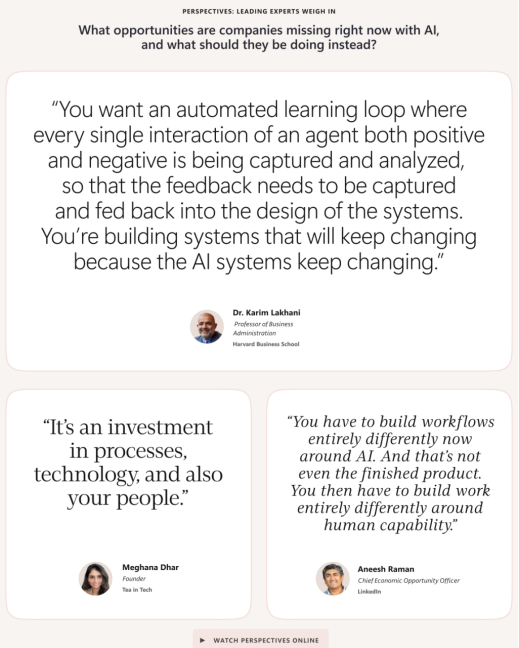
At this point, the four roles of a Frontier Firm form a complete loop: employees redefine their division of labor with AI; leaders redesign the system around employees; organizations turn AI practices into learning capability; and IT and security teams build the identity, permissioning, evaluation, and audit foundation for agent operations. When all four layers change together, AI truly enters the enterprise operating system and becomes an organizational capability that can learn, scale, and be governed.
Conclusion and Reflection
Microsoft’s report provides companies with a clear direction: enterprise transformation in the agentic era needs to happen simultaneously across employees, leaders, organizational systems, and IT and security governance. Employees need to redefine their division of labor with AI; leaders need to redesign the system around employees; organizations need to turn AI practices into learning capability; and IT and security teams need to build an evaluable and governable foundation for agent operations.
For many companies, however, understanding this framework is only the starting point. Traditional enterprises and small and medium-sized businesses may agree with the judgments in Microsoft’s report, but they often lack the full set of conditions required to develop into Frontier Firms: they may not have mature AI talent development systems, mechanisms that can continuously drive process redesign, or dedicated IT, security, and governance teams to manage agent identities, permissions, evaluation, and auditability. The challenge they face is usually not that they “do not know AI matters,” but that they lack an executable, staged path for implementation.
This is where NextAI+ Praxis can intervene. The value of NextAI+ Praxis lies in helping enterprises translate the idea of the Frontier Firm into concrete action: starting with identifying business scenarios that should be prioritized for agentic transformation, clarifying human-AI division-of-labor boundaries, establishing quality standards for AI-assisted work, and then gradually building workflow templates, review mechanisms, and a basic governance framework. For companies that do not yet have complete IT and security capabilities, NextAI+ Praxis can also help them first establish a minimum viable agent governance framework, allowing them to advance AI deployment in an orderly way even under capability constraints.
This Microsoft report also shows us that the judgments NextAI+ Praxis has distilled from enterprise cases, hiring signals, product architectures, and deployment frictions in recent weekly reports are beginning to echo the research framework of a global technology leader. When AI output increases, companies need review mechanisms. Professional knowledge needs to be turned into operating assets. Job capabilities will be redefined by AI. When agents enter workflows, identity, permissioning, and governance issues follow. These observations now receive more systematic data support in Microsoft’s report. The fact that we can distill enterprise-relevant judgments from the same wave of AI transformation is also why NextAI+ Praxis is committed to continuing this exploration.
Further Reading
The public research and NextAI+ Praxis weekly reports referenced or recommended in this analysis are listed below for further reading. Publication years and links should be verified against official sources.
- Microsoft, 2026 Work Trend Index Annual Report, 2026.
- NextAI+ Praxis, Enterprise AI’s Real Inflection Point: After Standardized Processes Enter Production, Governance and Coordination Become the New Constraints, Enterprise AI Deployment Signals Weekly 1, 2026.
- NextAI+ Praxis, The Fragmented New Stage of Enterprise AI Deployment: When Agents Are Embedded into Software, Enterprise AI Deployment Signals Weekly 2, 2026.
- NextAI+ Praxis, Enterprise AI Enters the Stage of Operating Asset Management: From Deployment Expansion to Value Measurement and Dynamic Trade-offs, Enterprise AI Deployment Signals Weekly 3, 2026.
- NextAI+ Praxis, Job Redesign After AI Deployment: From Process Absorption to People Absorption, Enterprise AI Deployment Signals Weekly 6, 2026.
- NextAI+ Praxis, When AI Deployment Becomes a Product: The Deployment Logic and Applicability Boundaries of Agent Workspaces, Enterprise AI Deployment Signals Weekly 7, 2026.
This article primarily refers to Microsoft’s 2026 Work Trend Index Annual Report, published in May 2026 and authored by Dr. Karim Lakhani. It also incorporates observations from NextAI+ Praxis’s past Enterprise AI Deployment Signals weekly reports for compilation, paraphrase, and analysis. The data, figures, concepts, and views from Microsoft’s report are owned by their respective rights holders. NextAI+ Praxis has provided organization, conceptual explanation, and extended interpretation from the perspective of enterprise AI deployment. This article does not represent Microsoft’s official position.
This article is intended only for research, commentary, and exchange. If any compilation, paraphrasing, or image use contains inaccurate wording, incomplete source attribution, or copyright-related concerns, please contact us through the official account backend or at [email protected]. We will promptly review the issue and make corrections or remove the relevant content where necessary.
We welcome direct messages or comments telling us which enterprise AI practice topics you are curious about. You are also welcome to leave a message at NextAIPraxis.com or contact us at [email protected] with real challenges your enterprise is facing. We will respond within two business days and invite you to join our practice-sharing community.
Cite as · Deep Reads · 10 July 2026