
“Organizations are deploying agentic coding tools and coming to grips with the costs of AI while still seeking to capture more of the benefits that their workers are deriving from their individual use of AI.” This is how McKinsey & Company summarizes the progress of enterprise AI in this year’s survey report. The global management consulting firm has tracked the development of AI for nearly a decade and now observes a clear shift: AI is moving from localized experiments into more business functions. Employees are seeing tangible benefits, while enterprises are looking beyond isolated efficiency gains. They expect technology to become embedded in workflows and ultimately improve overall business performance.
On August 25, 2026, McKinsey and its AI arm, QuantumBlack, released “The state of AI in 2026: On the road to ROI.” The survey, which covers 1,719 respondents across 97 countries, finds that among organizations already using AI, the share of respondents reporting enterprise-wide scaling rose from 38% the previous year to 44%. The share reporting scaled use of AI agents at large enterprises also rose, from 27% to 40%. The breadth of AI use within enterprises and the depth of its involvement in work are both continuing to grow.
Business returns, however, are moving at a different pace. Among respondents who use AI at work, 80% say it has improved their productivity, and about half say it helps them make better decisions; yet only 37% report that AI has made a positive contribution to their organization’s earnings before interest and taxes (EBIT), essentially unchanged from last year. The gains employees experience and the returns enterprises realize are advancing at different speeds.
This is what makes the report worth a closer look. Individual activities are already delivering cost reductions, revenue growth, and innovation; the next task for managers is to carry those gains through business workflows so they become returns the whole enterprise can sustain. McKinsey observes that AI high performers more often fundamentally redesign workflows, with leaders continually driving adoption and measuring results. For AI’s value to move from individuals and departments to the enterprise as a whole, managers need the courage to “break, then build”: to rearrange how work gets done and who is responsible for the outcome.
Enterprises Are Already Seeing Benefits, but Value Appears at Different Levels
The benefits AI produces within enterprises are already spread across several levels. McKinsey records overall financial performance, cost reductions and revenue gains in individual business functions, and broader changes in innovation, competitive differentiation, and satisfaction. Even where AI has yet to register in enterprise-wide EBIT, some respondents have already seen financial gains in specific functions.
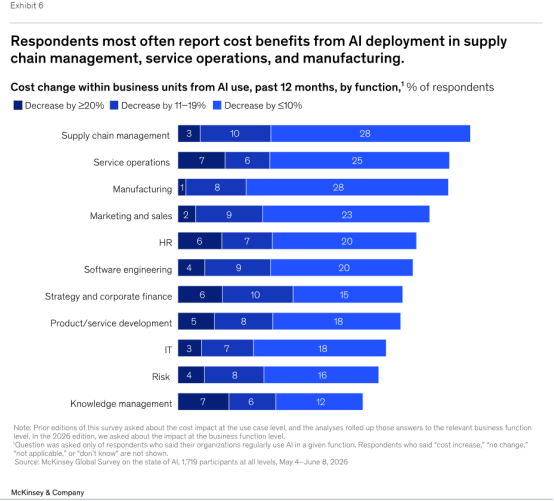
Cost-side changes are most apparent in supply chain management, service operations, and manufacturing. Among respondents whose organizations have deployed AI in the relevant function, 41%, 38%, and 37%, respectively, report lower costs over the past year. The report’s detailed chart also shows the scale of these reductions: in all three functions, improvements of less than 10% are most common, while some respondents report double-digit declines.
Revenue-side gains follow a different pattern. Marketing and sales, and product and service development, are the two functions most frequently reporting revenue growth: among respondents at organizations using AI in these functions, 37% and 36%, respectively, say their business unit’s revenue increased over the past year. These changes have reached business-unit revenue measures, beyond the speed of an individual employee’s work.
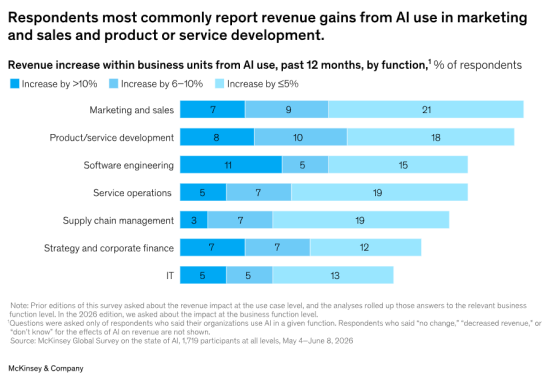
Taken together, the two figures show the distribution of AI’s benefits more clearly: supply chain, service operations, and manufacturing see more improvement on the cost side, while marketing and sales and product development see more on the revenue side. Beyond financial metrics, the report also records improvements in innovation, competitive differentiation, and customer and employee satisfaction. Enterprises are already deriving value from AI; These benefits appear in different financial and operational measures.
An Entire Workflow Stands Between Local Gains and Enterprise Returns
Employees work faster, business functions reduce costs and increase revenue, and enterprises also improve innovation, competitive differentiation, and customer and employee satisfaction. Faced with these changes, it is natural to expect these varied gains to flow gradually into overall profit. Yet McKinsey’s survey finds that only 37% of respondents say AI has made a positive contribution to their organization’s EBIT, a share essentially unchanged from last year. Individuals, departments, and organizations are all seeing benefits. Why, then, are improvements in overall profit not yet visible at more enterprises?
Start with employees’ work. AI can help people draft, analyze, or retrieve information faster, but whether the time saved turns into more or better work depends on how the subsequent tasks connect. If employees must still move materials around repeatedly and wait for approvals in the old way, speeding up one step may not speed up the work as a whole.
Gains made by a department must also cross the boundaries between functions. Lower costs in supply chain management often involve adjacent activities such as procurement, inventory, production, and delivery; revenue growth in marketing and sales also depends on reliable follow-through in service and delivery. If one department changes how it works while others keep their old pace, local improvements may not travel far. Task allocation, information flow, and decision-making across the entire business chain need to change together before functional gains can contribute more fully to enterprise-wide performance.
At the enterprise level, resources must be allocated to this new way of working. Connecting to business systems, organizing data, training employees, and calling models in ongoing operations all require investment; as agents take on more complex work, operating expenses such as tokens also enter managers’ calculations. Among respondents at organizations that regularly use AI in their business, about one in five say AI operating costs have begun to constrain its use. At the same time, 60% expect their organizations to increase AI investment over the next year. Together, these figures reveal a practical question for management: how to make the necessary investment support valuable applications and, through sustained use, generate business returns sufficient to cover the costs.
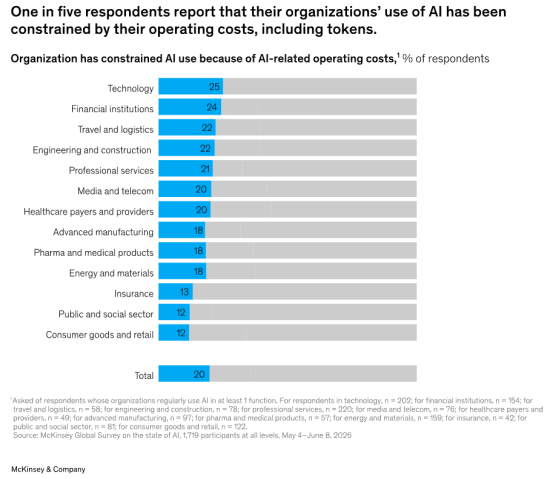
Individual productivity, departmental gains, and enterprise investment have therefore all come before managers at this stage. Whether they can combine into steadier enterprise-wide returns depends on how organizations now arrange AI use. The enterprises in McKinsey’s survey that already report a relatively high AI contribution to profit offer a further line of inquiry.
How AI High Performers Bring AI into the Entire Workflow
McKinsey classifies respondents who both attribute at least 5% of their organization’s EBIT to AI and describe its value as “significant” as “AI high performers”; They account for 6% of the total sample. The first difference between high performers’ organizations and others lies in what they expect from AI: the two groups are similarly likely to pursue efficiency, but 74% and 65% of high performers, respectively, cite growth and innovation as AI objectives, versus 47% and 49% of other respondents. They want AI-driven change to move beyond individual roles and into broader business activities.
These expectations are reflected in what they do. Nearly three-quarters of high performers say their organizations have fundamentally redesigned workflows because of AI use; Among other respondents, the share is about one-quarter. The share of high performers reporting workflow redesign has continued to rise from 55% last year.
As they build new ways of working, they are more likely to report sustained senior leadership involvement in AI deployment, clear decisions about which model outputs require human validation, processes for measuring results, and active management of costs such as tokens and computing power. The report also finds that high performers are more than twice as likely as other organizations to allocate over 15% of their information and communication technology budget to AI. In these enterprises, investment, workflow redesign, and outcome measurement are considered together.
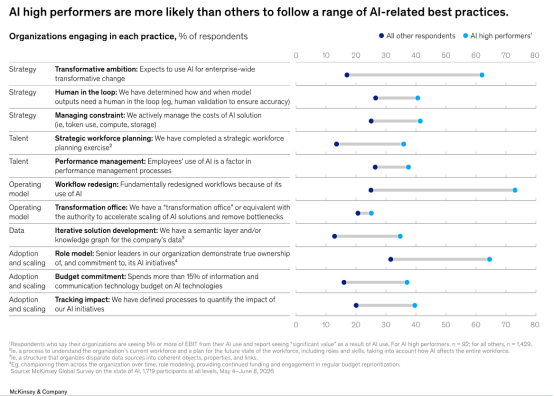
These practices give concrete content to “break, then build”: enterprises need to reexamine how a task runs from beginning to end, where AI participates, and how employees’ time and responsibilities should change. We can understand this shift at three levels—“point—line—network”: individual tasks, end-to-end workflows, and enterprise-wide coordination. As the scope of change widens, employees, workflow owners, and senior leaders take on different responsibilities.
- Point means improving AI use at a specific task node: in contract drafting, for example, an employee can have AI produce a first draft, then check key clauses and correct omissions or errors; if the output is unreliable, the employee can return the task to human handling or adjust how AI is used, while remaining responsible for the final document. At this level, the focus is on quality, time spent, and rework.
- Line means connecting multiple task nodes smoothly within a business workflow: the workflow owner needs to specify how materials enter an AI-handled stage, how the output passes to the next person, which decisions humans make, who handles exceptions, and who accepts the result. Once an upstream node speeds up, downstream approvals and delivery must be able to keep pace, so a point improvement becomes an improvement in the efficiency and quality of the whole workflow.
- Network means coordinating multiple workflows and the resources they share at the enterprise level: senior leaders need to decide which workflows to redesign first, align data, access rights, and responsibilities across departments, allocate budgets for system development and ongoing costs such as tokens, and measure investment and returns in a consistent way. Enterprises also need to consider which capabilities to build themselves and which to continue buying. In the report’s wider enterprise sample, 32% of respondents say their organization decided against purchasing at least one software product or feature because it could develop it in-house using coding agents. Such decisions bear on the enterprise’s technology path and allocation of investment.
Conclusion and Reflection
McKinsey’s choice of “On the road to ROI” as the report’s title aptly captures the stage enterprise AI has reached: employees and departments are already seeing benefits in their work, while enterprises are still finding ways to bring those gains more consistently into overall performance. High performers offer a point of reference: keep investing while adjusting workflows, roles and responsibilities, and outcome measurement together.
For managers, “break, then build” can begin with a specific workflow. Understand how it operates today, decide where AI should take on tasks and where people should exercise judgment and oversight, then connect processes across departments and test the investment against final outcomes. Only when the work itself changes can gains scattered across employees and departments accumulate into returns for the enterprise as a whole.
Further Reading
The following materials offer further reading. Publication dates and content should be checked against the original source pages.
- McKinsey and QuantumBlack, “The state of AI in 2026: On the road to ROI”, published August 25, 2026. The principal source for this article, covering enterprise-wide AI scaling, benefits at the individual and business-function levels, contributions to EBIT, and the practices of AI high performers.
- McKinsey and QuantumBlack, “The state of AI in 2025: Agents, innovation, and transformation”, published November 5, 2025. The previous year’s survey provides a comparison on enterprise-wide AI scaling, innovation-related benefits, and workflow redesign.
- McKinsey and QuantumBlack, “Where AI agents pay off: A practical guide to the economics of agentic workflows”, published August 24, 2026. A further discussion of costs such as tokens, human review, and infrastructure, and of how to assess investment and returns across a complete workflow.
Sources and Copyright
This article synthesizes and analyzes McKinsey and QuantumBlack’s publicly released “The state of AI in 2026: On the road to ROI.” The survey data cited here come from that report; Figures 1 through 4 correspond to its Exhibits 6, 7, 8, and 11, respectively. “Point—line—network” is this article’s own synthesis of the responsibilities and scope of change involved in enterprise AI deployment.
Rights to the quoted text, charts, and related marks belong to McKinsey or the respective rights holders. This article is an independent work of research and commentary and does not represent McKinsey’s official position or endorsement. If any rights holder has questions about the quotations, translation, or use of charts, please contact [email protected]; We will review them promptly and correct or remove the material as appropriate.
We welcome you to share in the comments the workflows you are trying to redesign and the practical difficulties you encounter along the way.
Cite as · Deep Reads · 14 October 2026