
On September 10, 2026, Technology Ireland DIGITAL Skillnet released Right-Sizing AI at Work: Workforce Transformation and Human-Machine Partnerships in Ireland, a study completed by Ireland’s SOHAM research team. Drawing on a survey of 487 employees, a scenario-based experiment involving 421 participants, and interviews with 32 senior executives, the research examines how AI is reshaping tasks, changing skills, and influencing human–machine collaboration.
Frequent Use Does Not Mean AI Is Being Used Where It Fits Best
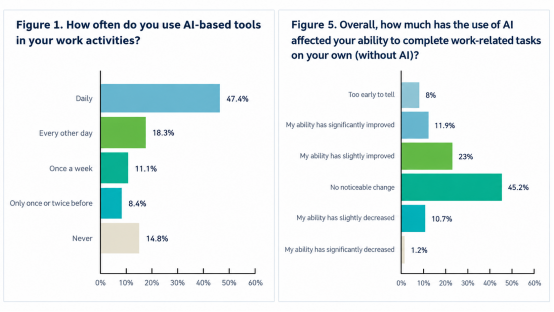
For many employees, using AI is becoming an everyday choice at work. In the employee survey reported by SOHAM, 47.4% of respondents used AI at work every day, another 18.3% used it every other day, and 11.1% used it once a week. Together, these groups accounted for 76.8%, indicating that most respondents had already developed relatively regular usage habits.
Yet despite frequent use, most respondents reported only limited changes in their ability to complete work independently. Some 45.2% believed that their ability to complete tasks without AI had not changed noticeably; another 23% reported a slight improvement, while 10.7% reported a slight decline. These three responses totaled 78.9%, nearly eight in ten, and were largely concentrated around “no noticeable change” or “only slight change.” The report also found that 40.9% of respondents said they were not dependent on AI. The widespread adoption of routine use therefore coexists with a substantial share of employees who still feel they do not rely on AI. This raises a question worth examining further: what kind of working relationship have people and AI actually developed?
One possible explanation is that AI has already taken on the tasks best suited to it. Employees devote more attention to professional judgment, reviewing outcomes, and handling exceptions, resulting in a clear and efficient division of labor between humans and machines. Another possibility is that AI remains concentrated in scattered support tasks and has not yet fully entered the core of work. Under both working models, employees may retain the ability to work independently, but the depth of AI’s involvement in their work differs markedly.
AI Mostly Handles Individual Tasks, While People Still Connect Many Workflows
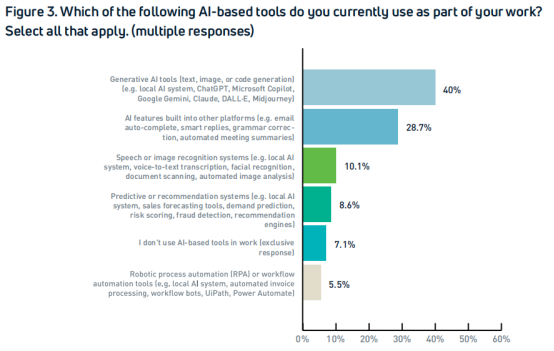
The report’s survey of actual uses and its management interviews provide evidence for assessing which of these two models current human–AI collaboration more closely resembles. In the distribution of responses by tool type, generative AI tools accounted for 40%, making them the most common category; AI features built into other platforms came next at 28.7%, including email autocomplete, grammar correction, and meeting summaries. By contrast, robotic process automation and workflow automation tools accounted for just 5.5%. General-purpose generative tools and AI features within existing software are the more common entry points for use.
Management interviews further illustrate how these tools fit into work. In many organizations, AI applications are concentrated primarily in routine and administrative activities, such as drafting materials, generating reports, retrieving information, extracting data, and supporting functions including human resources, finance, and customer service. Employees use AI to complete some of these steps, freeing up time for more complex work. These applications already provide practical assistance, but they are largely organized around individual tasks.
At the same time, a small number of managers interviewed, particularly those in technology and engineering, began discussing agentic systems capable of carrying out multiple consecutive steps, including parts of customer onboarding and software development workflows. Respondents from more traditional industries, by contrast, more often described exploratory, fragmented, or narrowly scoped applications. This suggests that progress from assisting individual tasks toward integrating workflows remains uneven across organizations.
Taken together, these observations lead us to interpret the common pattern shown in the report as “employees leading the work, with AI assisting as needed.” Under this model, AI may participate frequently in certain steps, but employees remain primarily responsible for sequencing tasks, connecting stages, and driving work through to completion. AI makes it easier for people to perform their existing work, while a deeper division of tasks between humans and AI has yet to take shape.
Individual Confidence in AI Use Has Developed, but Organizational Barriers to Deeper Adoption Remain
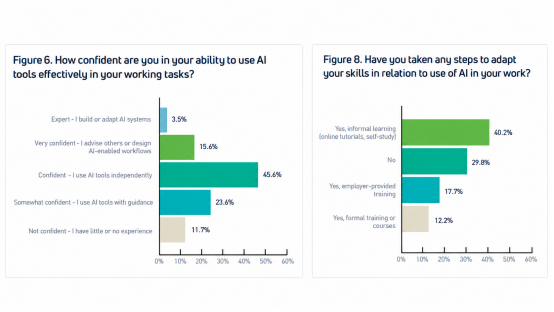
Understanding why AI remains largely at the task-support level also requires examining how employees learn and the conditions under which they use it. The report shows that 64.7% of respondents were confident in their ability to use AI tools effectively. However, in the distribution of responses on how they had developed their skills, informal learning such as online tutorials and self-study accounted for 40.2%, exceeding company-provided training (17.7%) and formal courses (12.2%). Many employees have already gained experience through their own exploration, but sustained, role-specific learning support has not kept pace.
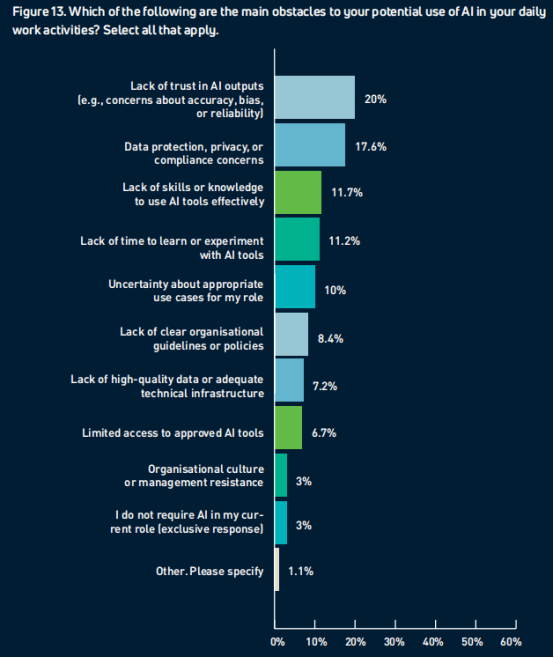
The distribution of barriers to use further clarifies which problems this support needs to address. Lack of trust in AI outputs had the highest share, at 20%; concerns about data protection, privacy, and compliance followed at 17.6%. Insufficient skills and knowledge accounted for 11.7%, while lack of time to learn and experiment accounted for 11.2%. Respondents also cited uncertainty about which situations were appropriate for AI and the absence of clear organizational guidance. The barriers to deeper use therefore involve capabilities, reliability, and organizational rules at the same time.
Management interviews add the conditions faced at the enterprise level. Respondents noted that fragmented systems, inconsistent data quality, and difficulties connecting data across functions can prevent AI from progressing beyond pilot projects into reliable day-to-day operations. Other interviewees linked employee resistance to unclear application benefits, insufficient integration with existing work, and a lack of role-relevant training. These issues affect both employees’ willingness and their ability to hand more work over to AI.
Taken together, our interpretation is that individuals have learned how to use AI tools, but enterprises still need to establish the conditions that allow AI to become more deeply embedded in work. Personal exploration can help employees discover useful practices. But identifying which core tasks AI should take on and embedding it reliably into actual organizational work also depend on whether data can be connected, tools can be approved for use, and outputs can be trusted. It is difficult to resolve all these issues through employees’ separate efforts alone.
Bringing AI into Real Work Requires Explicit Enterprise Support
Whether employees are willing to use AI more extensively is also shaped by how enterprises organize and recognize its use. The report describes a scenario-based experiment involving 421 participants. It set two types of tasks—an internal email and a product description for customers—and compared willingness to use AI under three conditions: AI-assisted editing, AI generation of the final version, and unauthorized AI use.
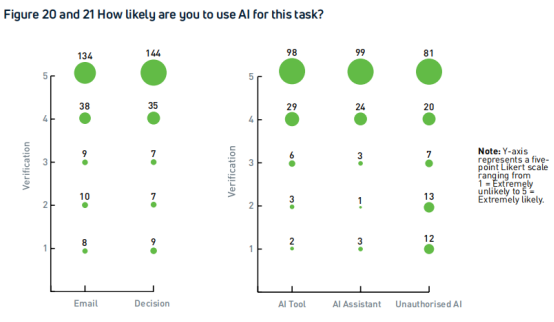
As the figure shows, under the two authorized-use conditions (permission to use AI for assisted editing and permission to use AI to generate the final version), responses were clearly concentrated at the higher end of willingness: 98 and 99 participants, respectively, selected a score of 5, while only 5 and 4, respectively, selected a score of 1 or 2. Even when AI use was unauthorized, 81 respondents remained inclined to continue using it (a score of 5), while 25 selected a score of 1 or 2. In other words, whether an enterprise gives clear authorization directly affects employees’ willingness to try AI in these scenarios.
Management interviews further show that explicit support must also be put into practice in actual work. Respondents placed greater value on continuous, hands-on learning tailored to their roles: employees should be able to try AI on their own tasks while learning to verify results and handle business data. Leadership support, internal AI champions, and communities of practice were also regarded as important conditions for helping employees share experiences and experiment. Such support creates opportunities to turn individual exploration into practices that teams can adopt together.
On this basis, we believe that the most convincing way for management to promote learning is to involve AI in a specific piece of real work. Enterprises can begin with a clearly defined business problem and assign AI suitable tasks, allowing employees to learn through actual execution what AI can do, what information it needs, and how its outputs should be passed to the next stage. Leaders should participate in this exploration, make time for learning, and help effective practices spread across teams. Employees can then see a working approach they can actually adopt.
The Human–Machine Division of Labor Requires Clear Boundaries Between Execution and Judgment
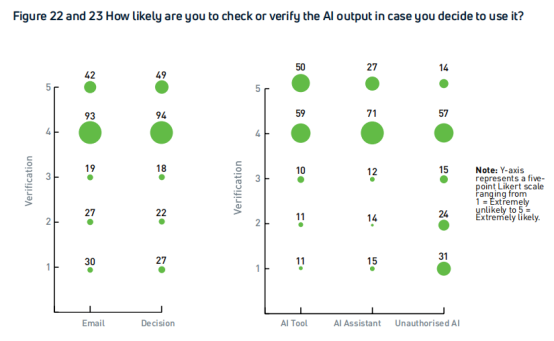
As AI becomes more involved in work, employees’ responsibilities must become correspondingly clearer. The scenario-based experiment went on to ask participants whether they would verify AI outputs when using them if they decided to adopt those outputs. Across the two tasks—an internal email and a product description for customers—135 and 143 participants, respectively, indicated a high willingness to verify (scores of 4 or 5); 57 and 49, respectively, indicated a low willingness to verify (scores of 1 or 2). Many participants already recognize the importance of verification, but willingness to check still varies from person to person.
Turning this awareness of verification into a clear division of labor also requires considering the demands of each task. The report’s “Right-Sizing Framework” for human–machine collaboration emphasizes that routine tasks may be candidates for automation, while tasks requiring professional judgment are suited to AI augmentation of human capabilities; some multi-step workflows may be assigned to agents, provided monitoring, exception escalation, and accountability are clearly defined. For high-risk decisions or those with significant consequences, meaningful human oversight and a clearly designated decision-maker should remain in place.
Building on this framework, we believe the extent of human involvement can be determined according to task risk. For clearly defined, highly repetitive, lower-risk work, AI can take on more execution, with people maintaining control through spot checks, quality checks, and exception handling; where important customer commitments, sensitive information, or major business decisions are involved, stricter verification and approval are needed. As execution is progressively delegated to AI, human professional expertise remains important: it determines whether employees can identify errors, handle exceptions, and judge whether results meet requirements.
A healthy model of human–machine collaboration therefore requires clear ownership of execution, verification, and decision-making. Employees’ ability to work independently and AI’s ability to take on suitable work can reinforce one another. What enterprises really need to advance is the application of this division of labor to specific tasks and workflows, gradually transforming everyday use into a stable and clearly defined model of collaboration.
Further Reading
The following materials are provided for further reading. Publication dates and content are subject to the original publication pages.
- Technology Ireland DIGITAL Skillnet and the SOHAM research team, Right-Sizing AI at Work: Workforce Transformation and Human-Machine Partnerships in Ireland, published September 10, 2026. The principal reference for this article, covering employees’ AI use and learning methods, management observations of changes at work, and organizational authorization, output verification, and the Right-Sizing Framework for human–machine collaboration. Readers may wish to focus on Chapter 4 (employee survey), Chapter 5 (scenario-based experiment), Chapter 6 (management interviews), and Chapter 8 (framework and recommendations).
- Trinity College Dublin, AI is reshaping workplace, not replacing jobs, new research finds, published September 10, 2026. An official introduction to the research, summarizing the main findings, the research background, and interpretations from the institutions involved, while providing access to the report.
Sources and Copyright Notice
This article was compiled and analyzed in Chinese by NextAI+ Praxis, based on Right-Sizing AI at Work, a report commissioned by Technology Ireland DIGITAL Skillnet and completed by the SOHAM research center jointly established by Trinity College Dublin and Technological University Dublin, together with official release materials. The survey data and experimental results cited here are taken from the original report, with some combined percentages calculated by adding the original figures. Figure 1 corresponds to Figures 1 and 5 of the original report; Figure 2 to Figure 3; Figure 3 to Figures 6 and 13; Figure 4 to Figure 21; and Figure 5 to Figures 22 and 23. The “Right-Sizing Framework” for human–machine collaboration comes from the report’s Right-Sizing Framework; the extended discussion of assistive applications, organizational support, and risk-based human involvement constitutes this article’s own analysis.
Rights to the original text, charts, and related marks cited belong to the original authors, publishing institutions, or other respective rights holders. This article is independent research and commentary and does not represent the official views or endorsement of those institutions. If rights holders have questions about quotations, translation, or the use of figures, please contact [email protected]; we will review the matter promptly and make corrections or remove material as appropriate.
We welcome you to share in the comments your organization’s experiences of human–machine collaboration, as well as the challenges you have encountered in bringing AI into actual work.
Cite as · Deep Reads · 15 October 2026