
As OpenClaw rapidly rose to prominence at the beginning of this year, more and more enterprises have begun to realize that the capabilities of AI agents are extending beyond answering questions and generating content to more concrete work tasks, including generating quotations, processing tickets, triggering workflows, calling systems, following up with customers, supporting procurement, and automating back-office operations. For an individual enterprise, this means that many tasks that previously depended on manual organization, judgment, and handoffs can now be advanced continuously by agents. As a result, the speed of internal information processing, task preparation efficiency, and workflow responsiveness are being improved.
However, when a task needs to cross the enterprise boundary, this continuity often breaks abruptly. For example, a buyer-side agent may organize specifications, budgets, and delivery-time requirements internally, yet still need to convert the results into emails, forms, or request-for-quotation documents; a supplier-side agent may have access to product information, inventory, and pricing rules, yet still need to communicate them externally through webpages, PDFs, portal systems, or sales representatives. A new structural mismatch is therefore emerging in enterprise AI deployment: internal workflows are beginning to adapt to agent execution, while the ways enterprises disclose information, receive requests, and conduct transactions with one another are still designed around human browsing, form-filling, and communication. Once a task crosses an organizational boundary, its original context, identity, permissions, and execution status become difficult to preserve, turning the enterprise boundary into a new bottleneck in agentic workflows.
Three core judgments can be read directly from this structural mismatch:
- The next bottleneck in enterprise AI deployment is shifting toward task continuity at the enterprise boundary. As internal agents gradually become able to advance tasks continuously, enterprises also need to build new business interfaces that can accommodate external agents’ access, understanding, and actions.
- The key to cross-enterprise agent handoffs is whether identity, permissions, business semantics, executable actions, and task status can be transferred continuously. Only when an enterprise can confirm whom an agent represents, what authorization it has received, and which data and actions it may invoke can a cross-enterprise task truly enter stable execution.
- The enterprises that need to pay attention first are those with frequent cross-organizational collaboration, relatively standardized business information, and clearly identifiable manual handoff costs. For processes that depend heavily on coordination across inquiries, quotations, orders, inventory, logistics, and after-sales service, efficiency losses at the enterprise boundary will become visible earlier, making these processes better suited for initial experiments in opening selected data and business capabilities to external agents.
From Serving Browsers to Serving Agents: External Business Interfaces Need Three Changes
External business interfaces must first provide agents with an access point that can be discovered, understood, and invoked.
In discussions of external business interfaces for agents, the internet infrastructure layer has already produced an early response. On April 17, 2026, U.S. cloud services provider Cloudflare introduced the Agent Readiness Score, which assesses whether a website is suitable for agent access across dimensions including content discovery, machine-readable formats, access control, and business capabilities; see “Introducing the Agent Readiness Score. Is Your Site Agent-Ready?”
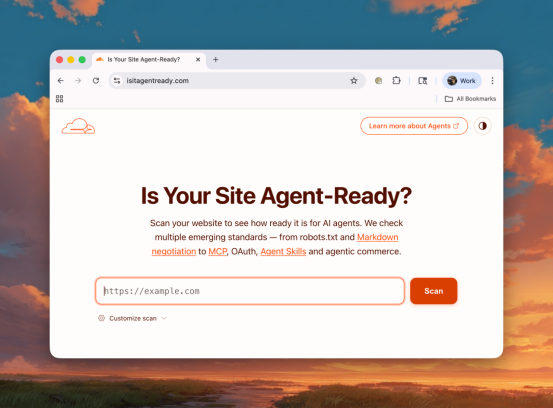
Cloudflare began by scanning 200,000 high-traffic domains and found that only 3.9% of websites supported providing agents with content in Markdown format, while newer standards such as MCP Server Card and API Catalog appeared on fewer than 15 websites across the entire sample. These capabilities may look like low-level website technical details, but they directly affect whether agents can understand and use website information reliably. Structured content formats such as Markdown help agents identify body text and key information on webpages more accurately, while MCP Server Card and API Catalog tell agents what data and services a website exposes, how they can be invoked, and what authentication requirements must be met. Without these mechanisms, agents often have to parse webpages like ordinary users, making it difficult both to understand information accurately and to discover or invoke the business capabilities a website provides. Even if an agent can read product, service, or policy information, it may still struggle to confirm inventory, submit an inquiry, or trigger the next step in a workflow. Cloudflare’s scoring data show that designing external interfaces for agents has become an engineering problem that can be measured and improved, but the internet’s overall level of readiness remains low. The current preparation of websites in information discovery, content access, and access methods still has a long practical distance to go before agents can complete cross-enterprise tasks.
After agents gain an access point, external business interfaces must also add identity recognition, authorization control, and behavioral verification capabilities.
The fact that an agent can read information does not mean an enterprise can directly allow it to enter real business processes involving orders, accounts, or payments. When an agent acts on behalf of a user or another enterprise, the enterprise needs to confirm who controls it, whom it represents in making the request, what permissions it has received, and whether its current behavior exceeds the scope of that authorization.
On June 10, Visa introduced Agent Score and Agentic Directory: the former helps merchants determine whether their websites can be navigated and understood by agents and whether tasks can be completed, while the latter is used to verify the identities of agents and merchants participating in transactions; see “Visa Announces New AI, Stablecoin and Token Innovations to Power Intelligent, Programmable Commerce at Visa Payments Forum.”
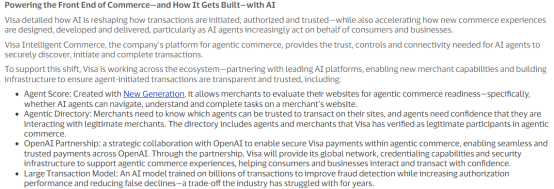
Visa also announced a partnership with OpenAI to connect credentials, payment networks, and security capabilities to agentic transactions, emphasizing that identity, permissions, and behavioral signals need to travel with the transaction. This shows that once agents begin acting on behalf of users or enterprises, website readability alone can no longer support business collaboration. Enterprises must also confirm whether an external agent is legitimate, whom it represents, and whether it is authorized to complete the current request.
The next change for external business interfaces is to form a two-way workflow that can receive requests and continuously return status updates.
After an external agent has obtained information, passed identity verification, and confirmed authorization, it still needs to submit inquiries, orders, payment requests, or after-sales requests through an enterprise interface. The external interface must not only pass these requests into internal systems, but also continuously return acceptance results, processing progress, payment status, and exception information to the external agent, enabling it to continue advancing the task based on the latest state. Without this feedback mechanism, the cross-enterprise workflow will still break at the enterprise boundary.
Early validation of this type of two-way connection has already appeared at the level of business actions. On June 2, Worldline, ING, and Mastercard announced the completion of an end-to-end agentic payment in a production environment. An ING customer asked an agent to find an anniversary gift and provided a date and budget; the agent then searched a merchant website for suitable concert tickets and initiated the purchase after the customer explicitly selected and approved the option. Once the payment request entered the financial system, the transaction carried a dedicated indicator identifying agent participation: ING handled cardholder authentication and transaction authorization, Worldline handled merchant-side payment acceptance and acquiring, and Mastercard used Agent Pay to connect issuers, acquirers, and merchants while providing agent onboarding standards, a unified merchant integration framework, and network-level security controls. Whether the transaction was approved, whether payment was completed, and the processing status of each participant could therefore be identified and transmitted along the same chain; see “Worldline, ING and Mastercard Complete a Live End-to-End European Agentic Payment in Production.”
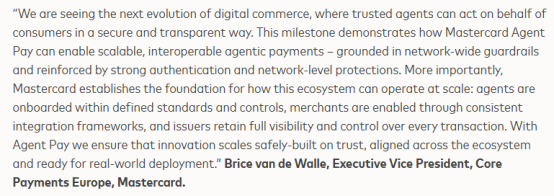
Although this was a single validation with limited scope and is not sufficient to show that agentic purchasing has achieved large-scale adoption, it demonstrates that the role of external business interfaces is beginning to extend from information display and access control to receiving business requests, connecting internal processes, and continuously feeding back processing status. Only when an external agent can obtain authorization results, execution progress, and exception information in a timely manner can it continue acting in response to changes in the enterprise’s internal process and gradually become a controlled participant in cross-enterprise business workflows.
Together, these signals show that the redesign of external business interfaces for agents is progressing along a clear path: first, enabling external agents to discover and understand the information and capabilities an enterprise provides; then establishing security boundaries through identity recognition, authorization control, and behavioral verification; and finally creating a two-way workflow that can receive business requests and continuously return processing status.
From the perspective of enterprise capability building, this path can be further abstracted into five layers: readable, verifiable, authorizable, executable, and traceable. Readability determines whether an agent can connect to and understand enterprise information; verifiability determines whether that information is authentic, valid, and applicable to the current task; authorizability clarifies whom the agent represents and what actions it may take; executability allows external requests to enter internal systems and trigger specific processes; and traceability runs through the entire process, allowing both parties to continuously understand task status, human approval points, and exception-handling results.
At present, most enterprises are still in the early stages of building readability and authorization. Cases that simultaneously achieve information verification, business execution, and status tracking remain concentrated in areas such as payments, where standardization is high, authorization mechanisms are mature, and transaction states are clear. Agent-ready business interfaces are therefore beginning to take shape, but they still have a long way to go before becoming a common enterprise deployment capability.
The First Movers Should Be Enterprises with Frequent Cross-Organizational Collaboration and Standardized Business Conditions
From a consulting perspective, enterprises will not develop the same degree of need for agent-ready external interfaces at the same time. The enterprises that feel this issue first are usually those with a large volume of cross-enterprise tasks, business conditions that can be expressed in structured form, and process states that can be tracked continuously. For these enterprises, whether external interfaces can accommodate agent access and action will affect business efficiency earlier.
The first characteristic is sufficiently frequent cross-organizational collaboration. The daily operations of these enterprises depend heavily on customers, suppliers, channel partners, and service providers, requiring them to handle inquiries, quotations, orders, inventory, logistics, and after-sales requests continuously. Many tasks must wait for another enterprise to provide information, confirm conditions, or complete the next action. Even if internal agents have shortened the time needed for requirement organization, material preparation, and system operation, the overall process may still stall at email replies, document transfers, and manual confirmations. The more frequent the cross-organizational collaboration, the more visible the gap becomes between internal acceleration and inefficient external handoffs.
The second characteristic is that business information and processing rules can be expressed relatively clearly. The more explicit the product codes, specifications, quantities, prices, inventory, delivery times, and required application materials are, the easier it is for an enterprise to convert information scattered across webpages, documents, and employee experience into data that external agents can understand and use. At the same time, actions such as searching, requesting quotations, booking, submitting orders, tracking logistics, and initiating after-sales service also need relatively stable input conditions, processing steps, and return results. Only when an enterprise can clearly describe what information a business task requires, which stages it passes through, and what status it may return can an external interface accommodate requests from agents.
The third characteristic is that the processing status of cross-enterprise tasks can be continuously identified. Whether a task has been accepted, who is currently handling it, what materials are still missing, when it can be completed, and who needs to intervene when an exception occurs all require relatively clear status points. Payments, logistics, orders, and standardized services are more likely to connect with agents early precisely because these processes usually have clear start, approval, execution, and completion states. For business that depends on complex judgment, multi-round negotiation, and substantial tacit information, agents can still participate in material preparation, booking, information queries, and progress tracking, but are less likely to advance the entire process continuously in the short term.
Therefore, determining whether an enterprise should move early cannot depend only on its industry; the assessment must be made at the level of specific business processes. Even within the same industry, different processes may have completely different requirements for external interfaces. Standard inventory queries may be suitable for earlier opening, while customized quotations may still require joint judgment by sales and technical teams; order status can be returned continuously, while complex contract negotiations need to retain more human communication. Enterprises are better served by first finding a cross-organizational task with clear boundaries, stable rules, and traceable status, and then gradually increasing the information that external agents can obtain and the actions they can initiate.
Enterprise Budgets Will Begin to Flow Toward Cross-Organizational Process Connectivity and the Opening of Business Capabilities
Agent-ready external interfaces rarely appear today as a standalone budget item. Related spending is usually distributed across website and customer-portal development, API and system integration, data governance, identity security, procurement and sales operations, and supplier and channel ecosystem management. However, once external agents begin reading enterprise information, submitting business requests, and continuously following processing status, these investments—previously borne by different departments—need to be reorganized around the same cross-organizational workflow. Enterprise spending will increasingly concentrate on two types of capabilities.
The first category of budget goes to cross-organizational process connectivity and status feedback. In “The Economics of Organization: The Transaction Cost Approach” (American Journal of Sociology, 1981), Oliver E. Williamson argued that transaction frequency affects the coordination mechanism an enterprise chooses. For an enterprise, the more frequently a cross-organizational task occurs, the more easily the repeated costs of searching for information, communicating conditions, confirming transactions, monitoring execution, and handling exceptions accumulate. The value of agent-ready external interfaces first appears in reducing these repeatedly incurred transaction frictions.
Thomas W. Malone, JoAnne Yates, and Robert I. Benjamin further argued in “Electronic Markets and Electronic Hierarchies” (Communications of the ACM, 1987) that coordination costs between enterprises arise from exchanging information, allocating tasks, confirming status, and managing interdependencies. One important role of information technology is to reduce these coordination activities. Related spending will therefore go to receiving and routing external requests, connecting internal systems such as CRM and ERP, synchronizing process status, providing asynchronous notifications, and establishing mechanisms for human takeover when exceptions occur. Enterprises pay for these capabilities in order to shorten inquiry-to-quotation cycles, reduce duplicate data entry and manual handoffs, lower waiting time for responses, and improve cross-enterprise task completion rates.
The second category is budget for data standardization and the modularization of business capabilities. In “Modularity, Flexibility, and Knowledge Management in Product and Organization Design” (Strategic Management Journal, 1996), Ron Sanchez and Joseph T. Mahoney argued that clear module boundaries and standardized interfaces allow different actors to collaborate without needing to understand all internal knowledge.
Enterprises therefore need to separate relatively well-bounded capabilities—such as inventory queries, delivery-time confirmation, standard quotation requests, order tracking, and after-sales applications—from complex internal systems, and define their input conditions, return results, permission scopes, and exception rules. Related spending will go to master-data governance, the unification of business fields and semantics, API or MCP interface development, the labeling of data sources and validity periods, and identity, permission, logging, and auditing mechanisms. What enterprises purchase is the ability to convert internal business capabilities into modules that external agents can understand and use reliably, while retaining control over data, permissions, and accountability boundaries. Relevant metrics include data-update latency, interface-call success rates, request-matching accuracy, the time required to expose a new capability, and interface reuse rates.
These two categories of budget correspond to two core questions in redesigning external business interfaces: whether cross-organizational tasks can be connected and advanced continuously, and whether internal enterprise capabilities can be opened externally in a clear, stable, and controlled manner. The former mainly reduces the transaction and coordination costs created by communication, waiting, and repeated operations; the latter determines whether a business capability can be invoked continuously by multiple external agents and business scenarios. Enterprises can begin by validating a cross-organizational process that occurs frequently, has relatively stable rules, and has a clear processing status. When process cycle time, manual handoffs, and exception rates improve, and the same data and interfaces can support more requests, this spending can gradually develop from a local system upgrade into a long-term business capability for the agent era.
Enterprises Should First Locate the Breakpoints in Cross-Organizational Processes, Then Build Agent-Ready External Interfaces
Once enterprises begin paying attention to agent-ready external interfaces, the most common problem is discussing which protocol, platform, or development tool to adopt too early, before determining which business capability should be opened. Enterprises differ greatly in their external collaboration models, data foundations, and risk boundaries. A unified entry point covering all customers, suppliers, and business processes is difficult to build at once and difficult to prove valuable at an early stage. Enterprises are therefore better served by starting from a real cross-organizational workflow, locating the point where the task loses continuity, and then deciding which interface capability needs to be added.
For enterprises that have not yet completed this assessment, NextAI+ Praxis can usually help with four things first:
- Map the cross-organizational workflow. Return to the real business process, map the information flows, system boundaries, and human nodes among customers, suppliers, and partners, and identify where emails, PDFs, portals, and manual confirmations cause tasks to break.
- Identify capability gaps at the enterprise boundary. Determine whether the main problem lies in information access, data verification, identity and authorization, request intake, or status feedback, and identify the data, interfaces, and governance conditions that need to be strengthened first.
- Select the business action to open first. Based on business frequency, rule stability, and risk boundaries, prioritize scenarios such as inventory queries, standard quotation requests, order tracking, or after-sales submissions where value is clear and results are easy to verify.
- Design a small-scale validation and subsequent ownership model. Define the required data, system interfaces, human approval points, and exception-handling mechanisms; first run a verifiable PoC, then decide whether to expand based on process cycle time, manual handoffs, and exception rates, while clarifying the long-term responsibilities of business, data, technology, and security teams.
At present, agent-ready external interfaces are still in an early stage of development. The practical path enterprises need to explore is to begin with a cross-organizational process that is high-frequency, governed by clear rules, and traceable in status, and verify whether external agents can reliably obtain information, submit requests, and continuously receive processing feedback. Only when an interface can shorten process cycles, reduce manual handoffs, and control identity and permission risks should an enterprise gradually expand the scope of access and replicate the validated data standards, interface rules, and governance mechanisms across more business scenarios.
Appendix: Reference List of Open-Source Components
The following list groups open-source components, open standards, and self-hostable tools that may be involved in the “agent-ready external business interfaces” discussed above, organized by capability area. It is intended as a reference for teams considering self-building, hybrid delivery, or an initial PoC. It is only a list of candidates, not a recommended configuration; the same capability can usually be implemented in multiple ways, and specific choices must still reflect the enterprise’s existing systems, data foundation, permission requirements, deployment environment, and technical-team capabilities.
- Machine-readable website content and structured extraction: Crawl4AI, Firecrawl, Unstructured, Apache Tika
- HTTP API description and capability discovery: OpenAPI, Swagger UI, OpenAPI Generator, Backstage Software Catalog
- MCP services and exposure of business tools: Model Context Protocol official SDK, FastMCP, MCP Inspector
- API gateways and external request entry points: Kong Gateway, Apache APISIX, Envoy, Traefik
- User and organizational identity authentication: Keycloak, Ory Hydra, Ory Kratos, ZITADEL
- Agent and software workload identity: SPIFFE, SPIRE
- Fine-grained permission and delegation management: OpenFGA, Open Policy Agent (OPA), Cedar
- Credential, key, and sensitive-information management: OpenBao, Infisical, SOPS
- External request intake and system integration: Apache Camel, n8n, Node-RED, Kafka Connect
- Durable workflow and task-state management: Temporal, Argo Workflows, Apache Airflow
- Asynchronous events and processing-status feedback: Apache Kafka, NATS, RabbitMQ
- Asynchronous API and event-format description: AsyncAPI, CloudEvents, Protocol Buffers, Apache Avro
- Validation of data fields, request parameters, and response results: JSON Schema, Pydantic, Great Expectations
- Human approval and exception-takeover workflows: Temporal, n8n, Node-RED
- Interface mocking, contract testing, and PoC validation: WireMock, Pact, Schemathesis, MCP Inspector
- Request tracing, logs, and audit records: OpenTelemetry, Jaeger, Grafana Loki
- Interface performance, success-rate, and exception monitoring: Prometheus, Grafana, OpenTelemetry
- Business interface and technical asset catalogs: Backstage, MCP Registry, Swagger UI
Further Reading
The following public studies and cases are cited in the analysis or considered worth sharing for further reading (publication years and links are subject to the official sources):
- Cloudflare, “Introducing the Agent Readiness Score. Is Your Site Agent-Ready?”, 2026.
- Visa, “Visa Announces New AI, Stablecoin and Token Innovations to Power Intelligent, Programmable Commerce at Visa Payments Forum”, 2026.
- Worldline, ING, and Mastercard, “Worldline, ING and Mastercard Complete a Live End-to-End European Agentic Payment in Production”, 2026.
- Oliver E. Williamson, “The Economics of Organization: The Transaction Cost Approach”, American Journal of Sociology, 1981.
- Thomas W. Malone, JoAnne Yates, and Robert I. Benjamin, “Electronic Markets and Electronic Hierarchies”, Communications of the ACM, 1987.
- Ron Sanchez and Joseph T. Mahoney, “Modularity, Flexibility, and Knowledge Management in Product and Organization Design”, Strategic Management Journal, 1996.
- Frederick J. Riggins, Charles H. Kriebel, and Tridas Mukhopadhyay, “The Growth of Interorganizational Systems in the Presence of Network Externalities”, Management Science, 1994.
- Tiffany Xingyu Wang and Matt McLarty, “APIs Aren’t Just for Tech Companies”, Harvard Business Review, 2021.
- Ali Sunyaev et al., “The Future of Enterprise Information Systems”, Business & Information Systems Engineering, 2023.
- Vítor Ribeiro, João Barata, and Paulo Rupino da Cunha, “Modeling Inter-Organizational Business Process Governance in the Age of Collaborative Networks”, Electronic Markets, 2024.
- Amit Joshi, Ivy Buche, and Caroline Schwaer, “How Gen AI Is Disrupting B2B Buying Decisions”, Harvard Business Review, 2026.
Feel free to send us a private message or leave a comment to tell us which enterprise AI practice topics you are curious about! You are also welcome to leave a message at NextAIPraxis.com or contact us at [email protected] with a real problem your enterprise needs to solve. We will contact you within two business days and invite you to join our practice-sharing community.
Cite as · Enterprise AI Deployment Signals · 14 July 2026